
Courier vs postal service: Right choice for urgent UK deliveries
Updated: May 14
TL;DR:
Couriers offer faster, more reliable delivery with real-time tracking and guaranteed windows.
Postal services are cheaper but often unreliable for urgent or high-value shipments.
Businesses should prioritize couriers for time-sensitive, legal, or high-risk deliveries to avoid costly failures.
Choosing between a courier and the postal service for an urgent business delivery seems straightforward until something goes wrong. A missed contract deadline, a lost document, or a parcel that simply never arrives can cost far more than the postage saved. Many businesses default to first-class post without questioning whether it is actually reliable enough for time-sensitive items. This article sets out the key differences between couriers and postal services, examines real performance data, and gives you a clear framework for making the right call on urgent deliveries.
Table of Contents
Key Takeaways
Point | Details |
Couriers offer higher reliability | Couriers consistently deliver urgent items with better on-time rates and offer tracking for peace of mind. |
Postal is cheaper but riskier | Royal Mail is less costly, but recent data shows a significant risk of delays, especially for first-class urgent deliveries. |
Choose based on critical business need | If lateness would damage contracts or reputation, the added cost of a courier is often a wise investment. |
Factor in total cost of delays | Indirect costs of failed or late deliveries often outweigh any initial savings from using standard post for urgent matters. |
Understanding the basics: What makes couriers and postal services different?
A courier is a dedicated delivery operator that collects and transports your item directly, often on an exclusive vehicle, to a named recipient within a guaranteed or agreed timeframe. A postal service, such as Royal Mail, operates a consolidated network where items are sorted, processed through depots, and delivered as part of a wider round. The two models serve different purposes.
For routine, low-value correspondence, postal services are cost-effective and widely used. For urgent, traceable, or high-value business shipments, the distinctions matter considerably. Here is a quick comparison:
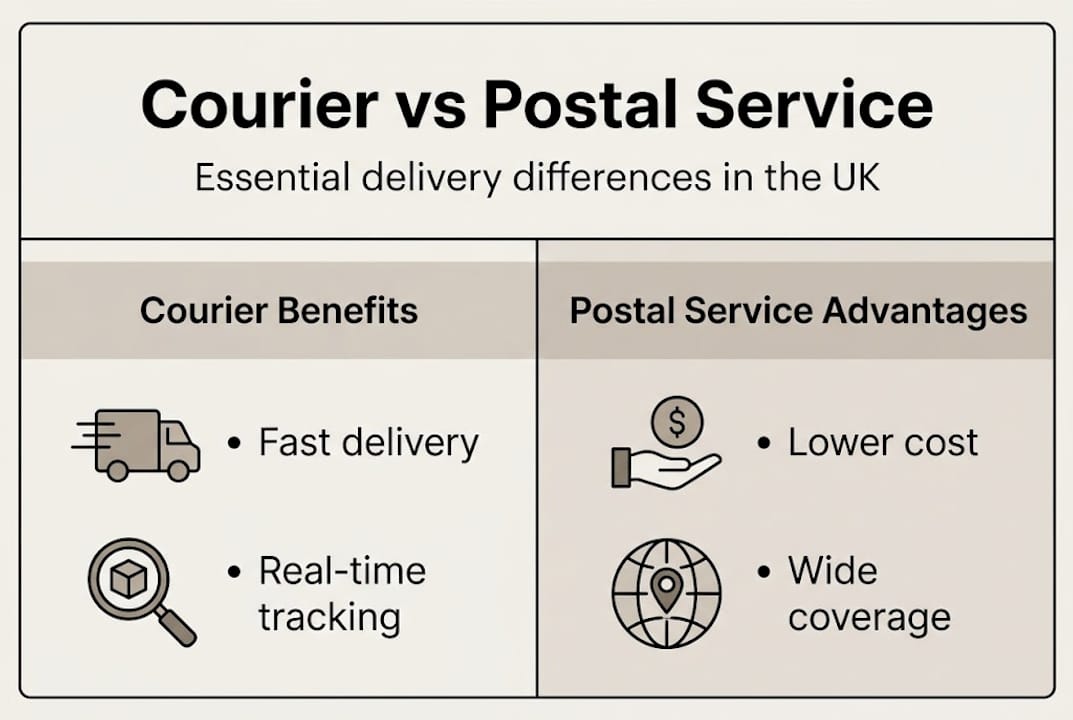
Feature | Courier | Postal service |
Delivery speed | Same day to next day | 1 to 3 working days |
Tracking | Real-time, detailed | Basic or limited |
Guaranteed windows | Yes, with most services | Rarely guaranteed |
Direct delivery | Yes, dedicated vehicle | No, via sorting depots |
Flexibility | High, rerouting possible | Low |
The courier service benefits for business clients go beyond speed. Dedicated vehicles mean fewer handling points, which reduces the risk of damage or loss. Couriers also offer direct accountability, with a named contact for any queries.
Key situations where each is appropriate:
Postal service: Non-urgent letters, marketing materials, low-value items with flexible timelines
Courier: Legal documents, signed contracts, urgent parcels, medical supplies, or anything with a hard deadline
Royal Mail struggles with delivery targets amid volume surges and industrial disruption, which makes couriers’ guaranteed timings increasingly vital for businesses where delays carry real reputational or financial consequences.
Reliability and performance: How do results stack up?
Performance data tells a clear story. Royal Mail first-class post is supposed to deliver the next working day. In Q3 2025, the first-class on-time rate reached only 77.5%, well below Ofcom’s 93% target. In Q1 2025/26, that figure was 75.9%. Second-class delivery within three days hit 91.6%, again falling short of the 98.5% Ofcom standard.
These are not small gaps. For a business sending ten urgent documents a month by first-class post, statistically two or three of them will not arrive on time.
Service | Target | Actual performance (2025) |
Royal Mail first-class | 93% next day | 75.9% to 77.5% |
Royal Mail second-class | 98.5% within 3 days | 91.6% |
Amazon/FedEx satisfaction | N/A | |
Evri/Yodel satisfaction | N/A | 31% to 38% |
Satisfaction scores also vary widely. According to Ofcom’s 2025 survey, Amazon and FedEx led customer satisfaction at 57%, while budget operators such as Evri and Yodel scored just 31% to 38%. Dedicated couriers that focus on business clients tend to outperform general parcel carriers on reliability and communication.
For businesses, optimising courier logistics means factoring in more than speed. Service consistency and accountability matter just as much. Courier reliability in the UK is especially important when reputational or contractual risk is involved.
Pro Tip: Do not judge delivery cost by postage price alone. A late document that costs you a contract renewal is far more expensive than the difference between a stamp and a courier booking.
Practical differences: Cost, tracking, and flexibility
On the surface, postal services appear cheaper. A first-class stamp costs under £2, while a same-day courier booking starts at a higher price point. But the comparison changes when you account for the full picture.
Consider the practical factors businesses should weigh:
Tracking visibility: Couriers provide real-time GPS tracking and delivery confirmation. Royal Mail’s standard tracking is basic and does not always update until the item is delivered.
Delivery windows: Couriers can often commit to morning, afternoon, or timed slots. Postal services deliver at the postman’s discretion, with no guaranteed window.
Rerouting and changes: If a recipient’s address changes or a delivery needs to be intercepted, couriers can often accommodate this. Postal services cannot.
Proof of delivery: Most couriers provide a signed, timestamped proof of delivery. This is essential for legal documents, high-value goods, or compliance purposes.
Failed delivery consequences: A missed postal delivery means a redelivery attempt or a trip to the sorting office. For a courier, a re-attempt is typically arranged the same day.
Choosing a reliable courier for business-critical items removes much of this uncertainty. As Ofcom’s data confirms, couriers lead on customer experience through tracking and delivery windows, even if postal options appear cheaper upfront.
“The true cost of a failed delivery is rarely just the cost of resending the item. It includes the time lost, the relationship damaged, and sometimes the contract not renewed.”
Pro Tip: When calculating delivery costs for urgent items, include the hourly value of staff time spent chasing missing items or managing complaints. This changes the cost comparison significantly. The dedicated courier advantages for UK businesses become far clearer when measured this way.
When to use which: Decision guide for business deliveries
Here is a practical breakdown to guide your decision on any given shipment.
Use a courier when:
The item has a hard deadline (legal submission, signed contract, tender documents)
The recipient must confirm receipt with a signature
The item is high value or sensitive (confidential documents, medical samples, electronic components)
Delivery must happen same day or within a guaranteed window
You need real-time tracking for your own records or for a client
A failed delivery would result in financial loss or reputational damage
Postal service is adequate when:
The item is non-urgent and has a flexible delivery window
The content is low value and easily replaceable
Cost is the primary concern and no deadline is at risk
Red flags that signal a courier is essential: any delivery tied to a legal or contractual date, anything being sent to a new or critical client for the first time, and any item that cannot be easily replaced or resent. Royal Mail’s ongoing target shortfalls make relying on first-class post for these scenarios a genuine business risk.
Pro Tip: Build a contingency plan for post disruption. Identify a courier provider in advance so that when a strike or service disruption occurs, you are not scrambling. Knowing which items suit courier delivery helps you make faster decisions. The role of couriers in urgent deliveries is most apparent in these moments.
Our view: What most businesses get wrong about urgent deliveries
Most businesses treat postage as a simple line item and choose based on price. That is the mistake. Years in the logistics field show that the businesses most exposed to delivery risk are those that have never experienced a costly failure. Once a signed contract misses its deadline because first-class post underperformed, the calculation changes permanently.
Seasoned operations planners treat reliability in urgent UK deliveries as part of their budget, not an optional upgrade. The cost of courier use is not a premium. It is risk management. One lost client relationship will always cost more than a year’s worth of courier bookings.
Get peace of mind with dedicated courier solutions
When an urgent delivery cannot afford to go wrong, a dedicated courier removes the guesswork entirely. DedicatedSameDayCourier.co.uk operates 24/7, covering urgent collections and deliveries across the UK with exclusive vehicles and real-time tracking.
[
Whether you need a sameday courier service for a time-critical document or want to explore the range of van courier options suited to your parcel size, getting a tailored quote takes minutes. Call, email, or use the online form to arrange your next urgent delivery with confidence.
Frequently asked questions
How reliable is first-class post for urgent documents in the UK?
Royal Mail first-class next-day delivery reached just 77.5% on-time in Q3 2025, falling well short of Ofcom’s 93% target. For urgent documents, this level of unreliability represents a significant business risk.
Are couriers worth the extra cost for urgent business items?
For time-sensitive items, couriers offer higher reliability, real-time tracking, and timed delivery windows that help businesses avoid costly missed deadlines and reputational damage. The upfront cost is often justified by the risk avoided.
What happens if my post or parcel is delayed?
Delays can result in missed contract deadlines, lost business, or damaged client relationships. Royal Mail’s volume and strike disruptions make this risk real, which is why courier guarantees exist.
How do I know if I should use a courier or postal service?
If speed, guaranteed timing, secure handling, or full traceability are important, a courier is the better choice. Ofcom data shows couriers lead on satisfaction and business experience metrics compared to standard postal operators.
Recommended


Comments