
Document transport procedures: a practical guide

TL;DR:
Effective document transport ensures legal compliance through proper procedures, authentic documentation, and a complete audit trail. Proper use of core documents, digital tools, and meticulous record-keeping prevent rejection risks and maintain chain of custody. Choosing the right delivery method based on urgency, sensitivity, and legal requirements provides tailored proof of service and minimizes failure points.
Document transport procedures are the processes and methods used to securely, efficiently, and legally deliver documents to their destination, with verifiable proof of delivery and compliance with applicable regulations. For small businesses and individuals, getting these procedures wrong carries real consequences: rejected court filings, missed deadlines, and legal disputes. The industry term for the broader discipline is document logistics, and it covers everything from physical courier dispatch to digital consignment notes under the eCMR protocol. Whether you are sending a contract, a legal notice, or a compliance filing, the method you choose and the records you keep determine whether the delivery holds up legally.
What document transport procedures actually require

Effective document transport procedures depend on three things: the right paperwork, the right tools, and the right authentication. Miss any one of these and your delivery may be legally void, even if the recipient has the document in hand.
Core transport documents you need:
Consignment note — records the sender, recipient, carrier, cargo description, and route. Under the eCMR protocol, electronic consignment notes carry the same legal weight as paper, provided authentication and signature requirements are met.
Proof of service certificate — required by courts and agencies. The Executive Office for Immigration Review (EOIR) mandates that a certificate of service is attached to all filings, and forms submitted without one can be rejected outright.
Delivery note — confirms receipt at the destination, signed and timestamped.
Tracking record — a digital or physical audit trail of the document’s journey.
Digital tools that support compliant procedures:
Oman’s Ministry of Transport requires electronic transport documents before any truck freight moves, with shipment, carrier, cargo, and route details accessible via an official portal. This model illustrates where document logistics is heading globally. Oracle Transportation Management allows document lifecycle control during transport, including persistent storage or immediate distribution, which directly affects your audit trail.
Pro Tip: If you use electronic consignment notes, confirm that your provider supports eSeals that link to the signatory and preserve data integrity. Without this, your digital note may only serve as evidence under national law rather than carrying full eCMR legal effect.
Document type | Purpose | Key requirement |
Consignment note | Records shipment details | Authentication and signature (eCMR) |
Proof of service certificate | Confirms legal delivery | Method-specific, timestamped |
Delivery note | Confirms receipt | Signed by recipient |
Tracking record | Audit trail | Contemporaneous and complete |
How to execute secure and compliant document transport
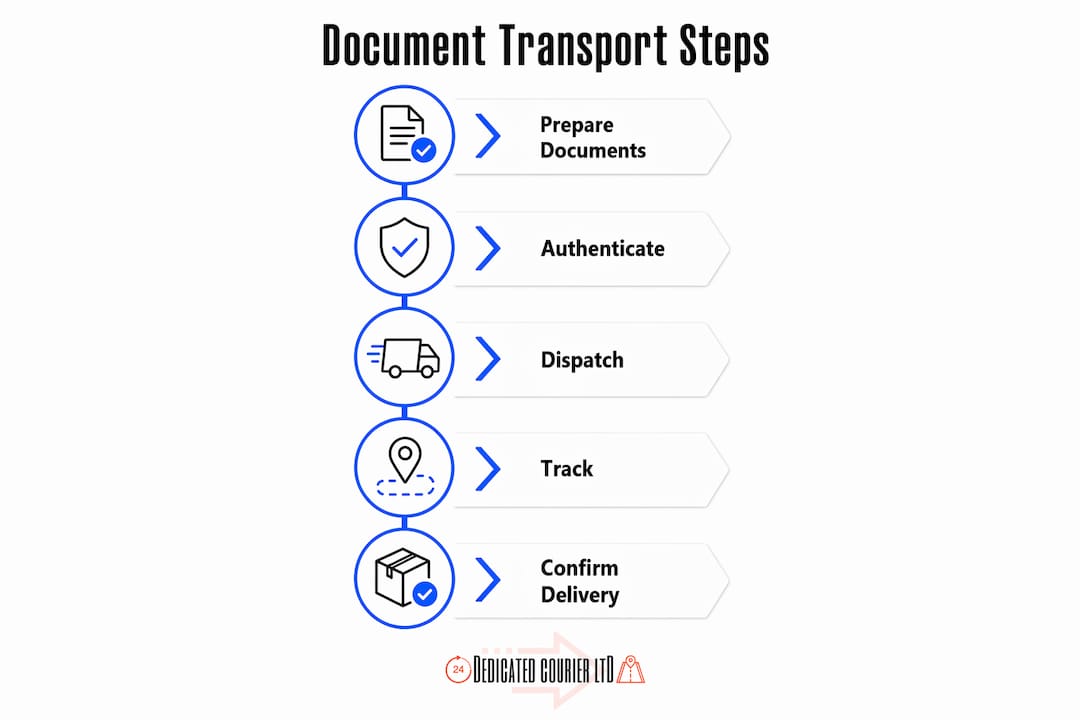
The transport workflow has four stages: preparation, dispatch, tracking, and confirmation. Skipping or rushing any stage creates gaps that courts and agencies will exploit.
Prepare the document package. Confirm the document is complete, signed where required, and accompanied by a consignment note. If the delivery has legal significance, attach a blank proof of service certificate for the recipient to complete.
Choose your delivery method. Your choice determines your proof requirements. Under Illinois Civil Procedure Rule 12, electronic or personal service completes on the day of transmission, third-party carrier service takes effect after three court days, and US mail completes after four days. These timelines affect deadlines directly.
Dispatch and record. Log the time, date, carrier name, and tracking reference at the moment of dispatch. For electronic delivery, retain the transmission confirmation. For physical delivery, retain the carrier receipt.
Obtain delivery confirmation. Under New York CPLR Section 312-A, service by mail is only complete when the signed acknowledgement is returned within 30 days. Failure to receive it can trigger additional service costs and legal consequences.
File your proof of service. Attach the completed certificate to your filing immediately. Do not wait. Courts and agencies treat late or missing certificates as grounds for rejection.
What good proof of service must contain:
The delivery method used
The date, time, and location of service
The full name and role of the recipient
The sender’s signature or electronic equivalent
Pro Tip: Create a standard proof-of-service checklist mapped to the specific court or agency you are filing with. Requirements differ between jurisdictions, and a generic template will miss method-specific details that legal proof documentation demands.
Common problems in document transport and how to fix them
Most failures in document logistics come down to three recurring issues: incomplete proof of service, handoff errors between carriers, and poor record-keeping. Each is preventable.
Filing mistakes often stem from missing proof of service certificates or failing to cover supporting documents separately. If your main filing has a certificate but your exhibits do not, the exhibits may be treated as unserved.
Handoff errors occur when documents pass between multiple carriers without a continuous tracking record. Each transfer point must be logged with a timestamp and the receiving party’s details. A courier manifest is the standard tool for this, recording every handoff in sequence.
Signature irregularities are another common rejection trigger. Electronic signatures must meet the authentication standard required by the relevant protocol. Under the eCMR protocol, eSeals must link to the signatory and guarantee data integrity. A scanned image of a signature does not meet this standard.
Troubleshooting checklist:
Verify proof of service covers every document in the package, not just the main filing
Confirm electronic signatures meet the authentication standard for your delivery method
Check that tracking records are continuous with no unlogged handoff points
Retain all dispatch confirmations, receipts, and acknowledgements in a single file
If a delivery is rejected, re-serve immediately and note the original attempt in your new certificate
How to choose the right document delivery methods
The best delivery method depends on four factors: the legal requirements of the recipient body, the urgency of the deadline, the sensitivity of the document, and your budget.
Method | Speed | Proof requirement | Best for |
Personal delivery | Same day | Signed receipt or witness | Court filings, urgent legal notices |
Dedicated courier | Same day to next day | Proof of delivery, tracking log | Sensitive or high-value documents |
Commercial carrier | 1 to 3 days | Carrier receipt, tracking | Standard business documents |
Royal Mail recorded | 1 to 4 days | Signed acknowledgement | Low-risk, non-urgent documents |
Electronic delivery | Immediate | Transmission confirmation | Court-approved electronic filing |
Dedicated courier services offer the strongest combination of speed and proof. Because the vehicle carries only your documents, there is no shared handling and no unexplained gaps in the chain of custody. For legally critical documents, this matters as much as speed. You can review the secure document delivery workflow for a detailed breakdown of how this process works in practice.
Electronic delivery is fastest but only valid where the recipient body accepts it. Many UK courts and regulatory agencies now accept electronic filing, but you must retain the transmission confirmation as your proof of service.
Pro Tip: For documents with hard legal deadlines, use a dedicated courier and request a signed proof of delivery at the point of receipt. This gives you a timestamped, named confirmation that satisfies most court and agency proof-of-service requirements without additional steps.
Key takeaways
Compliant document transport requires method-specific proof of service, authenticated documentation, and a complete audit trail from dispatch to confirmed receipt.
Point | Details |
Proof of service is method-specific | The delivery method determines timing rules and what your certificate must contain. |
Digital notes need authentication | eCMR-compliant electronic consignment notes require eSeals linking to the signatory. |
Missing certificates cause rejections | Courts and agencies reject filings without valid proof covering every document served. |
Dedicated couriers reduce risk | Exclusive vehicle transport eliminates shared handling and maintains chain of custody. |
Record-keeping is non-negotiable | Every handoff, timestamp, and acknowledgement must be retained for audit purposes. |
Why most businesses underestimate document logistics
After years of working in this space, the pattern I see most often is businesses treating document transport as a postage problem rather than a compliance problem. They focus on cost and speed, then discover too late that their proof of service was incomplete or their electronic signature did not meet the required standard.
The shift to digital workflows is genuinely positive, but it introduces new failure points that paper never had. A physical signature on a delivery note is self-evidently authentic. An electronic signature without proper eCMR authentication can be challenged. Businesses adopting digital consignment notes need to verify their provider’s authentication method before assuming equivalence with paper.
The other thing worth saying plainly: from 2027, the EU’s eFTI (electronic Freight Transport Information) platform becomes mandatory for freight operators moving goods across EU borders. UK businesses with cross-border document logistics need to be preparing for this now, not after the deadline. Choosing a courier and document management system that already supports digital compliance puts you ahead of that requirement rather than scrambling to meet it.
— andrew
Urgent document transport with Dedicatedsamedaycourier
When a document cannot wait and the proof of delivery must be watertight, Dedicatedsamedaycourier provides dedicated same-day courier services across the UK with full tracking and signed proof of delivery as standard.
[
Every booking uses an exclusive vehicle, so your documents travel directly from collection to destination without shared handling or unexplained delays. The service operates 24 hours a day, seven days a week, covering nationwide collections and deliveries. Whether you need a van courier for a bulk document run or a dedicated vehicle for a single urgent filing, the service is built around your timeline. For time-sensitive or legally critical documents, the dedicated courier service provides the chain of custody and proof of delivery that compliance requires.
FAQ
What is proof of service in document transport?
Proof of service is a signed or certified record confirming that a document was delivered to the correct recipient by a specified method and at a recorded time. Courts and agencies such as the EOIR require it to be attached to all filings.
How long does service by mail take legally?
Under Illinois Civil Procedure Rule 12, mail service is complete four days after posting. Under New York CPLR Section 312-A, mail service completes only when the signed acknowledgement is returned within 30 days.
Are electronic consignment notes legally valid?
Yes, under the 2008 eCMR protocol, electronic consignment notes are legally equivalent to paper provided they meet authentication and signature requirements, including the use of eSeals that link to the signatory.
When should I use a dedicated courier for documents?
Use a dedicated courier when the document is legally sensitive, the deadline is fixed, or you need a signed and timestamped proof of delivery. Dedicated vehicles eliminate shared handling and provide a clean chain of custody. You can also review this urgent delivery guide if a delivery has already failed and needs resolving quickly.
What causes document delivery rejections?
The most common causes are missing proof of service certificates, electronic signatures that do not meet authentication standards, and incomplete coverage of supporting documents within the same filing.
Recommended


Comments