
On-demand delivery explained: a complete 2026 guide
- Andrew Buttrick
- Jun 9
- 7 min read
TL;DR:
On-demand delivery quickly transports goods to customers using real-time digital platforms and GPS technology. It offers speed, enhanced customer satisfaction, and operational flexibility, but also incurs high costs and supply challenges. Different models and industry needs shape how businesses implement and benefit from this logistics approach.
On-demand delivery is defined as a last-mile logistics model that delivers goods to customers within minutes or hours of ordering, using mobile apps and digital platforms to connect them with nearby drivers in real time. Unlike traditional delivery, which can take days or weeks, on-demand delivery services use GPS tracking, routing algorithms, and courier networks to fulfil orders almost immediately. Platforms such as Uber Direct and DoorDash Drive have built entire businesses on this model. The explanation of on-demand delivery matters now more than ever, as businesses across food, e-commerce, and healthcare increasingly depend on it to meet rising customer expectations.
How does on-demand delivery work in practice?
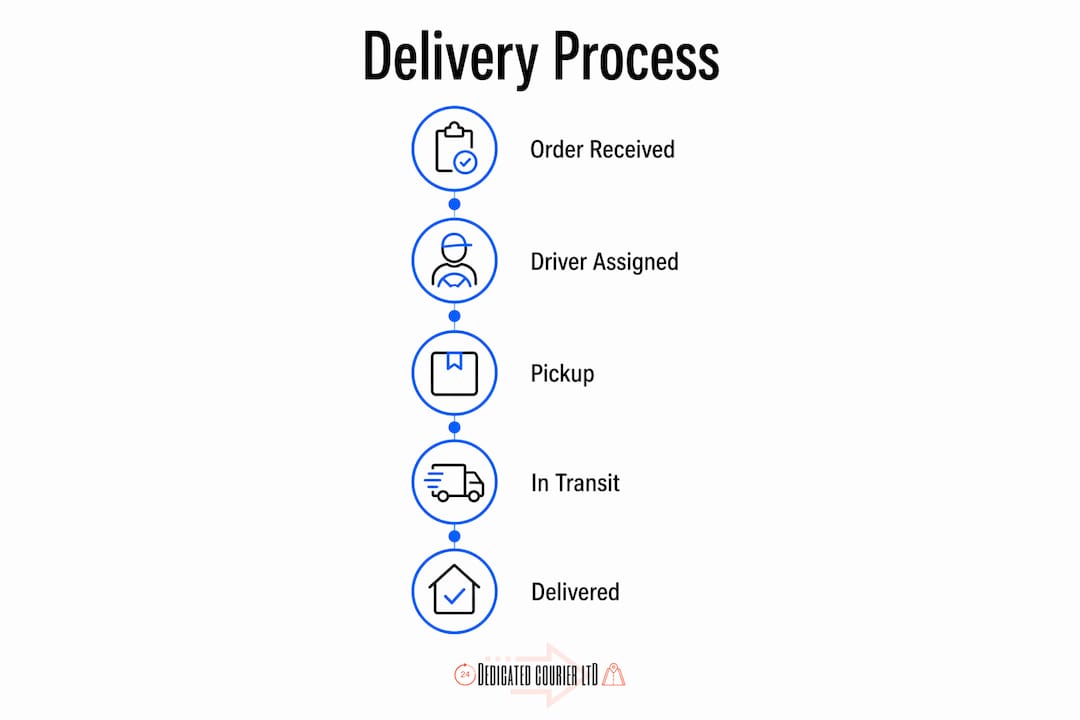
On-demand delivery uses digital platforms, routing technology, and local courier networks to match orders with drivers in real time. The operational flow is straightforward once you understand each stage.
Order placement. A customer places an order through a mobile app or website. The platform records the delivery address, item details, and preferred timing.
Driver matching. A routing algorithm identifies the nearest available driver and assigns the job automatically. This is where speed is won or lost.
Pickup. The driver collects the goods from the merchant or warehouse. Pickup handoff protocols and proof-of-delivery confirmation are critical at this stage, as they directly affect estimated arrival accuracy and customer trust.
Last-mile delivery. The driver navigates to the customer using real-time GPS. The platform monitors progress and sends live updates.
Confirmation and feedback. On arrival, proof of delivery is recorded digitally. The customer rates the experience, feeding data back into the platform.
Most delivery apps are built around three distinct interfaces: a customer app for ordering and tracking, a driver app for navigation and job management, and an admin dashboard for monitoring operations and handling exceptions. Delivery app development requires designing user journeys across all three roles, with GPS tracking, payment processing, push notifications, and order monitoring as core components.
Use cases span food and beverage, e-commerce returns, pharmaceutical deliveries, and urgent document couriering. Each vertical has slightly different requirements, but the underlying process remains consistent.
Pro Tip: When evaluating an on-demand delivery provider, ask specifically how they handle exception management, meaning what happens when a driver cannot complete a delivery. Providers with clear escalation protocols protect your customer relationships far better than those relying on manual intervention.
What are the key benefits and challenges of on-demand delivery?
On-demand delivery services offer genuine competitive advantages, but they also carry operational costs that businesses must plan for carefully.
Benefits:
Speed. Goods reach customers within hours rather than days. App-driven driver matching combined with real-time tracking makes same-day and sub-hour delivery achievable at scale.
Customer satisfaction. Flexible delivery windows and real-time tracking reduce waiting times and increase transparency, which directly improves loyalty in urban markets.
Flexibility. Businesses can scale delivery capacity up or down based on demand without maintaining a permanent fleet.
Competitive edge. Offering fast, trackable delivery differentiates businesses in sectors where customers now expect it as standard.
Challenges:
Cost. Pricing structures include flat fees, service charges, and distance tiers. Toast Delivery Services® charges fees starting around £6.99 per delivery, with a typical radius of ten miles. These unit economics add up quickly at volume.
Driver availability. Reliable driver supply is hardest to maintain during peak periods. Subscription plans and surge pricing improve economics, but driver retention remains a persistent challenge.
Technology reliability. System glitches and route optimisation failures can disrupt operations. Investment in scalable tech infrastructure is not optional for businesses operating at any meaningful volume.
Quality control. Goods in transit are handled by third-party drivers, which introduces variability in care and presentation.
Pro Tip: If you are a business starting with on-demand delivery, pilot with a single product category or delivery zone before scaling. This limits cost exposure and gives you clean data on driver performance and customer satisfaction before you commit further.
How do different operational models and technologies shape on-demand delivery?
The on-demand delivery process is not one-size-fits-all. Operational models vary significantly depending on the business type, geography, and technology investment.
Model type | Description | Best suited for |
Platform partnership | Use an existing network such as Uber Direct | Businesses wanting speed to market |
White-label solution | Branded app built on a third-party platform | Mid-size businesses needing control |
Custom-built MVP | Proprietary app with manual dispatch initially | Startups testing product-market fit |
Dedicated courier service | Exclusive vehicle per consignment | High-value or time-critical goods |
Building a lean MVP that focuses on user flows and manual dispatch before automating saves development costs and helps businesses find their operational footing before scaling. The minimum viable product for a delivery app requires GPS tracking, driver navigation, payment processing, push notifications, and order monitoring. Adding automation too early creates complexity without the data to justify it.
Vertical specialisation in pharmacy, grocery, or niche urban delivery provides competitive advantage that broad platform operators cannot easily replicate. Hyperlocal markets are frequently underserved by large-scale platforms, which creates genuine opportunity for focused operators.
One operational constraint worth noting: platform exclusivity rules mean businesses often cannot run multiple delivery options simultaneously on the same sales channel. Toast Delivery Services® requires choosing either their drivers or your own, not both. This limits flexibility and makes the initial choice of delivery partner more consequential than it might appear.
For businesses that need reliable, optimised courier logistics without building their own platform, partnering with a dedicated courier network is frequently the most practical route.
How does on-demand delivery impact different industries?
On-demand delivery has moved from a convenience feature to a core operational requirement across multiple sectors.
Food and beverage. Restaurants and dark kitchens depend on sub-hour delivery to maintain food quality and customer satisfaction. Real-time tracking reduces inbound customer service queries significantly.
E-commerce. Returns and same-day fulfilment have become differentiators. Retailers offering same-day delivery options report measurably higher conversion rates on time-sensitive purchases.
Healthcare. Pharmaceutical and medical supply chains use on-demand delivery for urgent prescription fulfilment and equipment transport, where delays carry real consequences.
Corporate logistics. Documents, contracts, and sensitive materials require dedicated, trackable delivery rather than standard postal services. Understanding the corporate courier workflow is directly relevant here.
Customer preference for convenience over cost drives demand for flexible delivery windows in urban markets. The operational impact extends beyond speed: businesses that offer real-time updates and flexible timing report stronger brand loyalty than those offering only standard delivery windows.
Key takeaways
On-demand delivery is a real-time logistics model that connects customers with nearby drivers through digital platforms, delivering goods within hours rather than days.
Point | Details |
Core definition | On-demand delivery matches customers with nearby drivers via apps for near-immediate fulfilment. |
Operational flow | Orders move through placement, driver matching, pickup, last-mile delivery, and digital confirmation. |
Cost structure | Flat fees, service charges, and distance tiers shape unit economics; pilot before scaling. |
Technology requirements | GPS, routing algorithms, payment processing, and exception handling are non-negotiable components. |
Vertical opportunity | Pharmacy, grocery, and hyperlocal markets offer competitive advantage over broad platform operators. |
Andrew’s take on where on-demand delivery is actually heading
Most commentary on on-demand delivery focuses on the customer-facing benefits: speed, tracking, convenience. What gets less attention is the operational discipline required to deliver on those promises consistently.
From what I have observed, the businesses that struggle most with on-demand delivery are not those that chose the wrong platform. They are the ones that underestimated driver experience and pickup protocol. A driver who does not confirm pickup correctly creates a cascade of ETA errors that no routing algorithm can fix after the fact. Real-time capacity constraints and routing density dictate operational reliability far more than the app interface does.
The trend I find genuinely interesting is vertical specialisation. Broad platforms have optimised for volume and speed in dense urban areas. The real opportunity in 2026 is in the gaps: regional healthcare logistics, specialist retail, and B2B document couriering where reliability matters more than price. AI-assisted routing will improve ETA accuracy across the board, but it will not solve the fundamental challenge of driver supply in lower-density areas. That remains a human and operational problem.
My recommendation for any business starting out: treat your first delivery partner as a learning exercise, not a permanent commitment. The data you collect in the first three months will tell you more about your actual delivery needs than any platform comparison will.
— andrew
How Dedicatedsamedaycourier supports your on-demand delivery needs
[
Dedicatedsamedaycourier provides dedicated, same-day courier services across the UK for businesses and individuals who need goods moved quickly and reliably. Every consignment travels on an exclusive vehicle, which means no shared loads and no unnecessary delays. The service operates 24 hours a day, seven days a week, with real-time tracking and direct communication throughout each delivery.
Whether you need a van courier for larger consignments or an urgent sameday courier service for time-critical documents or parcels, Dedicatedsamedaycourier covers the full range of on-demand delivery needs nationwide. Request a quote online, by phone, or by email to discuss your specific requirements.
FAQ
What is on-demand delivery?
On-demand delivery is a logistics model where goods are delivered to customers within minutes or hours of ordering, using mobile apps to match them with nearby drivers in real time. It contrasts with traditional delivery, which typically takes days.
How does on-demand delivery differ from standard courier services?
Standard courier services operate on scheduled routes and fixed timelines, whereas on-demand delivery uses real-time driver matching and GPS tracking to fulfil orders almost immediately after placement.
What are the main costs involved in on-demand delivery?
Costs typically include a flat delivery fee, a service charge, and distance-based pricing tiers. Toast Delivery Services® illustrates this with fees starting around £6.99 and a standard delivery radius of ten miles.
Which industries use on-demand delivery most?
Food and beverage, e-commerce, healthcare, and corporate logistics are the primary sectors. Each relies on speed, real-time tracking, and reliable last-mile fulfilment to meet customer and operational demands.
Can a business run multiple on-demand delivery options at once?
Not always. Platform exclusivity rules, such as those applied by Toast Delivery Services®, require businesses to choose a single delivery fulfilment option per sales channel, which limits operational flexibility.
Recommended


Comments