
The role of accountability in courier services

TL;DR:
Accountability in courier services involves clearly assigning responsibility and documenting hand-offs at each delivery stage. It enhances reliability through measurable tools like scans, ETA tracking, and proof of delivery, reducing disputes and building customer trust. Legal and financial risks arise without proper signed contracts and transparent liability clauses, which technology helps mitigate through automated audit trails and real-time updates.
Accountability in courier services is defined as the clear assignment of responsibility for every step of the delivery process, from collection through to proof of delivery. For logistics managers and small business owners, this is not a soft concept. It directly determines whether urgent shipments arrive on time, whether disputes are resolved quickly, and whether financial penalties are avoided. The role of accountability in courier operations covers service level agreements (SLAs), documented hand-off points, and the legal obligations that govern liability when goods in transit go missing or arrive damaged.
How does accountability improve courier service reliability?
Carrier performance SLAs clarify exactly when responsibility shifts from shipper to courier at the point of carrier acceptance. This single mechanism reduces the most common source of delivery disputes: the gap between who thinks they own a problem and who actually does. For logistics managers handling urgent consignments, that clarity is the difference between a recoverable delay and a lost client.
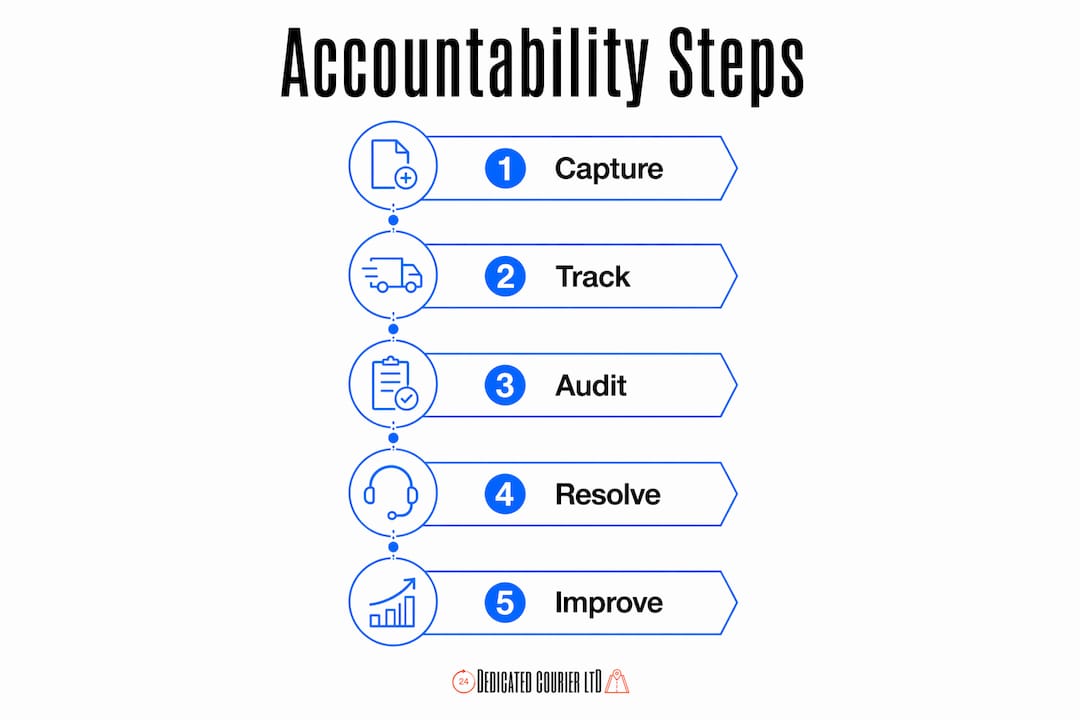
Accountability improves reliability through several measurable mechanisms:
Standardised hand-off points create a documented audit trail at every stage, from collection scan to final signature.
ETA accuracy tracking holds drivers and depots to published delivery windows, reducing late deliveries.
Scan compliance rates measure whether drivers are recording each milestone, flagging gaps before they become disputes.
Proof of delivery (POD) in the form of timestamped photos and signatures gives both parties a defensible record.
When these mechanisms are in place, dispute resolution improves because the data exists to settle claims without lengthy back-and-forth. Customer trust follows naturally. A shipper who receives consistent, documented delivery confirmation is far more likely to use the same courier for the next urgent job.
Pro Tip: Set a minimum scan compliance rate of 95% as a contractual KPI in your SLA. Below that threshold, require a written explanation from the carrier within 24 hours.

What are the legal and financial risks of poor courier accountability?
The financial exposure from inadequate accountability in logistics is concrete. Penalties for non-compliance can exceed 30% of shipment value in international freight scenarios. For a small business shipping high-value goods, that is a material loss from a single consignment.
Legal risk compounds the financial exposure. Courts and consumer protection bodies have consistently ruled that courier companies cannot enforce liability limitation clauses if those terms were not clearly communicated and signed by the sender. NCDRC rulings protect consumers against fine-print liability limits that were not properly accepted at the point of contract. This means a courier’s standard terms buried in a booking confirmation may offer no protection at all in a dispute.
The practical implications for logistics managers and business owners are direct:
Require signed, plain-language contracts that spell out liability caps before any consignment moves.
Confirm that your courier’s goods in transit insurance covers the full declared value of each shipment.
Keep copies of all booking confirmations, POD records, and correspondence as evidence in any future claim.
“Transparency and proper signing are vital for contracting accountability. Courier companies cannot enforce liability limits if customers were not made aware of terms.” Legal perspective on courier accountability
Without these protections in place, loss recovery becomes a protracted legal process rather than a straightforward claim.
What technology supports accountability in courier operations?
Technology is the most reliable way to embed accountability into daily courier workflows. Manual reporting depends on driver discipline and memory. Automated systems remove both variables. The role of technology in courier services has expanded significantly, with courier software now capable of prompting drivers through compliance steps automatically and recording timestamped audit trails at every delivery milestone.
The core tools that support accountability in delivery operations are:
Barcode and QR scan systems that record collection, transit, and delivery events in real time.
Electronic signature capture that creates a legally admissible POD record linked to a specific time and GPS location.
Photo documentation prompts that require drivers to photograph the delivery location before marking a job complete.
Exception management alerts that notify operations managers the moment a delivery falls outside its expected window.
Driver settlement integration that ties pay calculations directly to completed, compliant delivery records.
Technology | Accountability function | Operational benefit |
Barcode scanning | Records each hand-off point | Reduces missing parcel disputes |
Electronic signature | Confirms recipient identity | Provides legally admissible POD |
GPS timestamping | Links delivery to location and time | Supports claims and audits |
Exception alerts | Flags delays in real time | Allows proactive customer communication |
Intelligent courier tracking links proof directly to the delivery timeline, improving auditability and making dispute resolution faster and less costly. For a logistics manager overseeing multiple urgent consignments daily, that auditability is not optional. It is the foundation of operational control.
Pro Tip: When evaluating courier software, check whether it integrates POD data directly with your invoicing system. This removes a manual reconciliation step and reduces billing errors.
How can logistics managers build a culture of accountability?
Technology and contracts create the structure for accountability, but culture determines whether that structure is used consistently. The distinction matters because accountability must be chosen by teams rather than imposed through rigid monitoring. Forced oversight reduces trust and slows operations. Teams that accept accountability as a shared standard perform more consistently than those who comply only when watched.
Effective accountability shows up early, consistently, and quietly. It is steady stewardship rather than reactive enforcement. A driver who flags a potential delay before it becomes a missed delivery is demonstrating the kind of proactive ownership that protects service quality without requiring managerial intervention at every step.
Practical steps for logistics managers building this culture include:
Clarify ownership early. Every consignment should have a named responsible party from the moment it is booked. Ambiguity about who owns a problem guarantees it will be resolved late.
Reward early escalation. Drivers and coordinators who flag issues before they become failures should be acknowledged. Penalising bad news discourages the behaviour you need most.
Use performance data as a coaching tool, not a disciplinary weapon. Sharing scan compliance rates and ETA accuracy with drivers in a constructive context builds engagement rather than resentment.
Review corporate courier workflows regularly to identify where accountability gaps are most likely to appear and address them before they affect clients.
The goal is a team that holds itself to a standard, not one that performs only under surveillance.
Key takeaways
Accountability in courier services is the single most effective mechanism for reducing delivery failures, resolving disputes quickly, and protecting businesses from financial and legal exposure.
Point | Details |
SLAs define responsibility | Clear hand-off points in SLAs prevent disputes by specifying exactly when liability transfers to the carrier. |
Legal exposure is real | Liability clauses are unenforceable if not properly signed, leaving couriers and shippers financially exposed. |
Technology automates compliance | Barcode scans, electronic signatures, and GPS timestamps create audit trails without relying on manual reporting. |
Culture determines consistency | Accountability chosen by teams outperforms accountability imposed through monitoring or penalties. |
Early action protects value | Proactive ownership before problems escalate is more effective than reactive enforcement after failures occur. |
Andrew’s view on accountability in practice
The most common mistake I see logistics managers make is treating accountability as a post-failure tool. They build dispute processes, draft liability clauses, and invest in tracking software, but only activate those systems after something goes wrong. By that point, the client relationship is already under strain.
The businesses that handle urgent deliveries most reliably are those that define courier accountability for UK businesses at the point of contract, not the point of complaint. They know exactly what their SLA says about ETA windows, they have signed documentation confirming liability terms, and their drivers are prompted through compliance steps automatically rather than relying on memory.
The harder challenge is driver buy-in. Scan compliance rates drop when drivers feel monitored rather than supported. The fix is not removing the monitoring. It is explaining why the data matters, sharing it transparently, and connecting it to outcomes the driver cares about, such as faster dispute resolution when a delivery goes wrong through no fault of their own. Accountability protects drivers as much as it protects clients.
How Dedicatedsamedaycourier delivers built-in accountability
[
Dedicatedsamedaycourier operates dedicated vehicle services across the UK, meaning your consignment travels on an exclusive vehicle with no shared loads and no depot transfers that create accountability gaps. Every booking includes documented collection and delivery records, real-time tracking, and proof of delivery as standard. For urgent same-day jobs where a missed delivery is not an option, that level of operational transparency matters. Explore the full range of dedicated courier vehicles or get a quote for a sameday courier service tailored to your delivery requirements.
FAQ
What is the role of accountability in courier services?
Accountability in courier services is the clear assignment of responsibility at every stage of the delivery process, supported by documented hand-off points, SLAs, and proof of delivery records. It reduces disputes, protects against financial penalties, and improves on-time delivery rates.
Why do SLAs matter for courier accountability?
SLAs define exactly when responsibility transfers from shipper to carrier, which is the foundation for performance tracking and claims management. Without this definition, liability disputes have no clear resolution point.
Can a courier limit its liability without a signed agreement?
No. Legal rulings, including NCDRC decisions, confirm that liability limitation clauses are unenforceable if the sender was not made clearly aware of the terms and did not sign to accept them.
How does technology improve accountability in delivery?
Courier software automates data capture through barcode scans, electronic signatures, and GPS timestamps, creating a timestamped audit trail that supports dispute resolution and removes reliance on manual driver reporting.
What is the difference between reactive and proactive accountability?
Reactive accountability addresses failures after they occur. Proactive accountability involves early ownership of potential issues before they escalate, which research shows is more effective at protecting delivery consistency and reducing operational costs.
Recommended


Comments