
Ways to ensure secure delivery of sensitive shipments
TL;DR:
Secure delivery involves verified, tamper-free transfer of goods with documented proof at each handoff. Combining physical seals, digital verification, and trusted couriers creates a layered security approach that mitigates risk effectively.
Secure delivery is defined as the verified, tamper-free transfer of goods from sender to authorised recipient, with documented proof at every handoff. The most effective ways to ensure secure delivery combine physical controls such as ISO 17712-compliant seals with digital verification tools including ephemeral codes, signed delivery payloads, and real-time GPS tracking. For small business owners and logistics managers handling sensitive documents or high-value goods, no single measure is sufficient. The strongest protection comes from layering multiple methods across the full delivery chain.

1. Ways to ensure secure delivery start with tamper-evident packaging
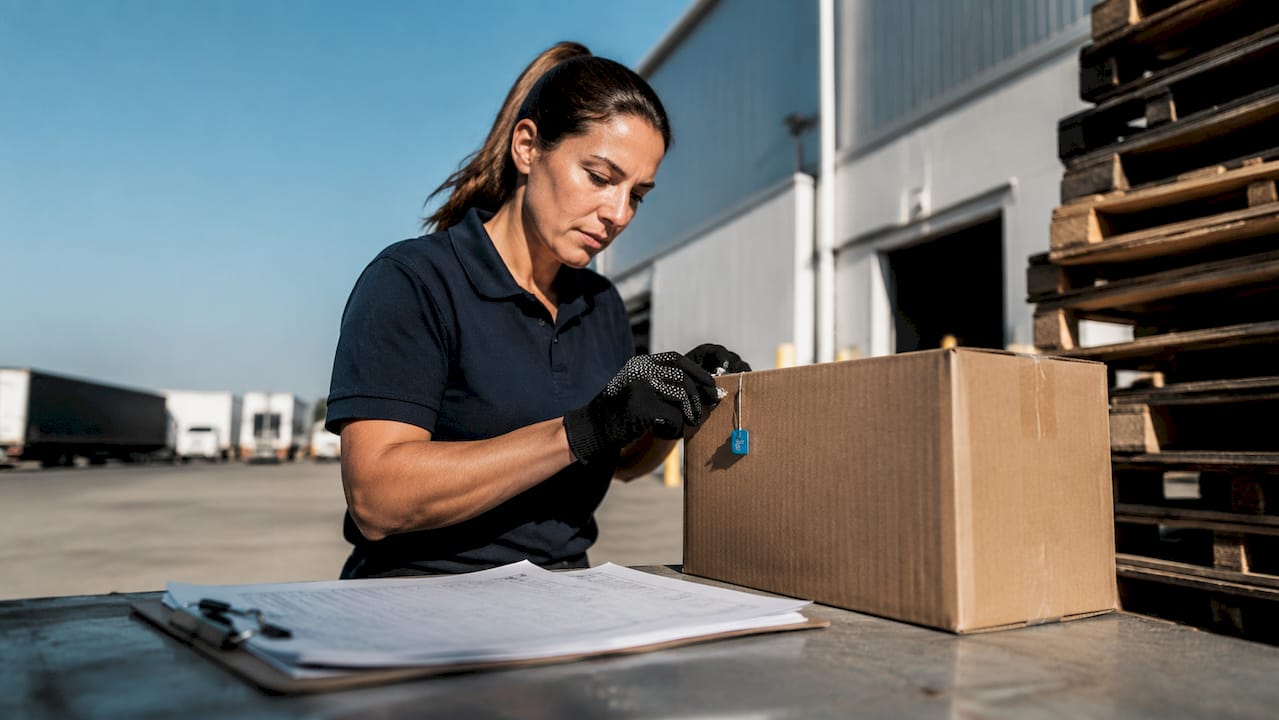
Tamper-evident packaging is the first physical barrier between your shipment and interference. It does not just protect contents. It creates visible evidence of any unauthorised access, which matters enormously in dispute resolution and insurance claims.
Opaque, tamper-evident envelopes prevent casual inspection and deter opportunistic theft of confidential documents. This is particularly relevant for legal firms, financial institutions, and medical practices sending sensitive paperwork by courier.
For higher-risk consignments, the choice of seal type determines your security level:
Seal type | Security level | Best use case |
Bolt seal | High (ISO 17712 H) | Shipping containers, heavy freight |
Cable seal | Medium (ISO 17712 M) | Pallets, transit cages |
Plastic seal | Indicative (ISO 17712 I) | Cartons, document bags |
RFID seal | High with digital audit | High-value goods requiring tracking |
ISO 17712-rated seals combined with photographic documentation at every handoff are the recommended standard for high-risk shipments. Serial number verification at each transfer point reduces tampering risk substantially and provides a clear chain of evidence.
Pro Tip: Photograph the seal serial number before despatch and again at delivery. If numbers do not match, you have immediate, documented proof of interference.
2. Identity verification at the point of handoff
Confirming that a package reaches the correct, authorised person is as important as protecting it in transit. Last-mile delivery must be treated as an extension of your organisation’s trust boundary, and that requires proper recipient authentication.
The most reliable methods currently in use include:
One-time passwords (OTPs): Sent to the recipient’s registered mobile number, valid for a short window only.
Ephemeral QR codes: Single-use codes that expire after scanning, preventing reuse or screenshot fraud.
Signed JSON Web Tokens (JWTs): Cryptographically verified tokens that confirm both identity and delivery session integrity.
Bluetooth proximity checks: Confirm the recipient’s registered device is physically present at the delivery location.
Device attestation verifies that only trusted, unmodified devices can redeem delivery credentials, which blocks scripted or emulator-based fraud attempts. This is a control that most small businesses overlook, yet it closes a significant gap in last-mile security.
Pro Tip: Set tight expiry windows on all delivery codes, ideally under 10 minutes. A code valid for 24 hours is not a security control. It is an open door.
Fallback procedures matter too. If verification fails, the courier should not leave the parcel unattended. A documented failed-attempt record and a rescheduled delivery with fresh credentials is the correct protocol.
3. Digital tracking and delivery data integrity
Real-time GPS tracking gives both sender and recipient visibility over a shipment’s location throughout transit. That visibility alone deters theft and helps identify route deviations quickly. However, tracking data is only as trustworthy as the systems that record it.
Signed delivery payloads using HMAC or asymmetric signatures prevent parameter tampering when delivery confirmation data passes between courier systems and client platforms. APIs between logistics partners are a major attack surface, and unsigned data exchanges create opportunities for fraudulent delivery confirmations.
The table below outlines the key digital controls and their purpose:
Control | What it protects against |
Mutual TLS on APIs | Man-in-the-middle interception |
HMAC-signed payloads | Delivery data tampering |
Append-only audit logs | Retrospective record alteration |
WORM storage for proof-of-delivery | Fraudulent dispute claims |
Immutable audit trails using append-only logs or WORM (Write Once, Read Many) storage are critical for resolving delivery disputes. When a recipient claims non-delivery and your records show a signed, timestamped, GPS-confirmed handoff, the audit trail is your defence.
Timestamped delivery photos should be stored server-side, not on the courier’s device, to prevent local deletion or alteration.
4. Layered controls: why one measure is never enough
A single security control, however well implemented, creates a single point of failure. Layered security means that if one control is bypassed, others remain active. This is the principle behind the most resilient secure delivery systems operating in the UK today.
Geofencing alone is insufficient because GPS coordinates can be spoofed. Geofencing confirms proximity, not identity. It must always be combined with ephemeral codes and device attestation to carry any real security weight.
A practical layered approach for business shipments looks like this:
Physical layer: tamper-evident packaging and ISO 17712 seals with serial number documentation.
Identity layer: OTPs or ephemeral QR codes with short expiry windows and device attestation.
Digital layer: signed delivery payloads, mutual TLS, and append-only proof-of-delivery logs.
Operational layer: direct routes, trained couriers, and chain-of-custody documentation at every transfer.
Risk-tiered deployment makes this manageable. A standard parcel may need only packaging controls and GPS tracking. A legal document or pharmaceutical shipment warrants the full stack. Matching security intensity to cargo value and route risk keeps operations efficient without leaving gaps.
For a detailed breakdown of secure parcel transportation standards applicable to UK businesses, the controls above map directly to recognised industry practice.
5. Choosing the right courier and delivery protocols
The courier you select is not just a transport provider. They are an active participant in your security chain. A poorly vetted driver or an unstructured handoff protocol can undermine every technical control you have put in place.
Direct, no-stop delivery routes with security-cleared drivers improve chain of custody and reduce theft risk substantially. Each additional stop or transfer point is an opportunity for interference, misdirection, or substitution.
Key protocols to require from any courier partner:
Credential checks against recognised databases before driver assignment.
Seal inspection and photographic documentation at collection and delivery.
Chain-of-custody records signed at every transfer point.
Dedicated vehicles carrying only your consignment, not consolidated loads.
For sensitive or high-value goods, a dedicated courier service operating on exclusive vehicles removes the risks associated with shared-load or hub-and-spoke models entirely. The last-mile delivery guide published by Fulfil Packers confirms that multi-factor authentication and direct routing are among the most effective enhancements available for last-mile security.
Two-factor authentication linked to tokenised delivery passes integrates identity verification with payment and despatch systems, creating a closed loop that is far harder to exploit than a simple signature on delivery.
For businesses sending documents regularly, reviewing a step-by-step document delivery workflow will help standardise these protocols across your team.
Key takeaways
Secure delivery requires physical seals, verified identity at handoff, signed digital records, and a trusted courier operating on direct routes.
Point | Details |
Use ISO 17712 seals | Match seal security level to cargo risk and document serial numbers at every transfer. |
Verify recipient identity | Deploy OTPs or ephemeral QR codes with short expiry windows and device attestation. |
Protect delivery data | Use signed payloads, mutual TLS, and append-only logs to prevent tampering and fraud. |
Layer your controls | Combine physical, identity, digital, and operational measures rather than relying on one. |
Choose dedicated couriers | Direct routes and security-cleared drivers reduce chain-of-custody risk at every stage. |
What I have found actually works in practice
The gap I see most often is not in the technology. Businesses invest in GPS tracking and tamper-evident packaging, then hand the parcel to a driver with no formal chain-of-custody process and no identity verification at delivery. The physical and digital controls are solid. The operational layer is missing entirely.
The other common mistake is treating geofencing as proof of delivery. It confirms a vehicle was near an address. It does not confirm the right person received the right parcel. I have seen this create genuine disputes that took weeks to resolve because the audit trail was incomplete.
My practical advice is to start with the operational layer first. Define your handoff protocol, train whoever is collecting and delivering, and document every transfer. Then add technology on top of that foundation. Technology applied to a broken process does not fix the process. It just makes the failure harder to trace.
Regular review matters too. Threat patterns change, and a protocol that was adequate in 2024 may have gaps by 2026. Build a quarterly review into your logistics planning, even if it is just 30 minutes checking whether your current controls still match your current risk profile.
— andrew
How Dedicatedsamedaycourier supports secure business deliveries
[
Dedicatedsamedaycourier operates dedicated, exclusive-vehicle courier services across the UK, meaning your consignment travels on its own vehicle from collection to delivery with no intermediate stops or shared loads. This model directly supports chain-of-custody integrity for sensitive documents, legal paperwork, and high-value goods.
Every booking through Dedicatedsamedaycourier can be handled as a same-day dedicated service, with 24/7 availability and direct routing to your specified recipient. For businesses that need a reliable, security-focused courier partner, the full range of courier services covers urgent, next-day, and overnight requirements nationwide. Request a quote by phone, email, or online form to discuss your specific security requirements.
FAQ
What are the most effective ways to secure packages in transit?
The most effective methods combine tamper-evident packaging and ISO 17712-compliant seals with real-time GPS tracking and signed proof-of-delivery records. Adding recipient identity verification via OTPs or ephemeral QR codes closes the last-mile gap.
Is geofencing sufficient to confirm secure delivery?
Geofencing confirms proximity but not identity, and GPS coordinates can be spoofed. It must be combined with ephemeral codes and device attestation to provide reliable delivery verification.
How do I prevent delivery theft for sensitive documents?
Use opaque, tamper-evident envelopes, require identity verification at handoff, and choose a dedicated courier operating on direct routes with no intermediate stops or shared loads.
What is chain-of-custody documentation in delivery?
Chain-of-custody documentation is a signed record of every person who handles a shipment from collection to final delivery. It provides a traceable audit trail that supports dispute resolution and confirms secure handling throughout transit.
When should a business use a dedicated courier over a standard service?
A dedicated courier is the correct choice for high-value goods, confidential documents, or any shipment where security, speed, and direct routing cannot be compromised. Shared-load services introduce additional transfer points that increase theft and tampering risk.
Recommended


Comments