
Courier flexibility explained: what it means for your business
- Andrew Buttrick
- May 2
- 8 min read

TL;DR:
True courier flexibility involves rapid adaptation in routing, capacity, and timing during peak demands.
Businesses damage their reputation and incur costs when relying on inflexible courier providers during busy periods.
Evaluating providers through SLA transparency, real-time tracking, and AI-driven scheduling ensures genuine operational flexibility.
Courier flexibility is often assumed to mean fast delivery, perhaps next-day or a two-hour window. That assumption costs businesses money. True courier flexibility is an operational capability that determines whether your logistics hold up when a client needs a contract signed across the country in three hours, or when an order surge doubles your despatch volume overnight. Peak failures cost UK businesses £464M during the 2024 holiday period alone, largely because rigid, inflexible courier arrangements could not adapt fast enough. This guide explains what courier flexibility actually means, why it matters to UK SMEs, and how to build it into your logistics.
Table of Contents
Key Takeaways
Point | Details |
Courier flexibility defined | It means adapting deliveries to urgent and shifting business needs, not just fast shipping. |
Business value | Flexible couriers reduce risk, prevent losses, and increase customer satisfaction. |
Essential features | Look for AI-driven logistics, elastic capacity, and strong SLAs in flexible courier services. |
How to assess | Test your courier’s surge response and tracking before committing for long-term needs. |
What is courier flexibility?
Courier flexibility refers to the ability of a delivery provider to adapt its methods, resources, and timing to meet the specific and often changing needs of a business. It is not simply about offering a range of delivery speeds, though that is part of it. Real flexibility covers route planning, vehicle selection, booking cut-off times, real-time tracking, and the capacity to absorb sudden increases in demand without failing customers.
For a small or medium-sized business, this means being able to book a same-day collection at short notice, choose the right courier vehicles for your consignment size, and receive accurate updates throughout the journey. It also means your provider does not hit a ceiling when things get busy.
The key enablers of flexibility in modern courier services include:
AI-powered scheduling: Automated systems that plan optimal routes and reassign drivers in real time.
Elastic capacity: A network of couriers that can scale up or down depending on demand, rather than relying on a fixed headcount.
Transparent SLAs: A service-level agreement (SLA) is a written commitment from the courier to meet specific performance standards, such as collection within one hour or delivery by a set time.
Real-time booking platforms: Systems that allow businesses to request, track, and manage shipments without manual back-and-forth.
Crowdsourcing networks: Technology-driven platforms that connect businesses to available couriers across multiple regions simultaneously.
According to industry analysis, true flexibility requires AI predictive analytics and elastic capacity to adapt effectively to customer needs, especially during peak periods.
Feature | Flexible courier | Rigid courier |
Same-day booking | Yes | Rarely |
Surge capacity | Scalable | Fixed |
Real-time tracking | Always available | Limited |
Vehicle options | Multiple sizes | Standard van only |
SLA transparency | Written and enforceable | Verbal or absent |
Pro Tip: Always ask a prospective courier provider how they handle surge demand. Specifically, ask whether their capacity is fixed or whether they draw from an extended network. A provider who cannot answer that question clearly is likely to struggle when you need them most.
Why courier flexibility matters for UK businesses
Rigid logistics create predictable problems: missed deadlines, failed deliveries, and damaged relationships with clients. These are not rare events. For UK SMEs, a single failed delivery during a critical period can result in a lost contract, a refund demand, or a client who simply does not return.

Peak failures cost UK SMEs £464M due to lack of flexibility in their courier arrangements. That figure reflects not only the direct cost of failed deliveries but also the downstream impact on customer retention and business reputation.
Consider a practical example. A regional legal firm needs a signed contract delivered to a client in Manchester by 2pm. Their standard courier operates on a next-day service only. The document misses the deadline. The client questions the firm’s reliability. That is not a logistics problem in isolation. It is a business credibility problem.
Flexible couriers remove that risk by offering:
Urgent same-day collection, often within 60 minutes of booking
Dedicated vehicle services, where your consignment does not share space with other goods
Nationwide reach, including routes that cover rural or less-served locations
24/7 availability, so a late-night or early-morning booking is possible
“The ability to adapt delivery timing and resources to client demand is not a premium add-on. It is a baseline requirement for any business that takes customer service seriously.”
The benefits of same-day delivery are well documented, but they only materialise when the courier infrastructure behind them is genuinely flexible. Understanding why courier services are essential for business continuity helps SMEs recognise that logistics is not a background function. It is a frontline part of the client experience.
Key components of courier flexibility
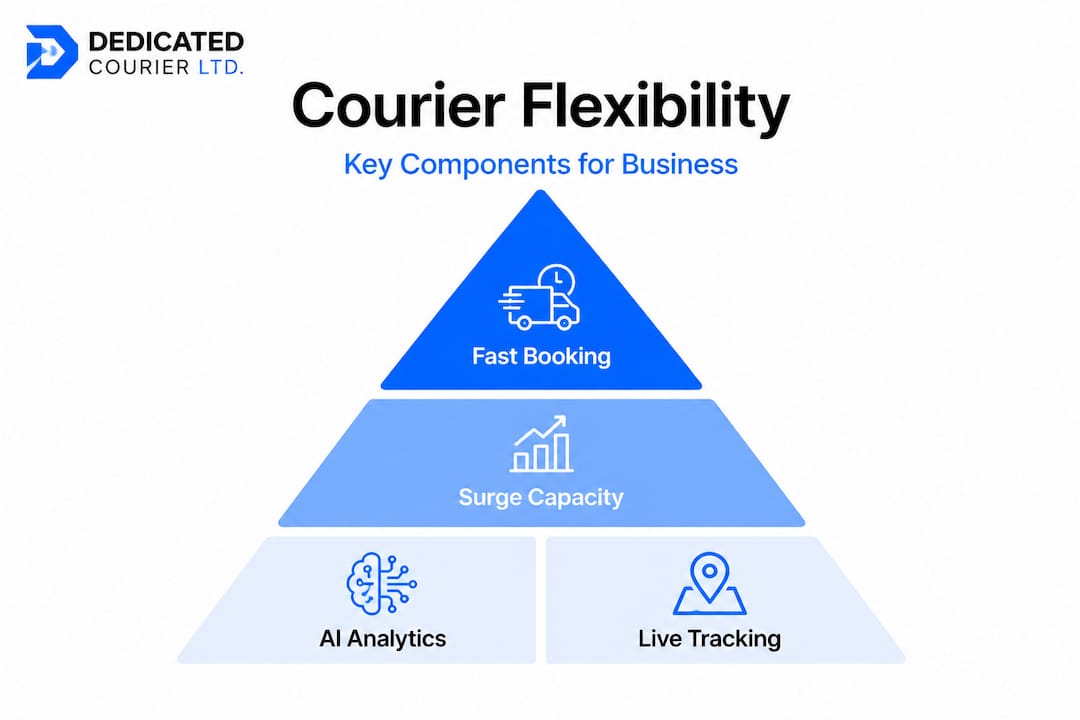
It is worth being specific about what actually makes a courier service flexible, because providers often use the word without the operational substance behind it. There are four core components to look for.
Flexible courier services use AI, elastic fleets, and clear SLAs to adapt quickly. Here is how those components break down in practice:
Same-day booking and real-time tracking: A flexible provider accepts bookings at short notice and gives you live visibility of your consignment from collection to delivery. No waiting for end-of-day updates.
Elastic fleet: The provider can deploy small vehicles for document runs, larger vans for multiple parcels, or specialist transport for pallets. Vehicle availability scales with your needs rather than operating on a fixed pool. Learning how to optimise courier logistics for your specific requirements is part of building this component into your operation.
AI-powered scheduling and route optimisation: Automated systems reduce the time between booking and despatch. They also adapt in real time to traffic, road closures, or sudden changes in drop-off locations.
On-demand pricing and transparent SLAs: A genuinely flexible provider gives you clear pricing at the point of booking and a written commitment to performance standards. If they cannot tell you what their SLA looks like, that is a warning sign.
Component | What to ask the provider | Why it matters |
Booking speed | How quickly can you collect? | Determines urgency response |
Tracking | Is real-time tracking included? | Reduces client-facing risk |
Fleet range | What vehicle sizes are available? | Ensures right-size delivery |
SLA terms | Are they in writing? | Creates accountability |
Understanding corporate courier workflow strategies can help businesses structure their logistics arrangements so that flexibility becomes a planned feature rather than a last-minute scramble.
How SMEs can assess and enhance courier flexibility
Knowing what flexibility looks like is one thing. Knowing how to test for it before signing an arrangement is another. Here are practical steps for assessing a courier provider’s true flexibility.
AI and elastic capacity are non-negotiable for genuine flexibility during busy periods, and any provider worth considering should be able to demonstrate both clearly.
Ask specific questions upfront: How many couriers are in your network? What is your average collection time for same-day bookings? Can you handle a sudden 50% increase in volume?
Review their SLA in writing: Avoid providers who offer verbal assurances only. A written SLA creates a performance baseline and gives you recourse if standards are not met.
Check their tracking capability: Request a demonstration of their tracking platform before committing. Real-time visibility should be standard, not an upgrade.
Look for warning signs of rigidity: Fixed collection windows, no weekend or out-of-hours service, and a single vehicle type are all indicators of an inflexible operation.
Run a test shipment during a busy period: This is the most direct way to assess real-world performance. A provider who performs well in quiet periods but struggles at peak times is not truly flexible. Reviewing a local retailer courier workflow can give SMEs a useful benchmark for structuring those test scenarios.
Pro Tip: Time your test shipment during a known peak period such as December or Easter week. If the provider delivers reliably under pressure, that is a strong indicator of genuine operational flexibility. If they cannot, you will find out before it costs you a client contract.
The reality of courier flexibility most businesses miss
Most businesses approach courier flexibility as a feature to look for on a provider’s website. That is the wrong frame. Flexibility is an operational foundation, and it either exists throughout the provider’s structure or it does not exist at all.
Poor implementation of flexibility costs UK firms significant sums each year, not because they chose the wrong vehicle size, but because they chose providers whose promises did not hold under pressure. A courier who offers same-day delivery as a listed service but has no elastic capacity behind it will fail you at exactly the moment you need them most.
The bigger risk is not the obvious one. A late parcel is visible and recoverable. A client who quietly moves their business elsewhere because your logistics let them down twice is not. That silent cost accumulates, and most businesses do not trace it back to their courier arrangements until significant damage has already been done.
Understanding what same-day courier services actually involve, and how they differ from standard next-day arrangements, is a starting point. Looking at same-day delivery benefits for 2026 gives a sharper view of how investment in flexible logistics translates into measurable business outcomes. The point is that flexibility is a strategic business decision, not a logistics preference.
Unlock flexible courier services for your business
If this article has clarified what courier flexibility really involves, the next step is finding a provider who can actually deliver it.
[

DedicatedSameDayCourier.co.uk operates a 24/7 dedicated same-day courier service built specifically for businesses that cannot afford to wait. Every consignment travels on an exclusive vehicle, meaning no shared loads, no delays caused by other customers’ schedules, and no compromise on security. The network covers the entire UK, with a range of courier vehicle options from small cars for document runs through to large vans for multi-parcel consignments. If your business needs a logistics partner that adapts to your deadlines rather than its own timetable, get a tailored courier quote today and find out exactly what we can do for you.
Frequently asked questions
What is the main difference between courier flexibility and regular delivery?
Courier flexibility means your consignment moves according to your urgent schedule, not a fixed daily route. True flexibility adapts quickly to client demand in ways that scheduled delivery services cannot.
How do businesses measure if a courier is truly flexible?
Look for real-time tracking, demonstrable surge capacity, AI-driven scheduling, and written SLAs as the core indicators. AI and clear SLAs are the essential metrics when evaluating a provider’s genuine flexibility.
Can flexible couriers handle same-day and urgent deliveries?
Yes, a genuinely flexible courier specialises in urgent same-day and time-critical shipments as a core service, not as an exception. Flexible couriers form the backbone of urgent delivery operations for businesses across the UK.
What is an SLA and why does it matter for courier flexibility?
An SLA, or service-level agreement, is a written commitment from the courier detailing their standards for speed, reliability, and communication. Clear SLAs are a core feature of any courier that takes accountability seriously and gives businesses meaningful recourse when standards are not met.
Recommended


Comments