
Step-by-step courier process for urgent, reliable delivery
TL;DR:
Proper preparation with accurate details and packaging is essential to ensure timely courier delivery.
Using dedicated vehicles and real-time GPS tracking reduces delays and increases delivery reliability.
Verifying all delivery information and maintaining post-delivery documentation ensures accountability and smooth operations.
A business-critical contract needs to reach a client’s office across the country by noon. The delivery window is tight, the stakes are high, and one missing detail on the booking form could cause the whole thing to fall apart. For small businesses and corporate teams alike, understanding exactly how the courier process works — from preparation through to post-delivery verification — is not just useful, it is essential. This guide walks through every stage clearly and practically, so urgent document and parcel deliveries reach their destination on time, every time.
Table of Contents
Key Takeaways
Point | Details |
Preparation is key | Gather all shipping details and documents before booking to avoid last-minute errors. |
Dedicated vehicles matter | Selecting a dedicated courier vehicle ensures your urgent items are delivered without unnecessary stops or delays. |
Real-time tracking is essential | Use couriers with live GPS tracking to monitor progress and quickly address any issues. |
Insurance provides peace of mind | Goods in Transit insurance protects your item against loss or damage while it’s in the courier’s care. |
Post-delivery verification closes the loop | Always file proof of delivery and update your records for future accountability and client trust. |
What you need before booking a courier
With the urgency established, let’s look at what you need to get ready before booking a courier. Skipping the preparation stage is the single most common cause of failed or delayed shipments. The more organised the information before the call or form is submitted, the faster and smoother the booking goes.
There are several key details every booking requires:
Full collection and delivery addresses, including postcodes
Recipient contact name and phone number
Parcel dimensions (length, width, height in centimetres) and weight in kilograms
Nature of the contents (documents, fragile items, hazardous goods)
Required delivery timeframe (same-day, next-day, specific time slot)
Any special handling instructions (fragile, upright only, temperature sensitive)
Packaging matters too. A document in a padded envelope survives most journeys fine. A parcel with fragile contents needs bubble wrap, a sturdy box, and sufficient void fill to prevent movement. Poor packaging can void a claim under Goods in Transit insurance if damage occurs in transit.
Speaking of insurance, Goods in Transit cover is mandatory for professional courier operations. This insurance protects against loss or damage during the journey. Always confirm your courier carries adequate cover before handing over high-value items.
The table below shows the minimum information needed depending on shipment type:
Shipment type | Essential details required |
Document envelope | Address, recipient name, phone, timeframe |
Standard parcel | All above plus dimensions and weight |
Fragile or specialist item | All above plus handling notes and declared value |
Pallet or large consignment | All above plus vehicle size requirement |
Pro Tip: Collate all booking details into a simple internal form or checklist before calling. This reduces the booking call to under two minutes and eliminates back-and-forth errors. You can also learn more about how to book an urgent courier to make the process even faster.
Step-by-step courier process for urgent delivery
Once prepared, it is time to action each step. Here is how the process unfolds in detail.
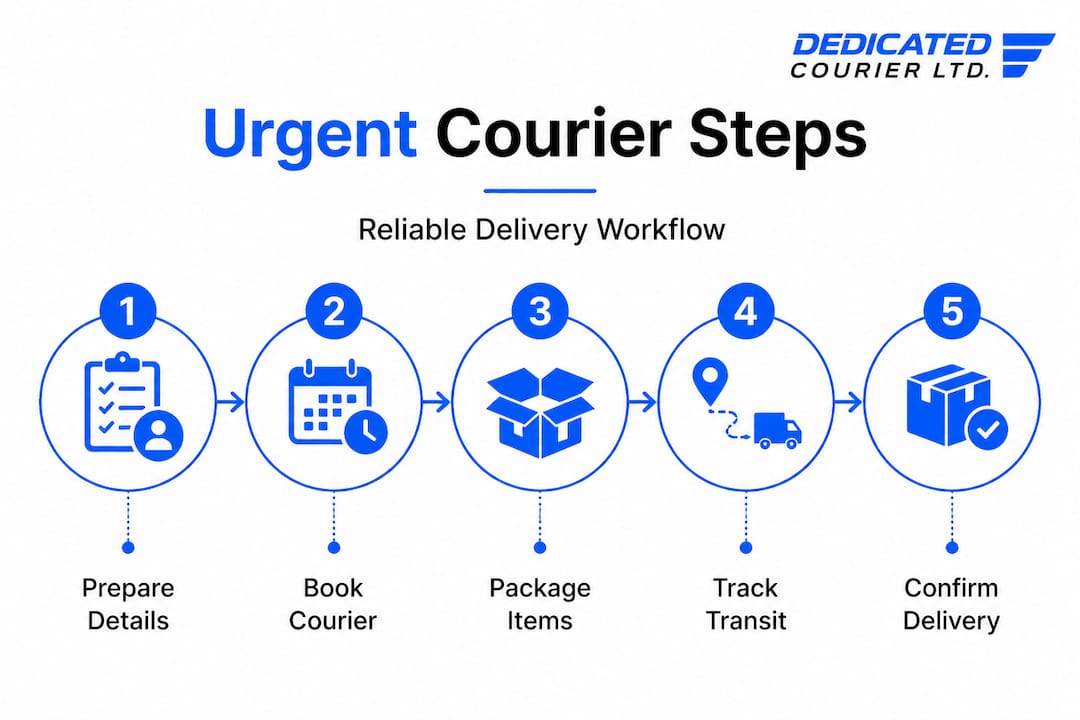
Confirm all details. Before anything else, verify both the collection and delivery addresses, parcel dimensions, declared value, and the required delivery window. A wrong postcode at this stage causes serious delays.
Book the courier and specify urgency. Contact the courier service by phone, email, or online form. Make it explicit that this is a same-day or time-critical booking. Vague requests lead to standard routing.
Choose the right vehicle. For urgent shipments, a dedicated vehicle is the correct choice. According to courier industry guidance, dedicated vehicles are recommended for urgent jobs while shared vans suit standard deliveries. A dedicated vehicle goes directly from your door to the recipient with no intermediate stops.
Hand over the parcel and confirm tracking. At the point of collection, ensure the driver confirms the booking reference and provides tracking access. Signature at collection creates an accountability record.
Monitor via real-time GPS. Real-time GPS tracking is essential for urgent deliveries. It allows immediate intervention if a vehicle is delayed, diverted, or involved in an incident. Most professional courier platforms provide this as standard.
The table below compares dedicated and shared courier vehicles for business use:
Factor | Dedicated vehicle | Shared van |
Delivery speed | Direct, fastest route | Multiple stops, slower |
Security | Exclusive load, no mixing | Shared with other parcels |
Suitability | Urgent, time-critical jobs | Standard, flexible timing |
Cost | Higher per booking | Lower per booking |
Tracking clarity | Clear, single-journey GPS | Complex multi-stop routing |
Understanding the difference between dedicated vs shared courier vehicles is critical when the delivery cannot afford a missed window. For corporate clients sending contracts, medical documents, or product samples, shared vans introduce unnecessary risk.
“A dedicated vehicle gives your shipment a direct, uninterrupted route. For urgent business deliveries, this is not a luxury — it is the baseline requirement.”
Pro Tip: Always request a signed proof of delivery immediately after the recipient confirms receipt. For high-value or legally significant items, this document may be needed for compliance or dispute resolution. A well-structured master delivery workflow ensures nothing is missed at this stage.
Troubleshooting delivery issues and common mistakes
Even with a solid process, errors can occur. Addressing and preventing the most common issues here saves time and money.
The most frequent problems include:
Incomplete address details. Missing a flat number or wrong postcode sends the driver to the wrong location entirely. This is avoidable with a simple verification step during booking.
Failing to specify urgency upfront. If the booking is processed as a standard job, it will be routed accordingly. Always state same-day or urgent clearly at the point of booking.
No tracking access confirmed. If tracking details are not shared at the point of booking confirmation, chase them immediately. Losing visibility of a shipment mid-journey creates unnecessary stress and risk.
Under-packaged items. Fragile goods that arrive damaged because of insufficient packaging create replacement costs and reputational damage with clients.
Route planning also plays a significant role. Route optimisation apps reduce fuel usage and delivery time, which is why professional couriers use them as standard. If a courier is not using any form of digital routing, that is a warning sign.
“The most preventable delays come from incomplete booking information. A sixty-second check before submitting a booking eliminates the majority of failed delivery scenarios.”
Pro Tip: After booking, check the confirmation email or message for accuracy. Verify the address, the vehicle type, and the delivery window. A mismatch found immediately can be corrected in seconds. A mismatch found at the wrong address takes hours to fix. These parcel delivery tips are practical and apply to most business shipping scenarios. Building a reliable courier workflow for reliability into your business operations reduces these incidents over time.
What happens after delivery: verification for your records
After delivery is not the end. Verifying and filing the correct documentation ensures trust, compliance, and a clear record for future reference.
The post-delivery process should follow these steps:
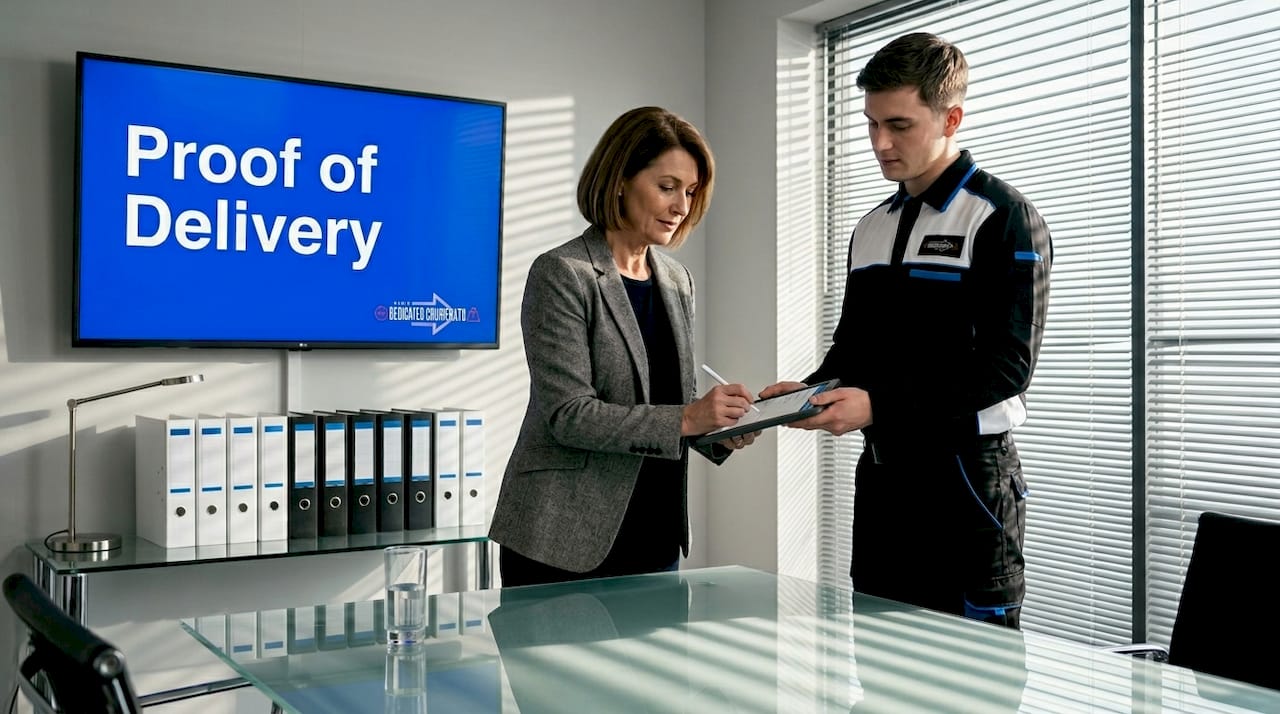
Obtain proof of delivery immediately. This is typically a signed document or digital signature confirmation from the recipient. Store it securely, whether in a physical file or a cloud-based document system.
Notify the relevant client or internal stakeholder. A brief confirmation message telling the client their item has been received builds confidence and keeps communication clean.
File all paperwork. This includes the booking confirmation, Goods in Transit insurance certificate, tracking record, and signed proof of delivery. For any dispute or audit, these documents are essential.
Review performance for ongoing accounts. For businesses making regular shipments, corporate courier account benefits include access to dedicated account managers who review delivery data and suggest improvements.
Business accounts with established courier providers typically offer corporate courier workflow support, meaning a dedicated manager oversees bookings and helps identify inefficiencies. For companies with frequent courier needs, business accounts also offer preferential pricing and priority handling. This is particularly valuable during peak periods when standard capacity is under pressure.
The reality behind fast courier delivery: what actually works
Most guides on urgent delivery focus entirely on speed. Get it there fast. Choose the fastest vehicle. Book the earliest slot. Speed matters, certainly, but it is not the primary factor in whether a delivery succeeds or fails at business scale.
The couriers and businesses that consistently achieve reliable urgent delivery share one characteristic: process discipline. They confirm details twice. They choose dedicated vehicles for cutting delivery delays rather than assuming shared capacity will work. They track every shipment in real time, not because they distrust the driver, but because visibility allows immediate action if something unexpected occurs.
Real-time GPS tracking and dedicated vehicles are not optional add-ons for premium clients. Ignoring them for cost-saving reasons introduces a level of risk that frequently costs more than the saved fee when things go wrong.
Technology helps, but it does not replace accountability. A courier partner with a structured internal process and clear communication protocols will outperform a tech-heavy operation with poor coordination every time. Build a relationship with a dedicated courier manager. Review delivery performance regularly. This ongoing dialogue is where real improvement happens, not in a single urgent fix.
Pro Tip: Rather than treating each shipment as a one-off transaction, invest in building an ongoing relationship with a courier provider. A manager who knows your typical volumes, vehicle preferences, and delivery requirements will handle urgent requests faster and with fewer errors.
Choose the right courier partner for urgent deliveries
Understanding the full process is the first step. Putting it into practice with a trusted partner is what secures a consistent result.
[
DedicatedSameDayCourier.co.uk provides urgent same-day and next-day delivery solutions across the UK, operating 24 hours a day, seven days a week. Whether the need is a small van for a single document or a larger vehicle for a multi-item consignment, the service is built around dedicated vehicles and real-time tracking. Explore the full dedicated sameday courier service for time-critical bookings, or review the range of van courier options to match the right vehicle to the job. Request a quote by phone, email, or online form for a fast, tailored response.
Frequently asked questions
What information is needed before booking a courier?
You need the recipient’s full address, parcel dimensions, weight, contact details, and any special delivery instructions such as fragile handling or a specific delivery window.
Why choose a dedicated courier vehicle for urgent shipments?
A dedicated vehicle provides direct, priority delivery with no intermediate stops, significantly reducing the risk of delay compared to shared van services.
Is tracking included with urgent courier services?
Yes, real-time GPS tracking is standard for urgent deliveries and provides full visibility from collection through to confirmed receipt.
How can I avoid delays with business courier shipments?
Double-check all booking details, request a dedicated vehicle, and ensure your courier uses route optimisation to maintain efficiency and reduce transit time.
Do courier companies provide insurance?
Goods in Transit insurance is mandatory for professional courier operations and covers your shipment against loss or damage during transit.
Recommended


Comments