
How to optimise urgent shipments with a door-to-door plan
Updated: Aug 30

The fastest reliable way to optimise urgent shipments is to define the operational clock first, choose the transport mode that actually meets that door-to-door deadline, and pre-position your processes and partners so you are never starting from zero when a job lands. Speed on paper means nothing if a shipment misses an airport acceptance cutoff or sits waiting for a partner who was never properly vetted.
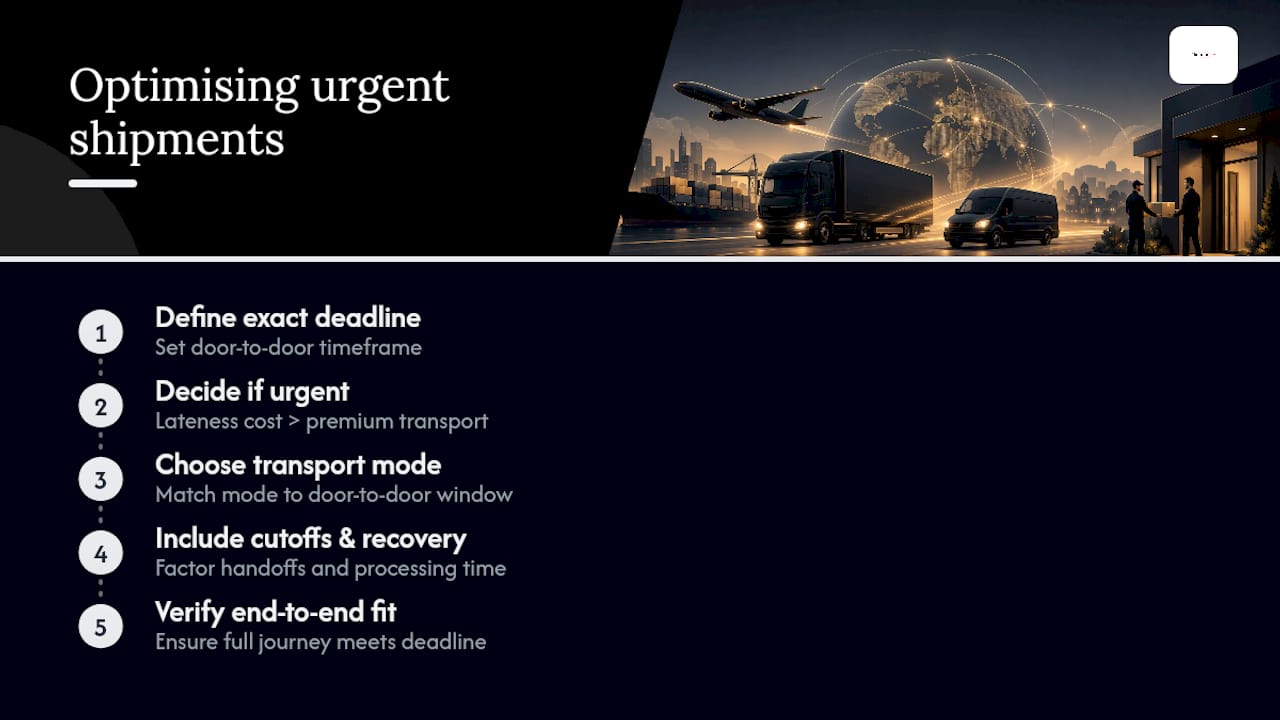
Before anything else, run this checklist:
Confirm the exact deadline, not “ASAP” — get a date and time.
Check size, weight and handling needs (fragile, hazardous, temperature-controlled).
Calculate true door-to-door time, including cutoffs and recovery, not just transit time.
Select a pre-vetted mode and partner rather than shopping cold.
Set an escalation trigger in case the first plan slips.
Metrics like OTIF (on time, in full) and IATA acceptance windows matter here because they force precision onto a vague request. A courier that operates 24/7, such as Dedicatedsamedaycourier, can absorb the first three steps for you once you know the deadline and the shipment specifics.
Key Takeaways
Optimising urgent shipments means calculating true door-to-door time, matching transport mode to cost-of-failure rather than headline speed, and pre-vetting partners before a crisis hits.
Point | Details |
Define the operational clock | Replace “ASAP” with a specific latest delivery time worked backwards from destination. |
Match mode to failure risk | Choose hot shot, team drivers, scheduled air or charter based on cost-of-failure, not linehaul speed alone. |
Prepare documentation early | Pre-lodge customs details and EORI numbers to avoid border delays on cross-border urgent moves. |
Pre-vet partners and set SLAs | Agree pickup windows, delivery windows, and escalation triggers before you need them. |
Track a small set of KPIs | Monitor OTD, OTIF, exception rate and mean time to recovery on every urgent lane. |
Use a dedicated courier for zero-slack jobs | Dedicatedsamedaycourier runs exclusive vehicles with 60 to 90 minute collection and 24/7 dispatch for time-critical UK deliveries. |
Table of Contents
How do you set up partners and SLAs for reliable urgent execution?
What does an urgent shipment playbook look like step by step?
Which metrics show your urgent shipping is actually working?
What has running urgent shipments actually taught the industry?
How can Dedicatedsamedaycourier help with an urgent shipment right now?
What counts as an urgent shipment?
An urgent shipment is any consignment where the cost of lateness exceeds the cost of premium transport, whether that cost is financial, regulatory, or measured in patient or public safety. It is not simply “anything sent quickly.” A next-day parcel booked with plenty of lead time is not urgent. A blood sample that must reach a lab within four hours is.
Urgency splits into rough bands, each with a different procurement response:
Same-day/regional — pickup and delivery within a single working day, typically under 150 miles. Example: a replacement part needed on a factory floor by 3pm.
Overnight/next-flight-out — collection today, delivery by early tomorrow, often crossing regions or borders. Example: a legal contract needed at a court 300 miles away by 9am.
24 to 48 hours — less immediate but still deadline-driven, often multi-drop or palletised. Example: exhibition stand materials needed before a trade show opens.
Zero-fail/charter — failure is not an option regardless of cost. Example: an aircraft-on-ground (AOG) part grounding a passenger flight.
A useful rubric: treat a job as mission-critical when downtime costs more per hour than the premium transport costs, when there’s a safety or health dimension, or when a missed deadline triggers a contractual penalty.
Which industries rely on urgent shipments most?
Some sectors build urgent shipping into daily operations rather than treating it as an exception. Recognising your own profile against these helps you decide how much permanent capability to build versus how much to buy ad hoc.
Healthcare — pathology samples, donor organs, and pharmaceuticals often need temperature control and a documented chain of custody, and delays carry direct clinical risk.
Manufacturing and AOG — a single missing component can idle a production line costing thousands per hour; aircraft-on-ground parts are the extreme version of this, where an entire aircraft sits grounded until one part arrives.
Retail and e-commerce — a large share of online shoppers now expect fast delivery as standard, according to Statista’s research on delivery expectations, which means retailers must decide which orders genuinely warrant premium speed rather than absorbing the cost across every order.
Legal and financial services — signed contracts, tender documents and court filings usually have a hard deadline with no possibility of an extension, and often need proof of secure handover.
Events and exhibitions — stand materials, signage and equipment have a fixed, non-negotiable delivery window because the event date does not move.
Each sector has its own handling quirks. Healthcare needs cold-chain packaging and audit trails. Legal cargo needs signature-on-delivery and a documented custody trail. Manufacturing parts sometimes need protective crating for delicate components. Matching the mode to these specifics is just as important as matching it to the clock.
Why does the operational clock matter more than raw speed?
“ASAP” is not a deadline. It’s an instruction that forces every downstream decision to be reactive rather than planned. The fix is simple: replace “as soon as possible” with a specific latest acceptable delivery time, worked backwards through every stage the shipment will pass through.
Door-to-door timing includes several stages that headline transit speeds ignore entirely. A flight that takes ninety minutes can still mean a shipment arrives six hours after collection once you account for pickup readiness, the carrier’s acceptance cutoff, ground transfer to the airport, screening, the flight itself, recovery at the destination airport, and final-mile delivery. According to the Critical Cargo Mode Selection Guide, comparing modes by linehaul speed alone is misleading precisely because acceptance and recovery windows routinely erase air freight’s theoretical advantage on shorter or mid-distance lanes.
Pro Tip: Work the deadline backwards from delivery, not forwards from collection. Ask “what time must this leave the destination airport to arrive by 9am?” rather than “how fast can we get it there?” The answer usually reveals a tighter window than you expected.
A workable SLA for any urgent lane should specify:
The latest acceptable pickup window, in writing.
A documented latest delivery time, not a rough estimate.
At least one fallback option if the primary mode slips.
Clear rules on who gets notified, and when, if a delay looks likely.
Skipping this step is the single most common reason urgent shipments fail. Teams pick a mode that looks fast, then discover the cutoff was missed two hours before anyone checked.
How do you choose the right mode for an urgent shipment?
Mode selection should start with the deadline and the cost of missing it, not with whichever option sounds fastest. A shipment worth £200 that’s three hours late might cost you a customer relationship; a grounded production line might cost £50,000 an hour. Those two scenarios justify wildly different transport budgets, and treating them the same wastes money on the first and risks catastrophe on the second.
The Critical Cargo Mode Selection Guide frames this as matching mode to failure risk rather than to speed alone, and the framework holds up in practice. A dedicated hot shot run beats scheduled air freight on many regional lanes once you factor in airport cutoffs and recovery. Air charter only earns its premium when the cost of failure genuinely dwarfs the charter fee.
Here’s how the main factors point towards different modes:
Factor | Points toward hot shot / dedicated ground | Points toward scheduled air or charter |
Deadline | Same-day, regional | Cross-country or international, tight window |
Distance | Under roughly 300 miles | Several hundred miles or more |
Shipment size | Single item to a few pallets | Small, light, high-value cargo |
Handling sensitivity | Moderate, no repeated handoffs wanted | Can tolerate airport handling if time-critical |
Tolerance for handoffs | Low, prefers one vehicle throughout | Higher, provided cutoffs are met |
A conceptual comparison of the main options looks like this:
Criteria | Hot shot / dedicated ground | Scheduled air freight | Air charter |
Door-to-door timing | Predictable, no cutoffs or screening delays | Fast linehaul but cutoff and recovery risk | Fastest and most controllable, but expensive |
Cost vs cost-of-failure | Low to moderate cost, good value for regional urgency | Moderate cost, good for long-haul when cutoffs are met | High cost, justified only when failure cost is severe |
Handling risk / handoffs | Minimal, often zero handoffs | Multiple handoffs through airport handling | Fewer handoffs than scheduled air, direct control |
Suitability by size | Single skid to several pallets | Small, light, or high-value items | Oversized or highly time-critical cargo |
Recoverability | Easy to reroute mid-journey | Limited once accepted for a flight | Full control, can be rerouted or held |
Rules of thumb that hold across most industries: same-day regional emergencies are usually solved fastest by a dedicated hot shot or direct run. Overnight, multi-state palletised freight tends to favour team drivers who never stop the vehicle. Long-haul jobs against a tight deadline generally need scheduled next-flight-out air. Charter only makes financial sense when the failure cost clearly exceeds the charter premium, a pattern this mode selection analysis backs up repeatedly.
Before you commit to a final purchase, confirm packaging is adequate for the chosen mode, documentation is ready, the collection and delivery sites can accommodate the vehicle or handling method, and you have a contingency if the first plan falls through.
How does each transport mode perform in real conditions?
Every mode has a sweet spot and a failure pattern. Knowing both prevents you from picking a mode that looks right on paper but fails in the specific conditions of your shipment.
Hot shot / direct run — best fit for single skids or a handful of pallets within a few hundred miles. Pros: no handoffs, fully trackable, flexible routing. Cons: limited by driver hours on very long distances, and cost per mile is higher than shared freight.
Team drivers / dedicated ground — best fit for overnight multi-state moves where stopping the vehicle isn’t an option. Pros: continuous movement, single point of custody, good for palletised freight. Cons: higher cost than solo driving, and availability can be tight during peak periods.
Scheduled air freight — best fit for long-haul shipments where the deadline still allows for standard cutoffs. Pros: fast linehaul, widely available routes. Cons: cutoff risk, multiple handoffs, vulnerable to airport delays and customs holds.
Air charter — best fit for zero-fail situations like AOG parts or organ transport. Pros: fastest possible control, flexible departure times, minimal handoffs. Cons: expensive, and availability depends on aircraft positioning.
On-board courier — best fit for small, high-value or highly sensitive items that must never leave someone’s custody. Pros: continuous human oversight, ideal for documents or small critical components. Cons: limited by passenger flight schedules, not suited to bulky freight.
Same-day parcel / express — best fit for lightweight, low-complexity urban or regional jobs. Pros: cheap relative to dedicated options, widely available. Cons: shared network means less control over handling and timing precision.
Oversize items and dangerous goods almost always rule out shared parcel networks and push you toward dedicated ground or charter, where handling can be controlled directly.
What packaging and paperwork can delay an urgent shipment?
Packaging and paperwork failures are entirely avoidable, yet they remain one of the most common causes of missed urgent deadlines. A shipment can be booked on the fastest mode available and still fail because a label was wrong or a customs form was missing.
Get the packaging right first:
Secure palletisation appropriate to the mode and handling method.
Adequate cushioning for fragile or sensitive items.
Clear, durable labelling that survives handling and weather.
Temperature control maintained and verified for the full journey, not just at dispatch.
Security seals on high-value or sensitive cargo, checked at every handover.
Then confirm the documentation:
Commercial invoice with accurate values and descriptions.
EORI number where required for cross-border movement.
Hazardous goods declarations completed correctly if applicable.
Waybills and full receiver contact and appointment details.
Preparing accurate documentation and pre-lodging customs details prevents the border bottlenecks that quietly turn a fast option into a delayed one, a point the urgent freight shipping guide makes clearly. Missing an EORI number or submitting an incorrect commercial invoice is a routinely cited cause of delay on EU-bound movements.
Pro Tip: Keep a pre-filled document template for your most common urgent lanes. When a shipment becomes critical, you should be editing details, not starting a customs form from a blank page.

How do you set up partners and SLAs for reliable urgent execution?
Ad hoc urgent shipping, where you scramble to find a courier every time something goes wrong, is expensive and unreliable. Pre-vetting partners in advance turns firefighting into a repeatable process, a shift the optimised warehouse solutions for success identifies as the difference between reactive and designed capability.
Before you need them, vet potential partners against:
Proven capability on your typical shipment sizes and modes.
Coverage across the regions or countries you actually ship to.
Genuine 24/7 operations, not just an answerphone out of hours.
Security clearances appropriate to your cargo type.
Customs expertise if any lanes cross borders.
Automated visibility so you can track status without phoning for updates.
Your SLA with any partner should specify:
Guaranteed pickup windows in writing, not verbal assurances.
A documented guaranteed delivery window with named fallback options.
A notification cadence, so you know before a delay becomes a crisis.
A clear claims process for damage or loss.
Penalty clauses tied to the actual cost-of-failure for that lane.
An escalation matrix removes guesswork under pressure. Set clear thresholds: if a shipment hasn’t been collected within the agreed window, who gets called first, who has authority to approve a switch to charter, and what cost-of-failure threshold triggers that approval automatically rather than needing a meeting.
Which technologies actually speed up urgent deliveries?
Not every logistics tool moves the needle on urgent shipments. The ones that genuinely help concentrate on visibility, prediction and exception handling rather than general fleet management.
Look for capability in these areas:
Visibility and TMS platforms that show shipment status without a phone call.
Real-time tracking with GPS-level granularity, not just “in transit” statuses.
Automated routing that recalculates when conditions change mid-journey.
Predictive ETAs that flag a likely miss before it happens, not after.
Exception management that surfaces a problem the moment it occurs.
Visibility and predictive ETAs materially improve recovery times and reduce how often teams need to expedite a shipment twice, according to analysis from Load1’s expedited freight guide. The value isn’t in the technology itself, but in what it lets you do with the extra warning time.
Build the process around the tools:
Standardise quote request templates so partners get complete information first time.
Keep pre-filled document packs ready for your most common urgent lanes.
Run 24/7 dispatch protocols so a shipment doesn’t wait for office hours to be actioned.
Assign clear ownership for reroute decisions before a crisis, not during one.
Set auto-alerts that trigger escalation the moment a milestone is missed.
A well-designed exception workflow shortens mean time to resolution because nobody has to figure out who owns the decision while the clock is running.
How much should you pay for urgent shipping?
The decision comes down to one comparison: freight cost against cost-of-failure. If missing the deadline costs £10,000 and the premium transport costs £800, the choice is obvious. If the gap is much narrower, it’s worth questioning whether the shipment is truly urgent or just labelled that way out of habit.
Set approval thresholds in advance so operations staff aren’t negotiating budget mid-crisis. A pre-approved emergency budget, sized to your typical cost-of-failure range, removes that friction entirely.
Pricing generally falls into a few shapes: spot market rates for one-off jobs, contract rates for lanes you use often, a premium uplift on standard services for faster handling, and full charter for zero-fail situations. Segmenting lanes and SKUs by margin and downtime risk, as recommended in the urgent freight best practices guide, stops you overpaying for speed on low-stakes orders while protecting genuinely critical lanes with reserved capacity.
When tendering an urgent move, give the carrier precise specifications up front. Vague requests produce vague quotes and slower confirmations. Pre-negotiated rates on your core lanes save time exactly when you have none to spare.
What does an urgent shipment playbook look like step by step?
A written playbook turns a stressful, ad hoc scramble into a sequence anyone on the team can follow without improvising.
Confirm the deadline precisely — get a date, time and time zone in writing.
Verify shipment details — size, weight, handling needs, documentation requirements.
Calculate door-to-door timing — work backwards from delivery, including cutoffs and recovery.
Select the mode — match to deadline, size, and cost-of-failure, not to headline speed.
Dispatch through a pre-vetted partner — avoid cold-shopping under time pressure.
Monitor actively — use real-time tracking, don’t wait for a status update to arrive.
Confirm delivery — get proof of delivery and timestamp logged.
Review cost and root cause — was this genuinely unavoidable, or a process gap?
Set escalation timepoints in advance: at T+0, confirm pickup has actually happened. At T+1 hour, check the shipment is moving as planned. At any missed milestone, trigger the pre-agreed escalation contact immediately rather than waiting to see if it resolves itself. A standard playbook of assess, activate the expedited option, engage a trusted carrier, and monitor continuously is exactly what the emergency freight shipping guide recommends when a shipment turns critical.
Close every urgent job with a short review: what caused the urgency in the first place, did the actual cost match the budget, and did the partner perform to the agreed SLA.
Which metrics show your urgent shipping is actually working?
A handful of well-chosen metrics tell you more than a dozen vanity numbers. Track these on every urgent lane:
On-time delivery (OTD) — the percentage of shipments arriving by the agreed deadline.
OTIF (on time, in full) — OTD combined with completeness and condition of the shipment.
Exception rate — how often a shipment deviates from plan mid-journey.
Mean time to recovery — how quickly a delayed shipment gets back on track once an exception is flagged.
Cost per emergency shipment — the true all-in cost, including any penalty or rebooking fees.
Cost-of-failure incidents — how often a miss actually triggered a financial or reputational consequence.
Dashboard field | What it tells you |
Pickup-to-delivery time | Whether the actual door-to-door time matches your original estimate |
Acceptance cutoffs missed | Where in the process bottlenecks are recurring |
Handoffs count | How much handling risk each lane carries |
Escalation frequency | Whether your first-choice mode is genuinely reliable or needs revisiting |
What has running urgent shipments actually taught the industry?
One lesson comes up again and again in operations conversations: the shipments that go wrong are rarely let down by the transport mode itself. They’re let down by a missing detail that surfaces too late, an EORI number nobody checked, a receiver’s appointment window nobody confirmed, a carrier who turned out not to have the security clearance they claimed.
Pre-vetting isn’t paperwork for its own sake. It’s the difference between finding out a partner can’t handle your cargo at 2pm on a Tuesday with time to fix it, versus finding out at the loading dock with none. Clarity and cross-team communication get cited constantly by people who run this work day to day, and missing handling information is one of the most frequent causes of an otherwise well-planned shipment sliding into delay.
The uncomfortable truth is that most “urgent shipment failures” are really planning failures wearing an urgency costume. Fix the planning, and the transport mode mostly takes care of itself.
How can Dedicatedsamedaycourier help with an urgent shipment right now?
If everything above sounds right in theory but you need a shipment moving in the next hour, that’s precisely the gap Dedicatedsamedaycourier fills. Every job runs on a dedicated vehicle with no co-loading, meaning your consignment isn’t waiting its turn behind someone else’s freight, and collection typically happens within 60 to 90 minutes of booking.
[
Three scenarios map directly onto the urgency bands covered above. A regional same-day emergency, such as a factory part needed across the country by 3pm, suits a direct hot shot run booked through the same-day courier service. An overnight, multi-drop job, like exhibition materials needed at a venue before doors open, fits a dedicated overnight vehicle with a single point of custody throughout. A zero-fail situation, where the cost of lateness is severe, gets the full attention of a 24/7 operations team who can pre-position a vehicle before you’ve finished briefing the job.
Every quote is bespoke, built around your actual deadline, shipment size and handling needs rather than a generic parcel tariff. Explore vehicle options and capacities to match your shipment before you call, then get a tailored quote by phone, email or the online form. If you’re not sure where to start, the homepage has a direct route to a same-day quote whenever the clock starts running.
Frequently asked questions
What is the fastest way to optimise urgent shipments? Define the exact deadline first, then choose the transport mode that meets that door-to-door timeframe, including cutoffs and recovery. Speed only matters if the full journey, not just the linehaul, fits your window.
How do I know if a shipment counts as urgent? A shipment is urgent when the cost of lateness, financial, regulatory or safety related, exceeds the cost of premium transport. If a delay triggers a contractual penalty or safety risk, treat it as mission critical.
What is the difference between same-day and next-flight-out shipping? Same-day shipping typically covers regional distances within a single working day using dedicated ground transport. Next-flight-out uses scheduled air freight for longer distances, but carries more cutoff and handoff risk than a direct ground run.
When is air charter worth the cost? Charter earns its premium when the cost-of-failure clearly exceeds the charter fee, such as an aircraft-on-ground part or a health-critical shipment where any delay is unacceptable.
What documentation commonly delays urgent cross-border shipments? Missing EORI numbers and incorrect commercial invoices are frequently cited causes of delay on EU-bound movements. Pre-lodging customs details in advance prevents most of these hold-ups.
Which metrics should I track for urgent shipping performance? Track on-time delivery (OTD), OTIF, exception rate, mean time to recovery, and cost per emergency shipment. These reveal both execution quality and where your process needs fixing.
Sources
Recommended


Comments