
Courier for prescription medication: UK guide 2026
- Andrew Buttrick
- Jul 20
- 6 min read

Courier services for prescription medication in the UK are fully legal, tightly regulated, and available to both individuals and pharmacies. The best services combine real-time tracking, temperature-controlled vehicles, trained handlers, and full compliance with MHRA and GPhC standards. Key features to look for include:
Regulatory compliance with MHRA guidelines and GPhC standards for safe medication handling
Temperature control and cold-chain logistics for vaccines, biologics, and temperature-sensitive drugs
Real-time tracking and audit trails that confirm every stage of transit
Same-day and emergency delivery options for critical prescriptions
Secure data handling to protect patient information throughout the delivery process
Well Pharmacy operates one of the UK’s better-known prescription delivery services for patients, while SpeedLink and CitySprint serve pharmacies and healthcare providers needing reliable, scheduled, or urgent collections. Dedicatedsamedaycourier offers dedicated vehicle options with 24/7 availability, making it a practical choice for time-critical pharmaceutical runs.
What types of prescription medication courier services are available in the UK?
The UK market for pharmaceutical courier services covers a broad range of operational models, from national logistics networks to local same-day specialists. Pharmacies and healthcare providers can choose from scheduled daily runs, on-demand urgent collections, and fully managed prescription delivery programmes.
Key service types and features include:
Dedicated vehicle services where a single vehicle carries only your consignment, reducing contamination and handling risk
Cold-chain logistics using refrigerated compartments and temperature data loggers for vaccines, insulin, and biologics
Integrated pharmacy partnerships where couriers connect directly with dispensing systems to collect and deliver prescriptions without manual intervention
Same-day prescription delivery for urgent or emergency medication needs, available across most UK cities
Scheduled route deliveries for care homes, GP surgeries, and hospital wards requiring regular, predictable supply
Specialist couriers trained in pharmaceutical handling use advanced tracking systems to give pharmacies and patients live visibility of every delivery. This level of operational detail matters most for controlled drugs and high-value biologics, where any gap in the chain of custody creates both a safety and a compliance risk.
What are the legal and safety rules for couriering prescriptions in the UK?

The legal framework governing a medication courier service in the UK is specific and non-negotiable. Couriers transporting prescription medicines must operate within rules set by the MHRA and follow GPhC guidance on safe handling, storage, and delivery. Pharmacovigilance obligations also apply, meaning any adverse event linked to a delivery must be recorded and reported.
Practical compliance requirements include:
Controlled drug protocols: Schedule 2 and Schedule 3 substances require additional documentation, secure containers, and in some cases a witness signature on delivery
Temperature management: Cold-chain failures during transit can render medication unsafe and breach regulatory standards, so temperature data loggers are mandatory for many product types
Patient data protection: Couriers handling prescription labels and patient records must comply with UK GDPR, limiting who can access that information and how it is stored
Staff training and certification: Drivers and handlers need documented training in pharmaceutical handling, including how to respond to spillage, breakage, or temperature excursions
Insurance: Adequate goods-in-transit insurance and hire-and-reward cover are legal requirements for any courier carrying prescription medicines commercially
Controlled substances and temperature-sensitive drugs sit at the highest end of this compliance spectrum. A courier that cannot demonstrate documented protocols for both categories should not be handling prescription medication.
How do courier services affect pharmacy operations and patient care?
Reliable prescription delivery directly reduces the administrative and logistical burden on pharmacy teams. When a partnered courier service handles direct-to-home deliveries, pharmacy staff spend less time managing collections and more time on clinical tasks. This aligns with NHS initiatives encouraging home delivery as a way to improve patient access and reduce unnecessary footfall in dispensaries.
The patient-facing benefits are equally concrete:
Improved medication adherence for patients who struggle to collect prescriptions in person, including those with mobility issues or chronic conditions
Faster access to critical medicines through same-day delivery, particularly for patients in rural areas where the nearest pharmacy may be miles away
Support for home care services, where district nurses and carers rely on timely medication delivery to maintain treatment schedules
Reduced missed doses because a courier removes the logistical barrier between prescription issue and medication receipt
Pharmacy reputation also benefits. Patients who receive their medication reliably and on time are more likely to remain with the same dispensing pharmacy. For independent pharmacies competing with large chains, a dependable prescription delivery service is a practical differentiator.
How do you choose the right courier for prescription medication?

Selecting a courier for prescription medication requires more than comparing delivery speeds. Regulatory compliance, handling capability, and data security all carry equal weight. A courier that is fast but uninsured, or tracked but untrained, creates liability for the pharmacy and risk for the patient.
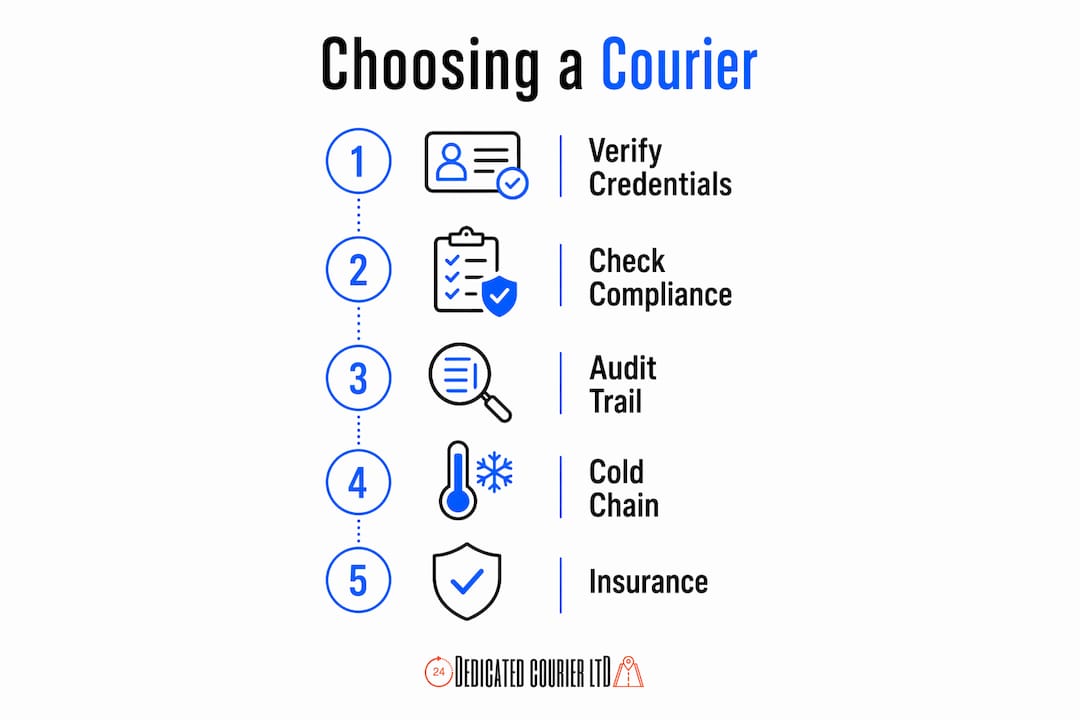
Evaluate any prospective courier against these criteria:
Regulatory credentials: Ask for evidence of MHRA-compliant handling procedures and GPhC-aligned training records
Temperature capability: Confirm whether the courier can maintain the required temperature range for your specific medication types, and ask to see data logger records from recent runs
Real-time tracking: A credible prescription delivery service provides live tracking and delivery confirmation, not just an estimated time window
Delivery speed options: Check availability of same-day, next-day, and scheduled slots, and whether out-of-hours or weekend cover is offered
Insurance and licences: Verify goods-in-transit insurance, hire-and-reward cover, and any sector-specific certifications before signing any agreement
Data protection: Confirm the courier’s UK GDPR compliance, particularly around how patient names and prescription details are handled and stored
Customer service: A direct contact number and clear escalation process matter when a delivery is delayed or a temperature excursion is flagged
Pro Tip: Ask any courier for a sample audit trail from a recent pharmaceutical delivery. A credible provider will produce one without hesitation. If they cannot, that tells you everything you need to know about their compliance culture.
Pharmacies should also check courier qualification standards including insurance documentation and training records before entering any formal arrangement. Partnering with a non-compliant courier exposes the pharmacy to regulatory sanction, not just operational inconvenience.
Why specialised logistics expertise matters for pharmaceutical couriers
Modern pharmaceutical products are increasingly complex. Cell and gene therapies, biologics, and radiopharmaceuticals require transport conditions that go well beyond a standard refrigerated van. Healthcare logistics experts point to the growing need for multimodal, temperature-controlled operations as product complexity increases across the sector.
What this means in practice:
Multimodal transport capability: Some pharmaceutical consignments require road, air, and sea legs within a single journey. Providers like PHSE operate across all three modes with certified handling at each transition point
Continuous temperature monitoring: Advanced data loggers record temperature at regular intervals throughout transit, producing a verifiable record for regulatory purposes
Specialist handling for high-value products: Biologics and cell therapies can be irreplaceable. A courier without documented protocols for these product types should not be handling them
Audit trails and visibility tools: Real-time monitoring gives pharmacies, hospitals, and patients a transparent view of where a consignment is and whether conditions remain within specification
Compliance with evolving regulations: UK and international pharmaceutical transport standards are updated regularly. A specialist courier tracks these changes and adjusts protocols accordingly
Pro Tip: For temperature-sensitive medications, always request a copy of the temperature log after delivery. This protects the pharmacy if a patient later questions medication efficacy, and it confirms the courier maintained the cold chain throughout.
Dedicatedsamedaycourier operates dedicated same-day courier services with 24/7 availability and dedicated vehicles, making it well-suited to urgent pharmaceutical runs where a shared vehicle or standard parcel network would introduce unacceptable risk.
Key takeaways
A compliant courier for prescription medication in the UK must demonstrate MHRA-aligned handling, cold-chain capability, real-time tracking, and full UK GDPR compliance before any pharmacy or patient should trust them with a prescription.
Point | Details |
Regulatory compliance is non-negotiable | Couriers must follow MHRA and GPhC standards, including controlled drug protocols and staff training records. |
Cold-chain integrity protects patients | Temperature data loggers and refrigerated vehicles are required for vaccines, biologics, and temperature-sensitive drugs. |
Real-time tracking builds accountability | Audit trails confirm every stage of transit and support compliance verification for pharmacies. |
Pharmacy operations improve with reliable couriers | Partnered delivery services reduce in-house workload and support NHS home delivery initiatives. |
Verify credentials before committing | Check insurance, training documentation, and data protection compliance before signing any courier agreement. |
Recommended


Comments