
Delivery options for retailers: a practical 2026 guide

TL;DR:
Choosing the right delivery options is crucial for reducing costs, satisfying customers, and boosting repeat business in retail.
Implementing store-based fulfillment, multi-carrier strategies, and rapid delivery can lower expenses and meet rising customer expectations for fast shipping.
Choosing the right delivery options for retailers is one of the most consequential decisions a retail business makes. Get it right and you reduce costs, satisfy customers, and win repeat orders. Get it wrong and you lose sales at checkout, generate complaints, and haemorrhage margin on unnecessary shipping spend. The challenge is that multiple delivery options with transparent checkout pricing now directly influence customer satisfaction, meaning there is no single correct answer. This guide cuts through the complexity and gives you a clear, practical framework for evaluating and choosing the right shipping methods for your retail operation.
Table of Contents
Key takeaways
Point | Details |
Match delivery to order type | Assess speed, weight, geography, and urgency before committing to any single carrier or method. |
Ship-from-store cuts costs | Retailers like Hackett London reduced transport costs by 40% by fulfilling orders directly from store locations. |
Technology integration matters | API-based delivery commitments are becoming critical as AI-driven shopping agents filter out retailers without live data. |
Multi-carrier strategy reduces risk | Using multiple carriers per order type gives you cost flexibility and protects against service disruptions. |
Same-day is growing fast | Amazon Prime members received over 13 billion same-day or next-day deliveries in 2025, raising the baseline expectation across all retail. |
1. Key criteria to evaluate delivery options for retailers
Before selecting any shipping method, you need a framework. Without one, you end up making decisions based on cost alone, which consistently leads to poor customer experience and operational problems further down the line.
The core criteria to assess are:
Delivery speed requirements. What does your customer base actually expect? Premium customers may expect next-day as standard. Budget shoppers often tolerate longer waits for free delivery.
Cost implications. Factor in not just carrier rates but dimensional weight pricing, fuel surcharges, and returns handling. Negotiated carrier rates through multi-carrier platforms can reduce shipping costs by 30 to 50%.
Geographic coverage. A carrier that performs well in London may be unreliable in rural Scotland. Test coverage before committing.
Order type suitability. Heavy palletised goods, fragile items, and small parcels all require different handling. Match the method to the merchandise.
Technology integration. Your carrier must connect with your order management system. Retailers without API-based delivery commitments risk being filtered out of AI-driven commerce platforms entirely.
Pro Tip: Run a 90-day pilot with any new carrier before fully committing. Track on-time performance, damage rates, and customer complaint volumes separately from your existing baseline.
2. Rapid and same-day delivery services for retailers
Same-day and rapid delivery has moved from a premium differentiator to a genuine competitive requirement in many retail categories. Amazon Prime’s 30% year-on-year growth in fast delivery volume in the US is a reliable signal of where customer expectations are heading in the UK too.
For retailers, same-day fulfilment typically involves:
Dedicated courier services that collect directly from store or warehouse
Local carrier networks covering specific urban or regional zones
On-demand booking platforms that match your parcel to available drivers in real time
The operational demands are real. On-demand delivery requires rapid picking processes and in-store technology that scheduled delivery simply does not. Retailers that try to bolt same-day onto an existing fulfilment workflow without adapting operations regularly run into picking bottlenecks and missed collection windows.
The benefits, however, are significant. Pets at Home handles some orders within 30 minutes and uses delivery orchestration to promise specific, achievable windows, which directly improved their conversion rates. For retailers with the right infrastructure, same-day is a genuine sales tool, not just a logistics function.
Pro Tip: Do not treat same-day as a universal offering. Restrict it to your highest-margin products or highest-value customer segments first, then expand once your operations are proven.
You can find a detailed breakdown of same-day delivery benefits for UK businesses if you are assessing whether rapid fulfilment is viable for your operation.
3. Standard and expedited parcel shipping methods
Standard parcel delivery remains the backbone of ecommerce shipping for most retailers. It covers the majority of orders and, when managed well, represents the best balance of cost and customer satisfaction.
More than 95% of shoppers prefer free standard delivery over paying extra for speed. That is a useful anchor when you are setting your delivery pricing strategy.
Method | Typical timeline | Best suited for | Relative cost |
Standard parcel | 2 to 5 days | Non-urgent, lower-value goods | Low |
Expedited parcel | Next day or 48-hour | Mid-value items, gifting | Medium |
Same-day courier | Same working day | Urgent, high-value, time-sensitive | High |
Tracked economy | 3 to 7 days | Lightweight, low-cost goods | Very low |
Key considerations for parcel shipping:
Dimensional weight pricing penalises bulky, lightweight parcels. Optimising your packaging directly reduces cost per shipment.
Multi-carrier shipping lets you select the cheapest or fastest carrier per order type, reducing both cost and the risk of service failure.
Negotiating volume discounts is worth doing even at modest order volumes. Platforms designed for ecommerce shipping choices often provide access to pre-negotiated rates that individual retailers cannot obtain directly.
4. Store-based and hybrid fulfilment strategies
Ship-from-store is one of the most underused retail delivery solutions available to multi-location retailers. Rather than routing all orders through a central warehouse, you fulfil directly from your nearest store to the customer.
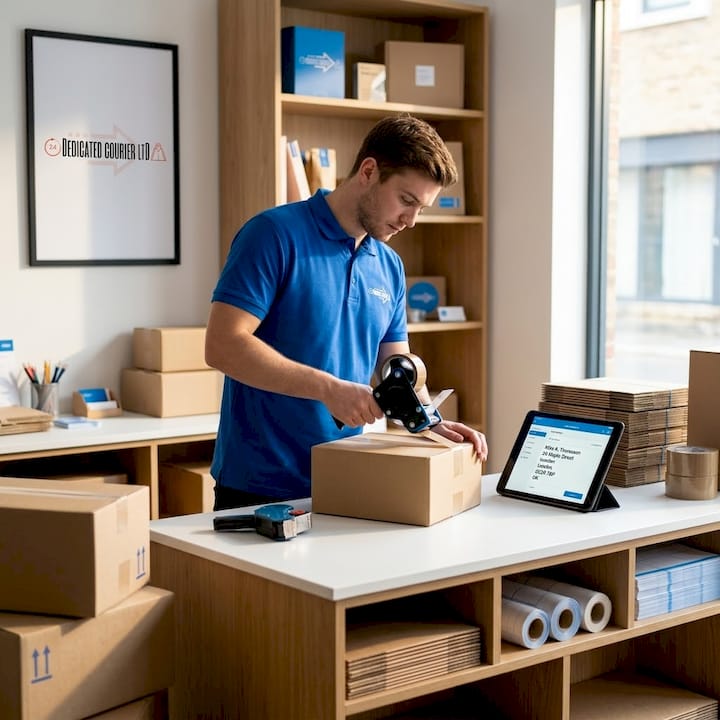
The cost and speed advantages are substantial. Hackett London cut transport costs by 40% by switching to store-based fulfilment. Similarly, splitting inventory across two or three locations can reduce logistics costs by 30 to 40% while cutting transit times, because goods travel shorter distances.
Hybrid models combine national parcel carriers for standard deliveries with local couriers or dedicated vehicles for urgent and same-day requirements. This gives you broad geographic reach without sacrificing speed on priority orders.
The comparison below shows how pure warehouse fulfilment compares with a store-based hybrid model:
Factor | Warehouse-only fulfilment | Hybrid store and warehouse |
Average transit distance | Longer, especially for regional orders | Shorter, using nearest store stock |
Same-day capability | Limited | High, where stores are located |
Transport cost | Higher for outlying regions | Lower due to reduced distance |
Inventory complexity | Centralised, simpler to manage | Distributed, requires real-time visibility |
Technology requirement | Standard WMS | Order orchestration and inventory sync |
The technology requirement is genuine. Without real-time inventory visibility and delivery orchestration, store-based fulfilment creates more problems than it solves. Staff training and workflow changes are also necessary; store staff picking and packing alongside serving customers need clear processes to avoid errors.
5. Comparing delivery options: which to choose for your retail business?
Your decision should be driven by three variables: order volume, customer expectations, and margin per product category.
Small retailers with low order volumes and local customer bases are often best served by a single reliable carrier for standard delivery, supplemented by a dedicated same-day courier for urgent orders. There is no operational justification for a complex multi-carrier setup at low volumes.
Medium retailers shipping across the UK should seriously consider a multi-carrier platform. High-volume retailers using multi-carrier strategies consistently report better cost control and reduced dependency on any single provider. It also gives you negotiating leverage.
Large retailers with multiple locations should be actively evaluating ship-from-store as part of a hybrid model. The cost savings alone justify the technology investment in most cases.
Pro Tip: Do not negotiate carrier rates in isolation. Use your total annual shipping spend as leverage, including returns volumes. Carriers will offer better terms when they see the complete picture of your business.
To assess how courier services for local retailers compare in 2026, there is a useful breakdown covering the top options for UK retail operations.
My take on retail delivery: what actually works
I’ve spent a good deal of time working alongside retailers trying to improve their logistics, and the pattern I keep seeing is this: businesses invest heavily in the delivery method itself but underinvest in the operational changes needed to support it.
Adding same-day delivery to your checkout without adapting your picking workflow is like buying a racing tyre and fitting it to the wrong vehicle. The delivery option looks right on paper, but it fails in practice. On-demand and scheduled deliveries need to be treated as fundamentally different operations, not variations of the same process.
The technology piece is also more urgent than most retailers realise. Retailers without API-first delivery data will start to disappear from AI-driven shopping platforms, not through any single event, but gradually, as those platforms improve at filtering by delivery reliability and commitment. Getting your delivery infrastructure connected and data-ready is not a future project. It is a current one.
The retailers I’ve seen manage delivery best are the ones who treat it as a customer experience function, not just a logistics cost. They measure delivery performance the same way they measure product returns or customer complaints, and they act on the data.
— andrew
How Dedicatedsamedaycourier can support your retail delivery
When your retail operation needs urgent or same-day delivery capacity without the overhead of managing a dedicated fleet, Dedicatedsamedaycourier provides a direct solution. The service operates 24/7 across the UK with dedicated vehicles, meaning your goods travel on exclusive transport with no consolidation delays or shared vehicle risk.
[
Whether you need a small van for urgent parcels or a larger vehicle for palletised stock, Dedicatedsamedaycourier can match the vehicle to your load. For retailers looking to complement their standard carrier setup with reliable on-demand capacity, the same-day courier service is available nationwide and can be booked by phone, email, or online quote request. It is a practical addition to any retail logistics setup where speed and reliability matter.
FAQ
What delivery options work best for small retailers?
A single reliable standard parcel carrier combined with a dedicated same-day courier for urgent orders covers most small retailer needs without adding operational complexity.
How does ship-from-store reduce costs?
By fulfilling orders from the nearest store location rather than a central warehouse, retailers reduce transit distances and transport costs. Hackett London achieved a 40% reduction in transport costs using this approach.
What is a multi-carrier delivery strategy?
A multi-carrier strategy involves using more than one carrier and selecting the best option per order based on cost, speed, or coverage. It reduces reliance on a single provider and improves cost control across a retail logistics operation.
Do customers prefer fast or free delivery?
Research shows that over 95% of shoppers prefer free standard delivery over paying for faster shipping, though demand for same-day options is growing steadily.
Why does API integration matter for retail delivery?
AI-driven shopping platforms increasingly filter retailers by delivery reliability and data availability. Retailers without machine-readable delivery data risk being excluded from these platforms entirely as agentic commerce grows.
Recommended


header.all-comments