
Parcel shipping process: a step-by-step guide

TL;DR:
Proper parcel preparation and timing significantly influence shipping reliability, especially for time-sensitive deliveries. Monitoring tracking events actively and choosing dedicated couriers for urgent shipments help prevent delays caused by internal handling mistakes or shared network issues. Consistent operational discipline, including accurate labeling, address verification, and prompt handovers, ensures on-time delivery and minimizes customer dissatisfaction.
Getting a parcel from A to B sounds straightforward until a delay, a missed scan, or a misrouted package throws your timeline off. For small businesses and individuals managing time-sensitive deliveries, understanding the parcel shipping process at each stage makes the difference between a reliable operation and a stressful one. This guide covers everything from pre-shipment preparation through to proof of delivery, with practical steps to avoid the most common pitfalls.
Table of Contents
Key takeaways
Point | Details |
Prepare before you book | Verify addresses, weigh accurately, and select packaging before generating a label. |
The origin scan activates tracking | Your parcel only enters the carrier’s system after the first physical scan at collection or depot. |
Pre-shipment delays are often internal | Fulfilment bottlenecks inside your own operation cause most “pre-shipment” holds, not the carrier. |
Monitor tracking status actively | Interpret scan events correctly and act quickly when an exception appears. |
Dedicated couriers suit urgent shipments | For time-sensitive goods, a dedicated service eliminates shared-network delays entirely. |
Preparing for the parcel shipping process
Before a parcel moves anywhere, the preparation stage determines whether the rest of the process runs smoothly or falls apart. Cutting corners here creates problems that no carrier can fix once a parcel is in transit.
Packaging and labelling
Packaging choice affects both protection and cost. Carriers calculate charges based on dimensional weight pricing, which means a light but bulky box can cost more to ship than a heavier compact one. The formula is straightforward: length x width x height, converted into a billable weight. Reducing unnecessary void space inside a box can genuinely reduce your shipping bill.
Labels must be legible, securely attached, and free from obstructions. A folded or smudged label causes scanning failures, which can misdirect your parcel entirely.
Packaging material | Suitable for | Not suitable for |
Double-walled cardboard | Heavy or fragile goods | Very lightweight items (adds unnecessary volume) |
Padded envelopes | Documents, small soft goods | Rigid or breakable items |
Polythene mailing bags | Clothing, soft goods | Anything that requires rigid protection |
Wooden crates | Industrial parts, high-value items | Standard ecommerce parcels |
Address verification and carrier restrictions
Always verify the recipient’s address before generating a label. A single incorrect digit in a postcode sends a parcel to the wrong delivery depot. Check carrier restrictions too. Some services will not accept certain item types, oversized parcels, or shipments to remote postcodes without a surcharge.
Pro Tip: Weigh and measure every parcel individually, even if it appears identical to one you’ve shipped before. Small differences in dimensions affect both cost and carrier eligibility.
Selecting the right service level matters just as much as the packaging. Parcel shipping urgency should dictate your speed choice: next-day, same-day, or economy, based on what the recipient actually needs and what the cost allows.
Step-by-step execution of shipping package steps
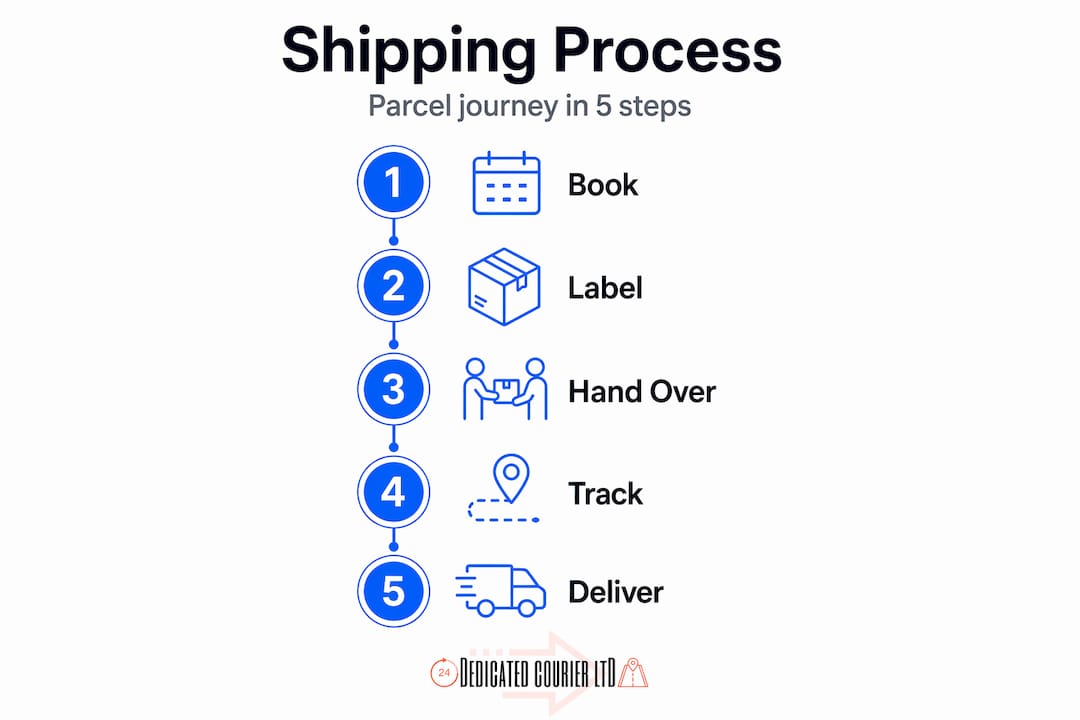
The parcel shipping process follows a clear sequence: booking, handover, first scan, sorting, linehaul, final depot staging, last-mile delivery, and proof of delivery. Understanding what happens at each stage helps you spot where problems can occur.
Book the shipment and generate a label. This creates a tracking number, but tracking only activates after a physical scan. A label in your hands is not confirmation the carrier has the parcel.
Hand over the parcel. You can drop it at a carrier access point or arrange a courier collection. For urgent shipments, a direct pickup reduces handling time considerably.
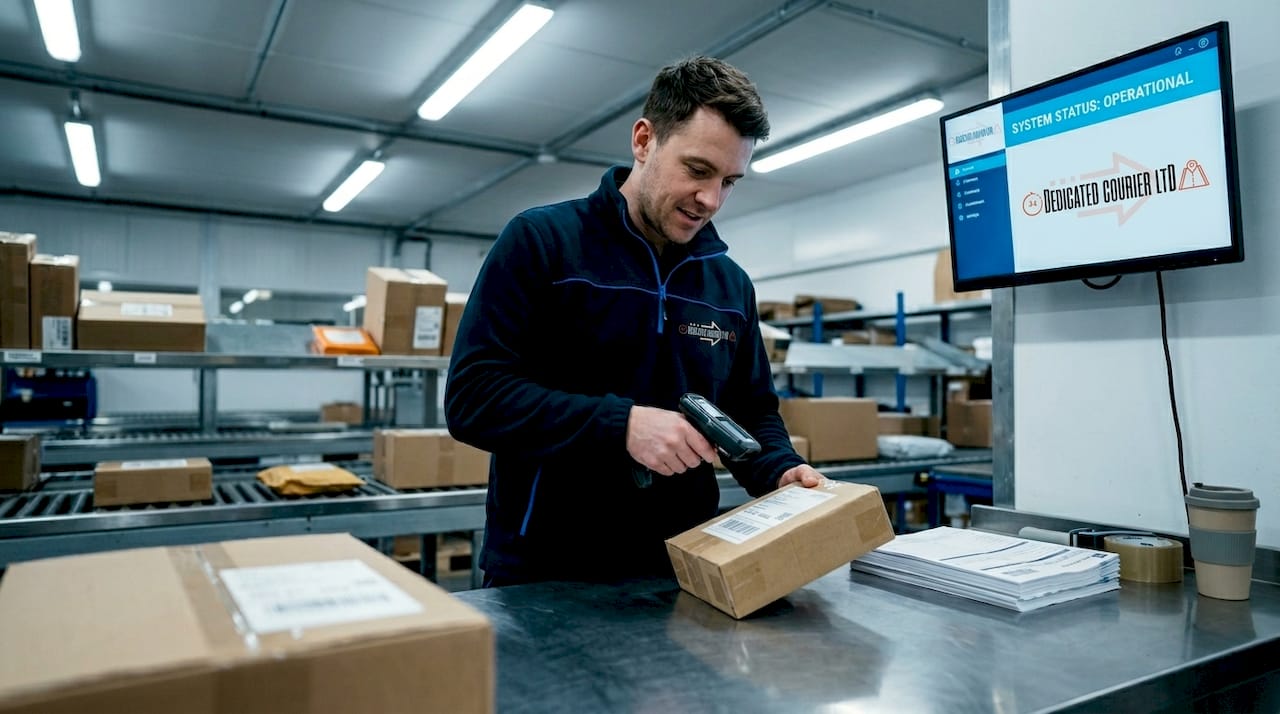
Origin scan. This is the first physical scan confirming the parcel has entered the carrier’s network. It records sender and recipient addresses, dimensions, and the selected service level. Until this scan occurs, tracking will show “pre-shipment.”
Sorting and routing. At the origin depot, automated or manual sorting directs the parcel toward the correct linehaul route based on the destination postcode.
Linehaul transport. The parcel travels between carrier hubs, typically overnight for next-day services. This is where long-distance ground or air legs happen.
Destination depot staging. On arrival at the local delivery depot, the parcel is sorted into a delivery route. This is where last-mile logistics are planned, grouping parcels geographically for driver efficiency.
Out for delivery. The driver loads the parcel and begins the route. Tracking updates to “out for delivery” at this point.
Proof of delivery. Delivery is confirmed by signature, photo, or GPS scan depending on the service and recipient preferences.
Pro Tip: If your tracking still shows “pre-shipment” more than 24 hours after handing over a parcel, contact the carrier immediately. No origin scan within that window likely means the parcel was not properly collected or processed.
The status “pre-shipment” often causes unnecessary anxiety. It simply means a label was created but the carrier has not physically scanned the item yet. The clock on estimated delivery does not start until that first scan.
Common causes of delays and how to avoid them
Many delays in the shipping process for packages have nothing to do with the carrier. Pre-shipment delays frequently originate inside the sender’s own operation, such as orders sitting in review queues, manual authorisation steps, or late label generation.
The practical fix is to align label creation with the actual handover time. Generating a label the day before without handing the parcel over creates a false tracking gap. Customers see “pre-shipment” and assume something is wrong. Automating label creation and syncing it with the physical pickup removes that ambiguity.
For marketplace sellers, the stakes are even higher. Platforms such as Walmart require valid tracking for over 99% of domestic orders to maintain seller performance standards. Uploading late or inaccurate tracking data risks penalties regardless of whether the carrier performed well.
Checklist before handing over any parcel:
Recipient address verified against a reliable source
Parcel weighed and measured accurately
Correct service level selected for the delivery deadline
Label printed clearly and attached flat with no folds over barcodes
Tracking number recorded and linked to the order or recipient record
Carrier collection confirmed or drop-off location identified
Pro Tip: For urgent shipments, do not rely on public drop-off points if your cut-off time is tight. A direct courier collection gives you a confirmed pickup time and removes the queue risk at a parcel shop.
For more targeted advice, the parcel delivery tips for 2026 resource from Dedicatedsamedaycourier covers specific strategies for urgent UK shipments in the current operating environment.
Verifying shipment success and handling exceptions
Once a parcel is in transit, active monitoring is the most useful thing you can do. Understanding what each tracking update actually means allows you to respond quickly rather than wait and hope.
Tracking status | What it means | Recommended action |
Pre-shipment | Label created, not yet scanned | Confirm handover took place; chase carrier if over 24 hours |
In transit | Moving through the carrier network | No action needed unless delayed against ETA |
Out for delivery | Loaded on delivery vehicle | Notify recipient; confirm access or safe place preferences |
Delivery attempted | Driver visited but no one was in | Arrange redelivery or redirect to a pickup point |
Delivered | Parcel handed over | Obtain proof of delivery confirmation |
Exception | Damage, address issue, or hold | Contact carrier immediately with shipment reference |
If no origin scan occurs within 24 hours of a domestic collection, treat it as a lost or uncollected parcel and contact the carrier with your booking reference. Waiting longer only reduces the chance of recovery.
For failed delivery attempts, check whether the carrier has left a calling card or updated the tracking portal with redelivery options. Missing that window can result in the parcel being returned to sender, adding cost and delay. Proof of delivery, whether by signature, photograph, or GPS-tagged scan, provides the final confirmation that closes the transaction.
My view on getting this right
I’ve spent time working through real courier workflows, and what I consistently find is that small businesses underestimate how much of the parcel shipping process is within their own control. Most operators focus on the carrier’s performance, but in my experience, the majority of failures start before the parcel even leaves the building.
The businesses that ship reliably are the ones that treat preparation as non-negotiable. They weigh accurately, they verify addresses, and they time label creation to match the actual collection. They also monitor tracking from the moment a parcel is handed over, not just when a customer complains.
When urgency is the priority, I think a dedicated courier service is the honest answer. Shared carrier networks involve multiple handling points, automated sorting, and consolidated routes. That works well for standard timescales. But when a parcel cannot afford to wait in a queue at a hub, a dedicated delivery workflow that puts your parcel on an exclusive vehicle is a different class of reliability.
The operational discipline required to ship parcels consistently on time is not complicated. It just requires following the steps correctly, every time.
— andrew
Need a faster, more reliable parcel service?
For time-sensitive deliveries where a standard carrier network carries too much risk, Dedicatedsamedaycourier provides a direct alternative. Every shipment travels on an exclusive vehicle, which means no shared sorting hubs, no waiting in queues, and no handling by multiple operators.
[
Dedicatedsamedaycourier operates 24 hours a day, seven days a week, with nationwide coverage across the UK. Whether you need a small van for a single urgent parcel or a larger vehicle for bulk goods, the right courier vehicle is matched to your consignment. For businesses and individuals who need a confirmed delivery time rather than an estimated one, the sameday courier service from Dedicatedsamedaycourier is built specifically for that requirement. Request a quote by phone, email, or online form.
FAQ
What is the parcel shipping process from start to finish?
The parcel shipping process covers booking, label generation, carrier handover, origin scan, sorting, linehaul transport, local depot staging, last-mile delivery, and proof of delivery. Each stage must complete correctly for on-time arrival.
Why does my tracking still say “pre-shipment”?
Pre-shipment status means a label has been created but the carrier has not physically scanned the parcel yet. Tracking only advances after the first origin scan at collection or at the depot.
How is parcel shipping cost calculated?
Carriers charge based on actual weight or dimensional weight, whichever is higher. Dimensional weight is calculated by multiplying the parcel’s length, width, and height, then dividing by a standard divisor set by the carrier.
What should I do if my parcel shows no tracking update after 24 hours?
If no origin scan appears within 24 hours of a domestic collection, contact the carrier with your booking reference. The parcel may not have been collected or scanned correctly.
When is a dedicated courier better than a standard parcel carrier?
A dedicated courier is the better choice when delivery timing is fixed and cannot accommodate delays from shared network sorting, multiple handling points, or consolidated routes. It suits urgent business deliveries, legal documents, and high-value goods.
Recommended


Comments