
How tracking transforms delivery outcomes in the UK
- Andrew Buttrick
- 11 minutes ago
- 13 min read
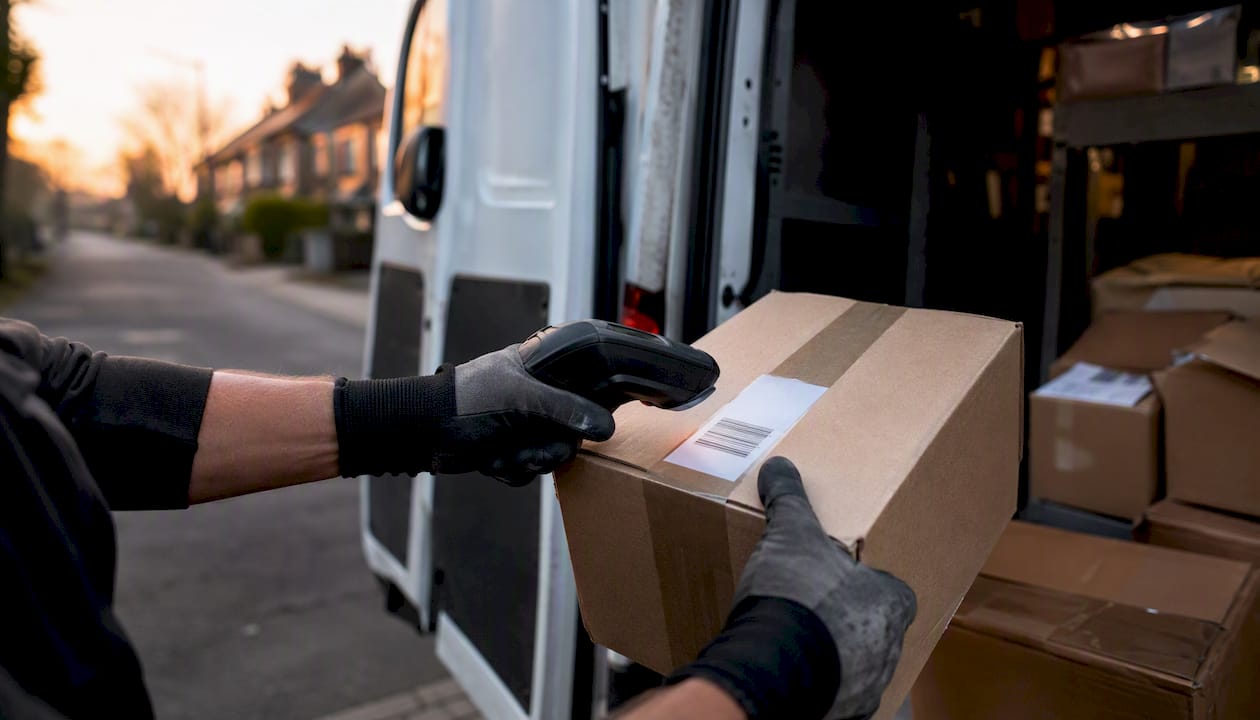
Modern tracking converts uncertain shipments into predictable, recoverable events. That is the core role of tracking in delivery, and it has three measurable consequences: fewer WISMO (“where is my order?”) enquiries reaching your support team, higher first-attempt delivery and on-time rates, and faster exception recovery that reduces cost per delivery. Platforms such as Shopify, ShipStation, and Dedicatedsamedaycourier all depend on this principle, whether for e-commerce parcel flows or urgent same-day consignments.
Reduced WISMO contacts: proactive status updates mean customers self-serve rather than call.
Improved first-attempt and on-time rates: accurate ETAs allow recipients to be available, reducing failed deliveries.
Faster exception recovery: visibility flags delays early, giving operations teams time to act before a customer notices.
Key takeaways
Tracking in delivery converts uncertainty into predictable, recoverable outcomes — and the operations that measure visibility as a capability, not just a feature, consistently outperform those that treat it as a passive dashboard.
Point | Details |
Tracking vs visibility | Tracking reports location; visibility predicts outcomes and connects to recovery actions. |
KPIs that matter | Measure ETA accuracy, first-attempt success, WISMO contact rate, and data latency alongside on-time delivery. |
Implementation approach | Pilot on mixed volume and geography for 2–4 weeks; measure KPI lift before full rollout. |
Regulatory compliance | UK GDPR requires a lawful basis for location data; Consumer Rights Act 2015 sets delivery timeframe obligations. |
Dedicatedsamedaycourier | Provides tracked same-day, next-day, and overnight services with continuous GPS records and proof-of-delivery for urgent UK consignments. |
Tracking is operational insurance
Tracking is operational insurance. It lets you plan, protect, and prove delivery outcomes — and when something goes wrong, it gives you the data to recover quickly and the evidence to resolve disputes without ambiguity.
The practical commitment that follows from that is straightforward: measure your visibility KPIs, not just your delivery outcomes. If your WISMO contact rate is not falling as you add tracking capability, the problem is usually notification timing or content, not the tracking system itself. Evolve your notification policy based on what customers actually respond to, and resist the temptation to add more messages when fewer, better-timed ones would serve them better.
Table of Contents
How UK businesses implement tracking: options and integrations
Best practices for getting value from tracking in UK operations
Tracking in same-day courier operations: a practical perspective
How tracking affects customer satisfaction and retention in the UK
Cost-benefit analysis of tracking technology in UK delivery operations
UK regulatory considerations for delivery tracking and data handling
How does delivery tracking actually work?
Tracking collects location and event data at each stage of a shipment’s journey. Visibility turns that raw data into predictions and, critically, into actions.
The data comes from several sources working together. Barcode and milestone scans record when a parcel is collected, sorted, or delivered. Carrier APIs push those scan events into a central platform in near real time. GPS and telematics devices fitted to vehicles provide continuous location signals between scan points. RFID tags and IoT sensors add granular data for high-value or temperature-sensitive goods, recording not just location but condition.
The event flow runs like this: an order is created → a collection scan triggers the first event → GPS updates track the vehicle in transit → carrier API pushes each scan to a visibility platform → the platform generates customer notifications and flags exceptions to the operations team → dispatchers act on those flags before they become customer-visible problems.
Key terms worth knowing:
Term | Definition |
ETA accuracy | How closely the predicted arrival time matches the actual delivery time |
Exception | Any event that deviates from the planned route or schedule |
Dwell time | The time a parcel spends stationary at a checkpoint or depot |
WISMO | “Where is my order?” — the most common post-purchase support query |
Shipment visibility goes beyond milestone tracking by providing near real-time signals — such as a parcel sitting too long at a checkpoint — so teams can act before exceptions become customer-visible. Visibility only delivers value when it leads to action.
Pro Tip: Connect your visibility platform directly to your dispatch workflow. A dashboard that no one acts on is just a screen; the value is in the recovery action it triggers.
What does tracking do for your customers?
Tracking reduces recipient anxiety and turns delivery into an anticipated event rather than an uncertain wait. That shift in experience has a direct effect on repurchase behaviour.

Practical benefits for customers include accurate ETAs that narrow progressively as a driver approaches, proactive notifications that remove the need to check manually, and clear proof-of-delivery records that resolve disputes quickly. Fewer missed deliveries follow naturally when recipients know a precise window and can plan around it. A large majority of consumers are likelier to buy again from retailers that provide real-time tracking, which makes tracking a retention tool as much as an operational one.
Customers now prefer self-serve tracking over calling support. Survey data shows that shoppers trust tracking data more than customer service agents, and accessible tracking often becomes a deciding factor when choosing between retailers. That preference changes support staffing priorities: fewer agents handling WISMO calls, more capacity for complex queries.
Notification channels customers expect:
Email: order confirmation, dispatch, out-for-delivery, and delivered confirmations.
SMS: time-sensitive alerts, particularly the out-for-delivery trigger.
In-app notifications: used by platforms with a native app (Shopify’s Shop app, for example).
Web tracking pages: branded pages where customers enter a reference number for live status.
“Accessible tracking often becomes a reason to choose one retailer over another and reduces calls to support.” — Why Customers Trust Package Tracking More Than Customer Support
How tracking cuts costs and improves operational efficiency
Tracking reduces cost per delivery and increases execution reliability when it is connected to decision processes, not just reporting screens.
The mechanics are straightforward. Route optimisation tools use live GPS data to adjust driver paths in response to traffic or access issues, reducing mileage and fuel consumption. Logistics tracking helps firms optimise routes, reduce transportation costs and gain transparency across the supply chain. A single failed first-attempt delivery carries a direct cost in handling, reattempt logistics, and potential customer compensation; visibility-driven recovery reduces these events when integrated into dispatch. Exception handling becomes proactive rather than reactive, cutting the time between a delay occurring and a resolution being dispatched.
Operational benefits tracking delivers:
Fewer failed first attempts, each of which saves reattempt handling cost.
Route adjustments mid-journey that reduce mileage on multi-drop runs.
Carrier performance data that supports contract reviews and carrier selection.
Faster claims resolution backed by timestamped, geolocated proof-of-delivery records.
Automated customer notifications that reduce support ticket volume, freeing staff for higher-value work.
Pro Tip: Attach visibility data to your dispatch workflow rather than a standalone dashboard. When a driver is running 20 minutes late, the system should prompt a re-route or customer notification automatically, not wait for a manager to notice.
Why the difference between tracking and visibility matters
Tracking reports where a parcel is or was. Visibility predicts what will happen next and connects to recovery options. That distinction determines whether your operation is reactive or proactive.
A basic track-and-trace system tells you a parcel missed a scan at 14:00. A visibility platform tells you at 13:30 that the parcel has been stationary for 90 minutes at a depot, flags it as at risk of missing the delivery window, and prompts a dispatcher to investigate. Mature logistics teams measure visibility as a capability in its own right, tracking KPIs like ETA accuracy and exception rate rather than just on-time delivery.
Dimension | Basic track-and-trace | Full visibility platform |
Data latency | Minutes to hours (scan-driven) | Near real time (GPS + API) |
Predictive ETAs | No | Yes |
Risk flags | No | Yes (dwell time, delay signals) |
Action layer | Passive dashboard | Connected to dispatch/re-route |
Exception handling | Reactive (after the fact) | Proactive (before customer impact) |
The practical difference: a late-scan notification tells you something went wrong. A visibility-driven early recovery action stops it going wrong in the first place.
How UK businesses implement tracking: options and integrations
Choose the implementation style that matches your scale and internal capability. A small e-commerce business needs a different approach from a national logistics operation.
Implementation options range from light-touch to full platform:
Carrier API aggregator: connects multiple carrier APIs into one data feed; low cost, moderate setup.
TMS/OMS native tracking: tracking built into your transport or order management system.
Parcel-tracking SaaS: standalone platforms that ingest carrier data and manage customer communications.
Embedded carrier integrations: Shopify’s Shop app, for example, pulls carrier tracking data directly into the post-purchase experience without custom development. ShipStation sits in the stack as an order management and fulfilment layer, connecting multiple carriers and pushing tracking data to storefronts and notification tools.
Telematics vendor: GPS hardware and software for own-fleet operations, providing continuous vehicle location data.
Integration checklist:
Confirm carrier APIs are available and document their data latency SLAs.
Define notification channels (email, SMS, web page) and set trigger events.
Establish proof-of-delivery capture requirements (photo, signature, geolocation).
Map returns handling flows and ensure tracking covers the return journey.
Obtain and store API credentials securely; complete sandbox testing before go-live.
Set data retention policies in line with UK GDPR requirements.
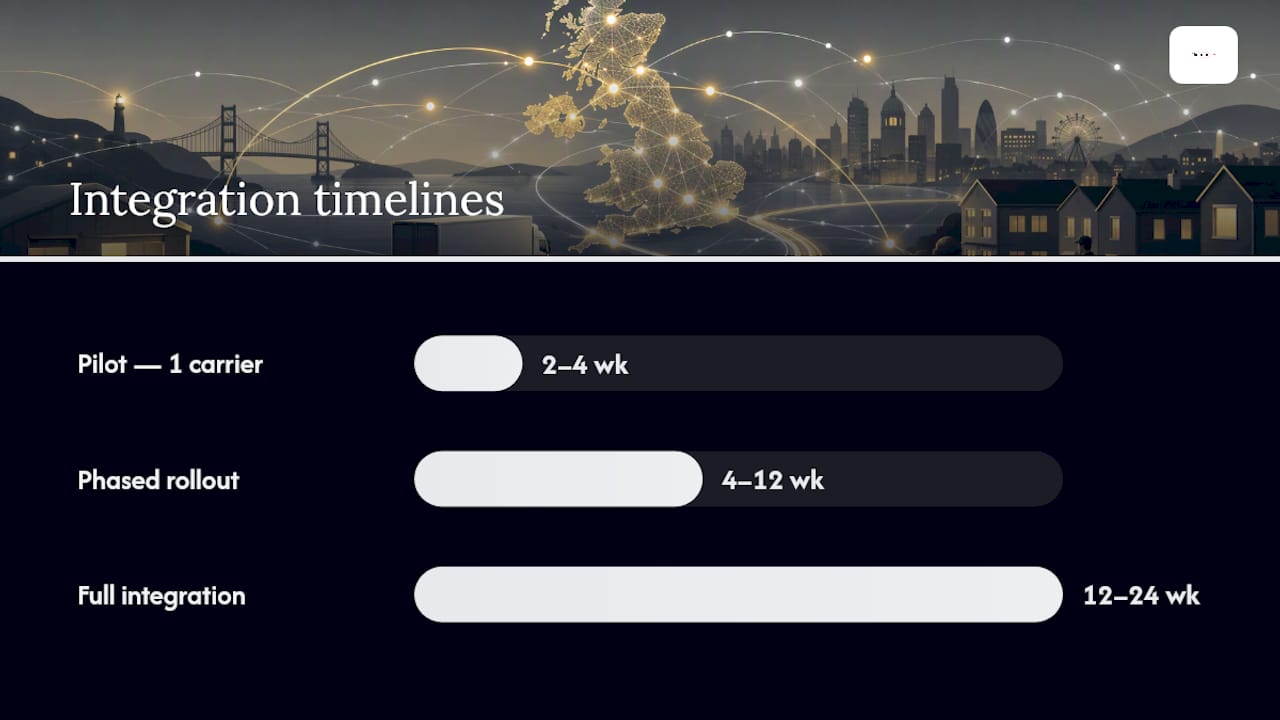
Typical timelines: a pilot with one carrier and one notification channel takes 2–4 weeks. A phased rollout across multiple carriers and channels runs 4–12 weeks. Full integration including TMS/OMS connections and returns tracking typically takes 3–6 months depending on scope and internal resource.
Pro Tip: Run your pilot on a mixed sample of shipment volumes and geographies. A pilot that only covers your easiest routes will not reveal the last-mile gaps that matter most.
Which KPIs should you track to measure visibility success?
Measure visibility capability as well as delivery outcomes. Both matter, and conflating them obscures where problems actually sit.
KPI | What it measures | Owner | Target direction |
ETA accuracy | Predicted vs actual delivery time | Operations | Minimise variance |
Exception rate | % of shipments with a deviation event | Operations | Reduce over time |
On-time delivery | % delivered within the agreed window | Operations | Maximise |
First-attempt success | % delivered on the first attempt | Operations | Maximise |
Dwell time | Time stationary at a checkpoint | Operations | Minimise outliers |
Data latency | Delay between event and platform update | Technology | Minimise |
WISMO contact rate | Support contacts | Customer service | Reduce over time |
Connecting KPI changes to business outcomes is the next step. A reduction in WISMO contact rate translates directly to support cost savings. Improved first-attempt success reduces reattempt costs and lifts NPS. Higher ETA accuracy correlates with repeat purchase rates, particularly in UK retail where reliable delivery is a key driver of customer trust.
Common challenges and UK regulatory considerations
Tracking delivers value but has limits. Last-mile visibility gaps, data latency, integration cost, and privacy obligations are all real constraints.
Common operational challenges:
Incomplete carrier data: not all carriers provide API-level tracking; some still rely on manual scans with significant latency.
Multi-carrier stitching: combining event data from several carriers into a coherent timeline requires normalisation of inconsistent event naming conventions.
Returns handling: return journeys are often less well tracked than outbound shipments, creating blind spots.
Carbon and emissions trade-offs: more frequent GPS polling and additional vehicle stops for narrow delivery windows can increase fuel consumption.
Over-notification fatigue: sending too many status updates reduces open rates and can irritate customers.
On the regulatory side, UK GDPR requires a lawful basis for processing location and contact data. For delivery tracking, legitimate interests or contract performance are the most common bases. Location data must be retained only as long as necessary, and marketing notifications (as distinct from transactional updates) require explicit consent. The Information Commissioner’s Office provides current guidance on lawful basis and retention periods.
Risk flags to monitor: high data latency (events arriving more than 30 minutes after they occur), inconsistent event naming across carriers, and WISMO contact rates that rise despite adding notifications (a sign that notification timing or content is misaligned with customer expectations).
Best practices for getting value from tracking in UK operations
Focus on accuracy, actionability, and communication cadence rather than feature quantity. More notifications are not better; the right notifications at the right time are.
Audit event completeness first. Map every scan point in your carrier’s network and identify where gaps occur. A missing scan at a depot is a data quality problem, not a tracking problem.
Set a data latency SLA. Agree with your carrier or platform provider that events will appear in your system within a defined window (15 minutes is a reasonable target for GPS-enabled operations).
Integrate visibility into dispatch, not just reporting. Connect exception flags to dispatcher alerts so recovery actions happen before customers notice.
Segment your notifications. B2B recipients often want fewer, more precise updates. Consumer recipients typically want more frequent reassurance. Treat them differently.
Test proof-of-delivery capture end to end. Confirm that photo, signature, or geolocation data is captured, stored, and retrievable before you need it for a dispute.
Include returns in your tracking scope. A return journey with no tracking creates the same anxiety as an outbound shipment with no tracking.
Pro Tip: Use the “out for delivery” trigger to send a final, narrow ETA. This single notification reduces missed deliveries more than any other message in the sequence, because it prompts recipients to be available.
For tracking urgent deliveries, the same principles apply with tighter tolerances: data latency SLAs should be under five minutes, and exception recovery workflows need to be scripted in advance rather than improvised.
Tracking in same-day courier operations: a practical perspective
In same-day courier operations, tracking is not a nice-to-have. It is the operational backbone that coordinates rapid pickup, route assignment, and proof-of-delivery for time-critical consignments.
Dedicatedsamedaycourier uses real-time driver telematics to provide customers with minute-level ETAs from the point of collection. Direct point-to-point transport means there are no depot handoffs to create scan gaps, so the tracking record is continuous. For sensitive consignments including medical, legal, and engineering items, timestamped proof-of-delivery with geolocation creates a non-repudiable audit trail that reduces dispute resolution time.
Practical recommendations for same-day and urgent operations:
Prioritise real-time driver telematics over scan-based tracking; GPS provides continuous data rather than event-only snapshots.
Use branded tracking pages so customers can check status without calling the operations team.
Script recovery workflows in advance for high-value consignments: if a driver is delayed, the next action should be defined before the delay occurs.
Capture proof-of-delivery at the point of handover, not retrospectively.
In same-day courier work, the tracking record is also the service record. Every timestamp and location point is evidence of what happened, when, and where — which matters as much to the client as to the courier.
For guidance on securing sensitive shipments, proof-of-delivery handling is covered in detail alongside chain-of-custody requirements.
How tracking affects customer satisfaction and retention in the UK
The impact of tracking systems on customer satisfaction scores and retention rates in the UK parcel market is well documented. UK consumers have high delivery expectations: next-day and same-day services are now standard reference points, and any deviation without communication damages trust disproportionately.
Tracking directly supports Net Promoter Score (NPS) and Customer Satisfaction (CSAT) outcomes by removing the uncertainty that generates negative reviews. A delivery that arrives slightly late but with proactive communication consistently scores better in post-delivery surveys than one that arrives on time with no communication at all. The mechanism is straightforward: informed customers feel in control; uninformed customers feel let down.
Retention rates respond to tracking quality because repeat purchase decisions are made in the post-purchase window. A customer who received clear, accurate updates is already in a positive frame of mind when the next purchase opportunity arises. Well-designed tracking pages and proactive notifications reduce repeat status checks and shift customer service work to higher-value enquiries, which compounds the retention benefit by freeing support staff to handle the queries that actually require human judgement.
For UK retailers, the Consumer Rights Act 2015 sets a baseline: goods must be delivered within the agreed timeframe, and failure to do so gives consumers the right to cancel. Tracking data provides the evidence base for both compliance and dispute resolution.
Cost-benefit analysis of tracking technology in UK delivery operations
Implementing tracking technology carries upfront and ongoing costs, but the return is measurable across several cost lines.
Upfront costs typically include API integration development or SaaS platform setup fees, telematics hardware for own-fleet operations, and staff training. Ongoing costs cover platform subscription fees, SMS notification costs (charged per message by most providers), and data storage. For a small UK courier or retailer using a SaaS tracking platform, monthly costs are modest. For a national logistics operation building a custom visibility layer, the investment is substantially higher.
The return side of the equation covers several areas. Reduced WISMO contact volume lowers support staffing costs. Improved first-attempt success rates reduce reattempt costs, which in UK parcel operations typically include driver time, fuel, and depot handling. Faster exception recovery reduces the cost of compensation and replacement shipments. Carrier performance data enables more informed contract negotiations, which can reduce per-shipment rates over time.
The break-even point depends on shipment volume and current failure rates. An operation handling high volumes with a first-attempt failure rate above the industry average will recover implementation costs quickly. A lower-volume operation with already-strong delivery performance will see a longer payback period, though the customer retention benefit remains regardless of volume.
For delivery optimisation, the cost-benefit calculation should include the indirect value of improved NPS and repeat purchase rates alongside the direct operational savings.
UK regulatory considerations for delivery tracking and data handling
UK GDPR and the Consumer Rights Act 2015 are the two primary regulatory frameworks affecting delivery tracking in the UK.
Under UK GDPR, any processing of personal data in connection with tracking requires a lawful basis. For transactional tracking notifications (dispatch confirmation, out-for-delivery alerts, delivered confirmation), contract performance or legitimate interests are the standard bases. For marketing messages appended to tracking communications, explicit consent is required and must be separately obtained. Location data is personal data under UK GDPR when it can identify an individual; retention periods must be proportionate to the purpose, and data subjects have the right to access and erasure.
The Consumer Rights Act 2015 requires that goods are delivered within the agreed timeframe. If no specific date was agreed, delivery must occur within 30 days. Tracking records provide the evidence base for compliance: timestamped delivery confirmation is the most reliable proof that a delivery obligation was met.
Practical compliance steps:
Document the lawful basis for each category of tracking data processed.
Set and enforce data retention periods; do not retain location data indefinitely.
Separate transactional notifications from marketing messages in your consent records.
Ensure your privacy notice covers delivery tracking data and is accessible at the point of booking.
The Information Commissioner’s Office publishes current guidance on legitimate interests assessments and data minimisation, both of which apply directly to delivery tracking operations.
Tracked urgent deliveries with Dedicatedsamedaycourier
When a shipment cannot wait and the tracking record matters as much as the delivery itself, Dedicatedsamedaycourier provides a direct answer. Every job is a dedicated, point-to-point service with no co-loading, which means the tracking record is continuous from collection to proof-of-delivery with no depot handoff gaps.
[
The service operates 24/7 across the UK, with collections typically available within 60–90 minutes of booking. Real-time driver telematics provide minute-level ETAs throughout the journey. Proof-of-delivery is captured at handover, with timestamped and geolocated records available for sensitive, high-value, and time-critical consignments including medical, legal, and engineering items.
For businesses that need a tracked same-day courier service with account support and bespoke pricing, Dedicatedsamedaycourier offers flexible vehicle options and a nationwide courier network. Get a quote via the delivery company page or call directly for urgent bookings.
Sources
Recommended


Comments