
Fragile items packaging: a practical guide for UK shippers
Updated: Aug 30
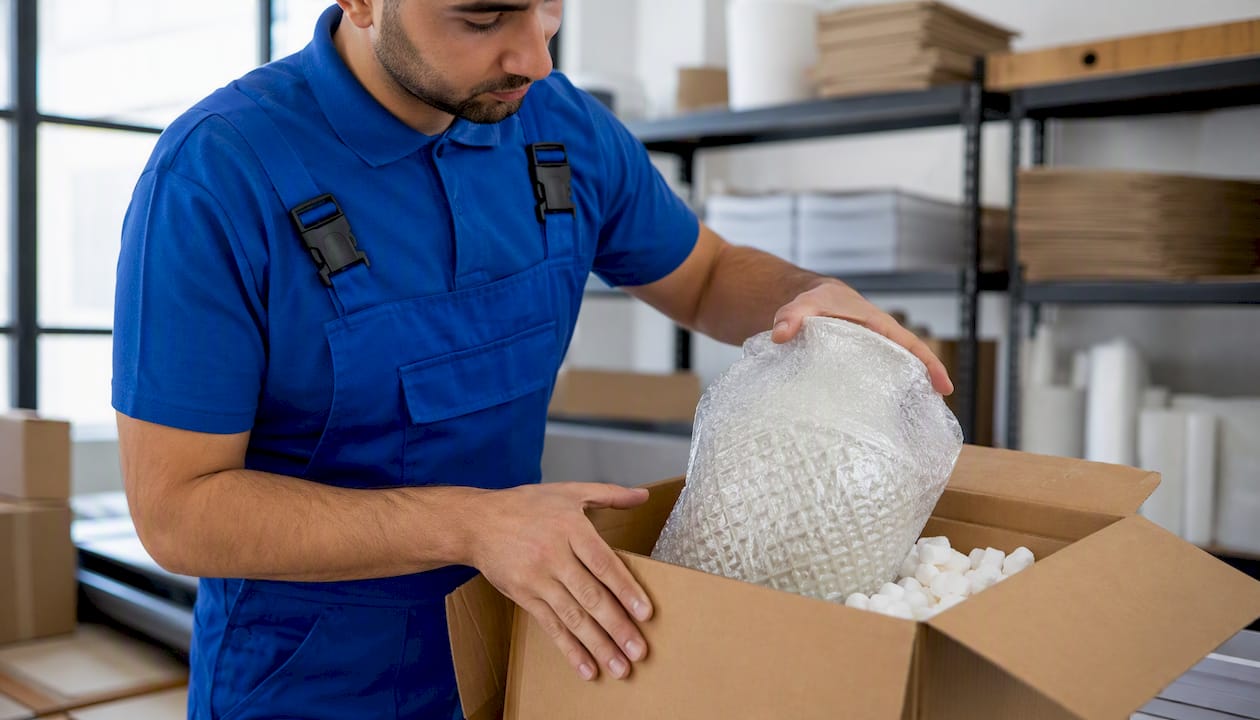
Pack every fragile item so it cannot move, with at least 3 inches (approximately 75 mm) of cushioning on all sides, inside a structurally sound corrugated box. That single rule, applied consistently, prevents the majority of transit damage. Fragile goods — glass, ceramics, precision instruments and similar items — break easily during handling, which means the packaging must do the protective work that careful handling alone cannot guarantee.
Three actions follow from that rule. First, choose a box with enough structural rigidity to resist compression. Second, wrap the item individually before placing it inside. Third, eliminate all internal movement before sealing. For high-value or crush-sensitive consignments, the box-in-box method adds a second layer of protection by creating a crush zone between the inner and outer containers.
Pro Tip: For items worth more than a few hundred pounds, or anything irreplaceable, use the double-box method: pack the item in a correctly cushioned inner box, then place that box inside a larger outer box with at least 3 inches of cushioning between the two. Professionals design packs to survive a 1-metre drop, and the double-box method is the most reliable way to meet that standard.
Immobilise the item completely — zero movement inside the box.
Provide at least 3 inches of cushioning on all sides; increase to 4–6 inches for items over approximately 10 pounds or those that are extremely delicate.
Choose a box that is 2–3 inches larger than the wrapped item on every side.
Key takeaways
Correct fragile items packaging requires immobilising the item completely, providing at least 3 inches of cushioning on all sides, and sealing the outer box with the H-tape method before labelling and documenting the consignment.
Point | Details |
The 3-inch cushioning rule | Maintain at least 3 inches of cushioning on all sides; increase to 4–6 inches for items over 10 pounds or extremely delicate goods. |
Immobilise before sealing | Perform the shake test after closing the box; zero internal movement is the only acceptable result before sealing. |
Match box strength to weight | Use stronger double-wall corrugated boxes for heavier or extremely fragile items and ensure the box strength rating matches expected compression loads. |
Choose materials by fragility class | Bubble wrap and foam sheets suit most items; custom foam inserts are best for repeat, high-value SKUs; anti-static bags are required for electronics. |
Dedicatedsamedaycourier for high-risk consignments | Direct point-to-point transport with no co-loading reduces handling events for fragile, high-value or time-critical shipments across the UK. |
Table of Contents
What is the correct fragile items packaging process, step by step?
How do you pack glassware, electronics, framed art and bottles?
What are the sealing, labelling and UK carrier rules you need to know?
When is a dedicated courier the right choice for fragile consignments?
Dedicatedsamedaycourier handles fragile shipments with direct, dedicated transport
What is the correct fragile items packaging process, step by step?
A structured sequence matters because skipping steps — particularly the shake test — is where most packing errors occur. Work through the following in order.
Step 1: Assess the item
Identify the item’s fragility class, weight and value. Decide whether a padded envelope or box is appropriate. As a general rule, bubble mailers suit flat, flexible or small rigid items that are lightweight; boxes are appropriate for glassware, multi-piece sets and items that require structural support. A padded envelope vs box decision comes down to whether the item can flex without damage and whether it needs rigid support on all sides.
Step 2: Prepare the inner protection
Start with a soft contact layer — tissue paper or a thin foam sheet — directly against the item’s surface. Never tape directly to the item. Over that, apply two to three wraps of bubble wrap, securing each layer with packing tape on the wrap itself, not on the item. For electronics, the first layer must be an anti-static bag before any bubble wrap goes on. Anti-static bags vs bubble wrap is not an either/or choice for electronics: the anti-static bag prevents electrostatic discharge, and the bubble wrap provides shock absorption.
Step 3: Choose and prepare the box
Select a box that gives 2–3 inches of clearance around the wrapped item on all sides. Add a base layer of cushioning material — crumpled kraft paper, foam sheets or air pillows — at least 3 inches deep before placing the item. Industry guidance confirms that 3 inches of cushioning on all sides is the minimum standard, with 4–6 inches recommended for heavier or extremely delicate items.
Step 4: Place the item and immobilise it
Lower the wrapped item into the centre of the box. Fill all voids around and above it with cushioning material. For multi-piece shipments, use dividers or custom inserts to prevent items colliding. Then perform the shake test: pick up the closed box and shake it firmly. If you detect any movement or hear shifting, open the box and add more fill. Zero internal movement is the target.
Step 5: Seal the box
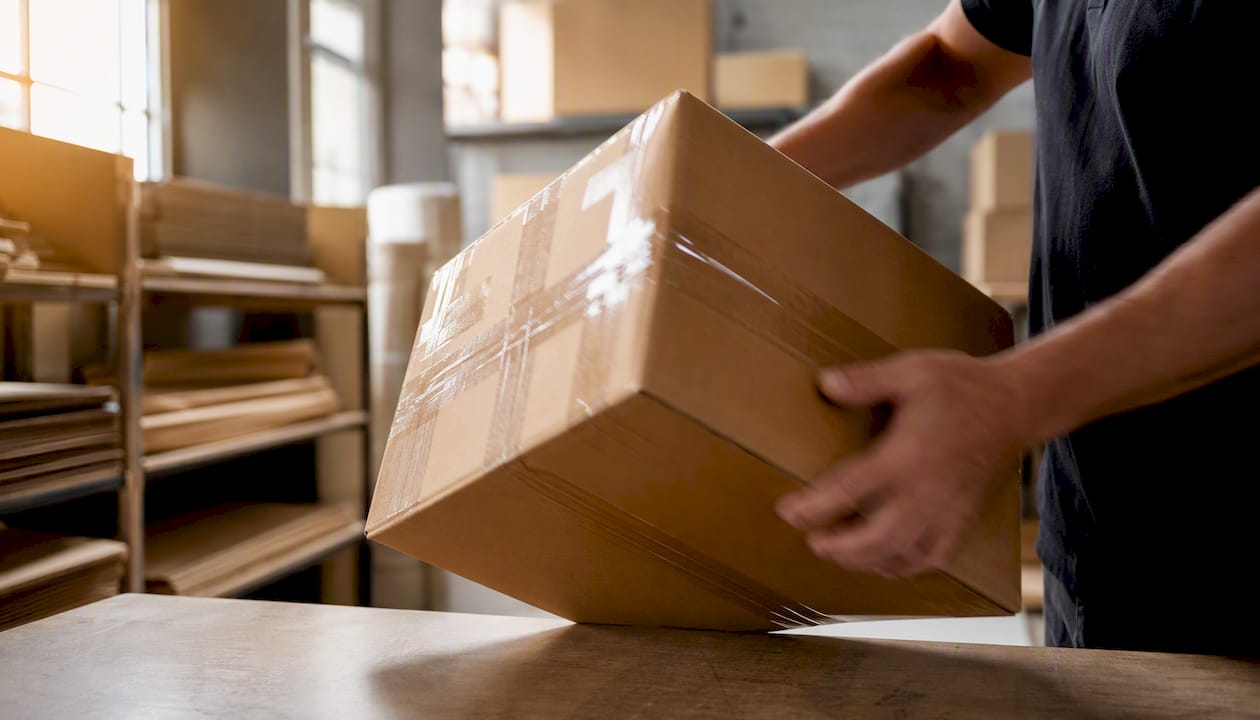
Close all flaps and apply the H-tape method: one strip along the centre seam, one strip along each side seam, forming an H shape across the top and bottom. Use pressure-sensitive packing tape at least 48 mm wide. Reinforce all four vertical corners with additional tape strips. Do not use masking tape, duct tape or parcel string — none of these provide reliable seam strength under courier handling conditions.
Step 6: Label, weatherproof and document
Apply address and returns labels to the top face of the box. Add FRAGILE and THIS SIDE UP labels on at least two sides. For shipments in wet weather conditions — a routine consideration for UK deliveries — wrap the sealed box in a polythene bag or use a water-resistant outer layer. Photograph the packed item, the sealed box and the labels before handover. Keep those photographs and the receipt; they are required evidence for any carrier damage claim.
Packing session checklist:
Item assessed for fragility, weight and value
Soft contact layer applied directly to item
Anti-static bag used for electronics
Two to three layers of bubble wrap applied and taped
Box sized with 2–3 inch clearance on all sides
Base cushioning at least 3 inches deep
All voids filled; shake test passed (zero movement)
H-tape method applied top and bottom
Corners reinforced
FRAGILE and THIS SIDE UP labels on two sides
Photographs taken before handover
Which packing materials should you use for fragile goods?
Choosing the right material depends on the item’s fragility class, weight, shape and the volume you are shipping. The table below sets out the main options.
Material | Protection level | Best use case | Environmental note |
Bubble wrap (small bubble) | Medium | Lightweight ceramics, glassware, small electronics | Recyclable where facilities exist; reusable |
Bubble wrap (large bubble) | High | Heavier items, artwork, appliances | As above |
Foam sheets | Medium | Wrapping individual items, interleaving plates | Often recyclable; low waste |
Foam-in-place | High | Irregular or one-off items, mixed SKUs | Harder to recycle; generates chemical waste |
Custom foam inserts | Very high | Repeat SKUs, presentation packaging, high-value goods | Reusable; efficient per-unit material use |
Kraft/shredded paper | Low to medium | Void fill, light items | Fully recyclable and biodegradable |
Air pillows | Medium | Void fill around already-wrapped items | Recyclable film; low weight |
Packing peanuts | Medium | Void fill for irregular shapes | Biodegradable options available (starch-based) |
Moulded pulp | Medium to high | Bottles, eggs, fragile retail items | Biodegradable and recyclable |
Anti-static bags | Specialist | Electronics, circuit boards | Recyclable where facilities exist |
Foam-in-place vs foam sheets is a common decision point. Foam sheets are pre-cut, easy to store and suit most individual wrapping tasks. Foam-in-place expands around the item to create a custom cavity, which is useful for irregular shapes or one-off shipments. Custom foam inserts are generally the better choice for stable, repeat SKUs where presentation matters, while foam-in-place suits mixed or lower-volume operations where storing pre-cut inserts is impractical.
For UK buyers, sustainable alternatives are increasingly accessible. Moulded pulp trays, starch-based packing peanuts and recycled kraft paper are stocked by UK packaging suppliers including Tiny Box Company and similar retailers. These materials meet most standard fragile-item protection requirements while reducing landfill contribution.
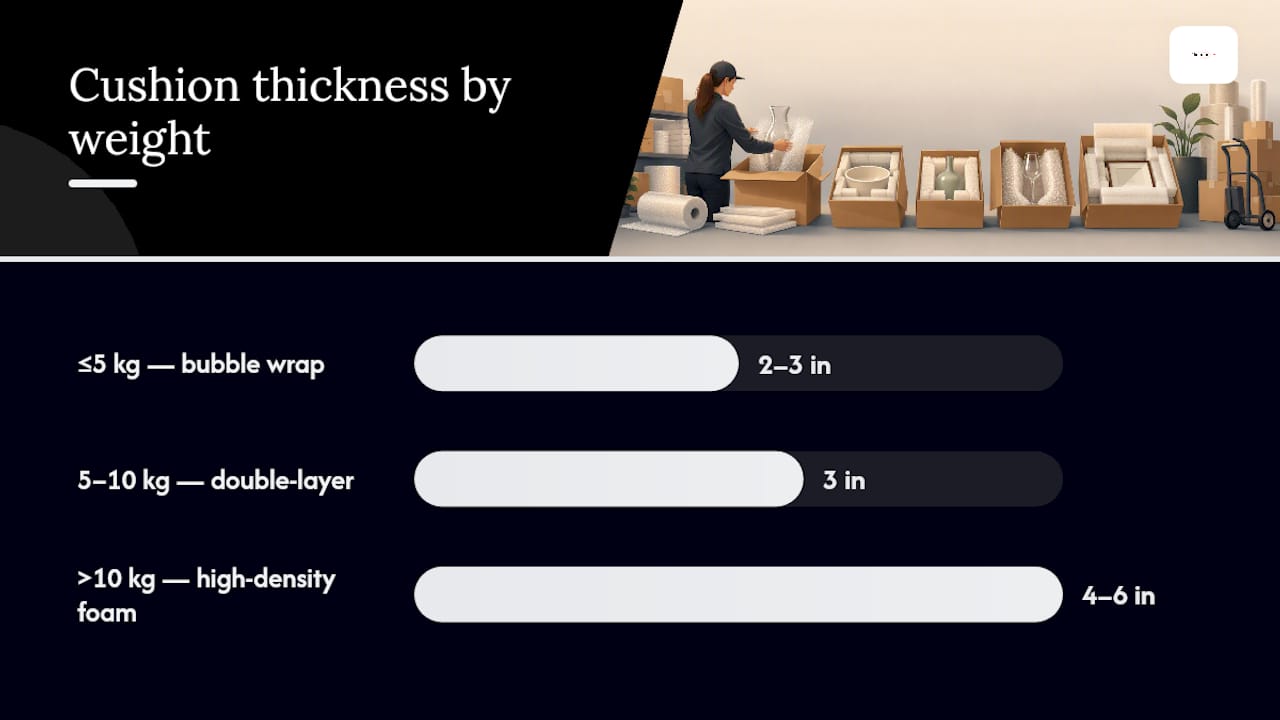
A practical layering rule: match cushioning thickness to fragility class. Light, moderately fragile items (mugs, small ornaments) need 2–3 inches of bubble wrap or foam. Heavy or extremely delicate items (large mirrors, scientific instruments) need 4–6 inches of high-density foam or a custom insert, plus a double-walled outer box.
How do you choose the right box size and strength?
Box construction is not a secondary consideration. A correctly cushioned item inside a structurally weak box will still suffer damage from compression during transit.
Single-wall vs double-wall corrugated
Single-wall corrugated board (one fluted layer between two liners) suits items up to approximately 10–15 kg with standard fragility. Double-wall corrugated (two fluted layers) is the correct choice for heavier items, anything extremely fragile, or consignments travelling long distances with multiple handling points. For items over 20 kg or those requiring maximum crush resistance, triple-wall board is available from specialist packaging suppliers.
The Edge Crush Test (ECT) rating on a box indicates its stacking strength. A higher ECT rating means the box resists more compression before collapsing. For fragile consignments, prioritise ECT rating alongside wall thickness rather than selecting a box purely by size.
Sizing rules
The 2–3 inch clearance rule applies on all six sides: top, bottom, left, right, front and back. Measure the wrapped item (not the bare item) and add at least 50–75 mm on every side to get the minimum internal box dimension. For the double-box method, the inner box becomes the item for sizing purposes: add 3 inches of cushioning around the inner box when selecting the outer box.
Box type | Typical weight range | Recommended use |
Single-wall, standard | Up to 15 kg | Light ceramics, books, small electronics |
Double-wall, standard | 15–30 kg | Glassware sets, appliances, framed art |
Double-wall, heavy duty | 30 kg+ | Large mirrors, machinery parts, bulk fragile goods |
Double-box (box-in-box) | Any weight, high value | Irreplaceable items, high-value goods, long-distance shipments |
Never reuse a box that shows creasing, water damage or structural weakness.
Avoid oversized boxes: too much void fill compresses unevenly and can shift during transit.
For items with protruding parts (handles, spouts), measure the widest point including the protrusion.
How do you pack glassware, electronics, framed art and bottles?
Different item categories carry different failure modes. The guidance below addresses the most common problem types.
Glassware and ceramics
Wrap each piece individually in tissue paper first, then two to three layers of bubble wrap. For sets of glasses or plates, place a foam sheet or folded bubble wrap between each item — never allow direct contact between pieces. Pack glasses upright where possible; plates should be packed on their edge (vertically), not flat, as vertical orientation distributes impact force more evenly. Use cardboard dividers or a purpose-made cell box for sets of six or more pieces.
Electronics
Place the item in an anti-static bag before any other wrapping. Remove batteries where the manufacturer recommends it, and secure any moving parts (disc trays, hinged covers) with foam inserts rather than tape. Wrap in bubble wrap after the anti-static layer. Never tape directly to screens or casings. Original manufacturer packaging, where available, is designed to meet drop-test standards and is worth retaining for shipping purposes.
Framed art and mirrors
Apply corner protectors to all four corners. Wrap the face in foam board or acid-free tissue, then cover the entire piece in bubble wrap. For large pieces, use a purpose-made picture box or construct a flat-pack frame from double-wall corrugated sheets. Mark the package clearly with THIS SIDE UP and FRAGILE on all four sides.
Bottles and liquids
Secure caps with tape or a heat-seal band. Wrap each bottle individually in bubble wrap. Use a bottle sleeve, moulded pulp insert or cardboard divider to prevent bottles touching each other. Place bottles upright where the carrier service permits, and apply THIS SIDE UP labels. Include an absorbent inner layer (paper towel or absorbent pad) as a precaution against minor leakage.
Pro Tip: For multi-piece sets — a dinner service, a set of wine glasses, a collection of laboratory samples — custom foam inserts or bespoke cardboard dividers are worth the additional cost. A single collision between two unprotected pieces inside a box can damage both, turning a minor packing shortcut into a costly replacement.
What are the sealing, labelling and UK carrier rules you need to know?
Sealing technique
The H-tape method is the professional standard. Apply one strip of 48 mm pressure-sensitive packing tape along the full length of the centre seam on both the top and bottom of the box. Apply one strip along each side seam, parallel to the centre strip. The result is an H shape on each face. Reinforce all four vertical corner edges with additional tape. This pattern distributes stress across the box structure rather than concentrating it at a single seam.
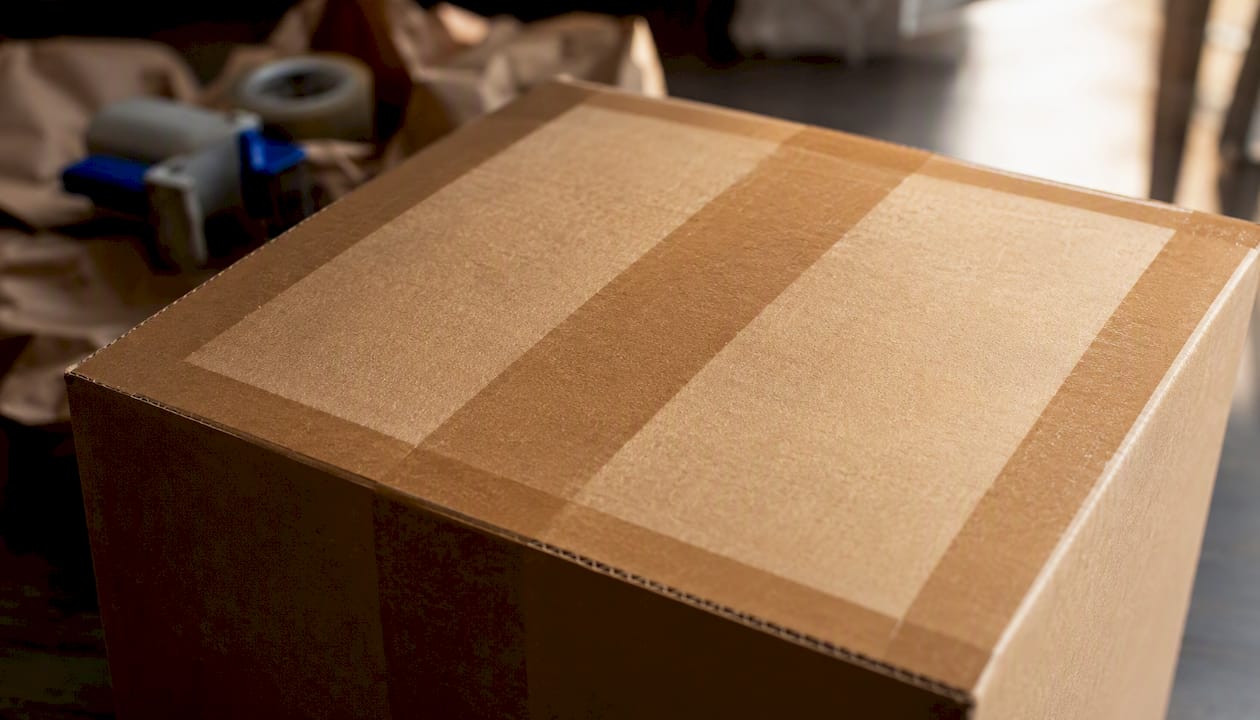
Do not use masking tape, brown parcel tape of less than 48 mm width, or duct tape. These either lack the adhesive strength for courier handling or leave residue that can interfere with label scanning.
Labelling
Place the primary address label on the largest flat face (the top). Add a returns label on a side face. Apply FRAGILE labels on at least two opposing sides and THIS SIDE UP on two sides where orientation matters. Labels help handlers make better decisions, but they do not substitute for correct internal packing. A fragile label on a poorly packed box does not reduce the risk of damage.
For secure parcel transportation, place labels under a clear self-adhesive pouch rather than directly on the box surface, which prevents labels lifting in wet conditions.
UK carrier insurance and claims basics
Most standard UK parcel services include a basic level of goods-in-transit cover, but the limit is often low — frequently £20–£50 per parcel unless additional declared-value cover is purchased. For fragile or high-value items, always declare the full replacement value and purchase the appropriate level of cover at booking.
Carriers typically require the following for a successful damage claim:
Photographs of the damage taken immediately on receipt
Photographs of the original packaging (outer box, inner cushioning)
Proof of value (receipt, invoice or valuation)
The original packaging retained for inspection if requested
Notification of damage within the carrier’s stated timeframe (commonly 24–48 hours for visible damage, up to 14 days for concealed damage)
UK parcel services impose weight and size limits that vary by service tier. Standard services typically accept parcels up to 30 kg and up to 120 cm on the longest side, but these limits differ between providers. Items that are exceptionally heavy, oversized or require special handling may fall outside standard parcel service parameters. In those cases, a dedicated courier or specialist freight service is the appropriate route. Check the items accepted by UK courier services before booking to confirm your consignment qualifies.
How do you test a pack before it leaves your hands?
The shake test
Pick up the sealed box and shake it firmly in all three axes: side to side, end to end, and top to bottom. Listen and feel for any movement. If you detect shifting, open the box, add more cushioning material to the voids, and repeat. Zero internal movement is the only acceptable result. Expert guidance confirms that even well-padded items fail if they can shift and collide inside the box.
Drop and compression expectations
Professionals design fragile-item packs to survive a 1-metre drop onto a hard surface. This is the informal benchmark used across the logistics industry, and it reflects the realistic drop height from a conveyor or loading bay. Box strength affects survival as much as internal cushioning: a correctly cushioned item inside a crushed box will still be damaged.
Compression risk is particularly relevant for parcels stacked in transit. Double-wall corrugated boxes resist stacking loads significantly better than single-wall, and the ECT rating is the most reliable indicator of compression resistance.
Foam-in-place vs custom inserts: a decision framework
The choice between foam-in-place and custom foam inserts depends on three factors: SKU stability, volume and presentation requirements. Custom foam delivers repeatable, validated protection for fixed SKUs, while foam-in-place offers flexibility for irregular or one-off shipments. For high-value repeat products, test both options using the same criteria: product condition after handling, pack time, inventory effort and unpacking experience.
Cushion thickness | Item weight class | Recommended material |
2–3 inches (50–75 mm) | Up to 5 kg, moderate fragility | Bubble wrap, foam sheets, air pillows |
3 inches (approximately 75 mm) | 5–10 kg, high fragility | Double-layer bubble wrap, foam sheets |
4–6 inches | Over 10 kg or extremely delicate | High-density foam, custom inserts, double-box |
When is a dedicated courier the right choice for fragile consignments?
Standard parcel services involve multiple handling points: collection, sorting hub, regional depot, local delivery. Each transfer is an opportunity for impact or compression damage. A dedicated courier moves the consignment directly from collection point to delivery address on a single vehicle, with no co-loading and no intermediate sorting.
The practical triggers for choosing a dedicated or same-day courier over a standard parcel service are:
The item is high value or irreplaceable (artwork, antiques, bespoke equipment)
The item cannot survive multiple handling transfers (large mirrors, precision instruments)
The delivery window is fixed and cannot accommodate a next-day or two-day service
The consignment is oversized or overweight for standard parcel services
The item requires a specific vehicle type (temperature-controlled, flat-bed, large van)
The risk trade-off is straightforward. Fewer handoffs mean fewer impact events. No co-loading means the consignment is not stacked under other parcels. Dedicated couriers reduce delays and handling risk precisely because the vehicle and driver are assigned exclusively to that job.
Operational checklist for booking a dedicated courier:
Pack readiness confirmed (shake test passed, sealed and labelled)
Declared value agreed and appropriate insurance purchased
Vehicle type specified (small van, LWB van, Luton) based on consignment dimensions
Collection address, contact name and access instructions provided at booking
Delivery address confirmed with recipient availability
Pro Tip: Brief the driver at collection. Tell them the item is fragile, specify which way up the package should travel, and ask that it is not placed under other items in the vehicle. A 30-second conversation at the door is the most cost-effective last-mile risk reduction available.
The real cost of cutting corners on protective packaging
The instinct to save money on packaging materials is understandable, particularly for businesses shipping at volume. But the total cost of a damaged shipment — replacement cost, return logistics, customer service time and reputational impact — almost always exceeds the cost of the additional cushioning that would have prevented it.
There is also a tendency to treat the FRAGILE label as a substitute for correct packing. It is not. Carriers handle thousands of parcels daily, and a label changes handling behaviour at the margins, not reliably. The pack itself must be the primary protection.
On the sustainability question: the choice between bubble wrap and biodegradable alternatives is not as stark as it sometimes appears. Recycled kraft paper, starch-based packing peanuts and moulded pulp all provide adequate protection for most standard fragile items. The cases where synthetic foam or bubble wrap genuinely cannot be substituted — high-density foam for precision instruments, anti-static bags for electronics — are specific and limited. For everything else, the biodegradable option is usually sufficient and increasingly cost-competitive from UK suppliers.
The one area where I would always recommend spending more rather than less is the outer box. A double-wall corrugated box costs marginally more than a single-wall equivalent, but it resists compression from stacking loads far better. For fragile consignments, that difference in box strength is where the protection budget is best spent.
Dedicatedsamedaycourier handles fragile shipments with direct, dedicated transport
When a consignment is too valuable or too fragile to risk through a standard parcel network, direct point-to-point transport removes the handling variables that cause most damage. Dedicatedsamedaycourier provides dedicated vehicle options across the UK, with collection typically within 60–90 minutes, 24/7 availability and no co-loading — the consignment travels on its own vehicle from your door to the recipient’s.
[
For fragile, high-value or time-critical goods, the service covers the full range of vehicle sizes from small vans to large LWB options, so the vehicle matches the consignment rather than the other way around. Whether you need a same-day courier for an urgent collection or a planned dedicated run for sensitive equipment, the booking process is straightforward: request a bespoke quote by phone, email or online form, and a dedicated vehicle is assigned to your job. To discuss your consignment and get a quote, visit the Dedicatedsamedaycourier delivery service page or call directly.
Sources
The following sources were used in preparing this guide and provide additional detail on specific aspects of fragile-item packing.
Recommended


Comments