
The role of document delivery in business operations

TL;DR:
Effective document delivery enhances operational efficiency, compliance, and client trust through secure, timely transfers. Businesses should assess workflows, standardize metadata, and choose appropriate services like dedicated couriers or hybrid models to meet specific document needs. Robust tracking, audit trails, and process integration are essential for managing risks and ensuring accountability in high-stakes deliveries.
Document delivery in business is defined as the process of transferring contracts, invoices, legal agreements, and financial statements from one party to another through physical courier, digital platform, or a combination of both. The role of document delivery in business extends well beyond simple logistics. It directly determines how fast your teams process work, how reliably you meet compliance obligations, and how professionally you communicate with clients. Businesses that treat document delivery as an afterthought routinely face missed deadlines, lost contracts, and damaged client relationships. Those that manage it deliberately gain a measurable operational advantage.
How does document delivery improve operational efficiency?
Adopting automated document management systems produces a 40–60% reduction in manual processing and a 20–35% decrease in storage and infrastructure costs. Those figures reflect what happens when AI-driven data extraction replaces manual sorting, filing, and retrieval across departments.
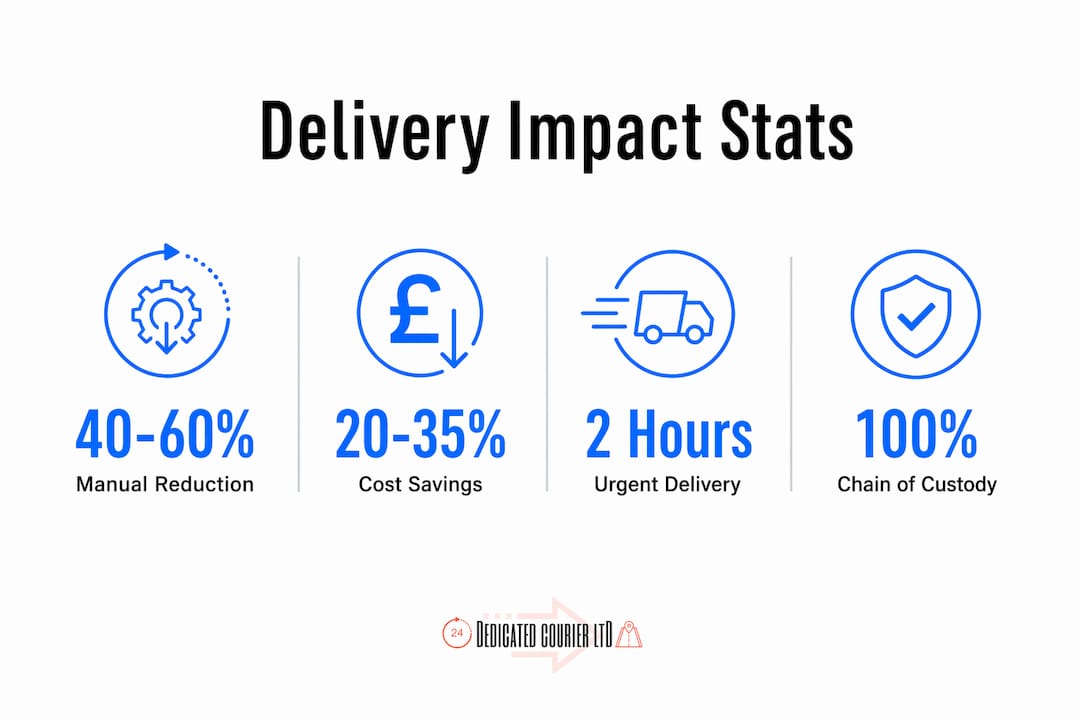
The efficiency gains go further than cost reduction. Digital document delivery eliminates manual printing, sorting, enveloping, and posting entirely. That frees staff to focus on higher-value work rather than administrative handling.
Centralised version control is another direct benefit. When documents are managed through a single repository, whether through an ERP-integrated system like SAP, Oracle, or M-Files, teams always access the current version. Errors caused by outdated documents circulating across departments drop significantly.
Automated workflows reduce approval cycle times for invoices and purchase orders
Centralised repositories prevent duplicate document acquisitions and version conflicts
Integration with ERP systems connects document delivery to financial and operational records
Document integration with audit trails and risk logs supports corporate governance requirements
Pro Tip: Most businesses focus on delivery speed but overlook metadata standardisation. Documents without consistent naming conventions, version numbers, and recipient details create routing errors that no courier or digital platform can fix downstream.
What types of document delivery services are available?
Document delivery services fall into three broad categories: physical courier, digital delivery, and hybrid. Each carries distinct advantages depending on the document type, recipient preference, and regulatory context.

Digital delivery is faster, cheaper, and more convenient for recipients where infrastructure and consent exist. Physical mail remains the required channel for regulated sectors such as legal, financial services, and healthcare, where wet signatures or paper originals are still mandated.
Hybrid approaches balance both requirements. A business might send a digital copy of a contract for review while dispatching a physical original by dedicated courier for signature. This model manages recipient preferences without increasing support volumes.
Delivery Type | Speed | Security | Best Use Case |
Standard postal service | 1–5 days | Low to medium | Non-urgent, low-sensitivity documents |
Digital platform (e-mail, portal) | Instant | Medium to high | Invoices, statements, routine correspondence |
Standard courier | Next day | Medium | Contracts, parcels, non-urgent originals |
Dedicated same-day courier | Under 2 hours | High | Legal documents, bank submissions, court deadlines |
Urgent physical delivery services guarantee delivery within 2 hours in fast-paced environments, unlike standard couriers operating on next-day or multi-day cycles. That difference is critical when meeting bank processing windows or court filing deadlines.
Dedicated courier services handle documents from pickup to handover without sorting hubs. That single-courier chain-of-custody model provides accountability and security that batch courier networks cannot match.
Why is secure document delivery critical for compliance and client trust?
Chain-of-custody is the formal record of who handled a document, when, and where. Without it, businesses cannot prove a contract was delivered, a notice was served, or a financial statement reached its intended recipient. That gap creates legal and reputational exposure.
Delays and delivery errors carry direct business consequences. A missed court deadline, a contract arriving after a signing window closes, or a financial statement reaching the wrong address can each result in financial penalties or lost business. The risk is not theoretical. It is a routine operational hazard for businesses without a structured document delivery workflow.
Automated notifications at every status milestone reduce enquiries and improve communication throughout the delivery process. Recipients who receive real-time updates require less manual follow-up from your team. That reduces inbound support volume and builds confidence in your processes.
Proof of delivery records protect businesses in contractual disputes
Real-time tracking updates reduce client uncertainty and inbound queries
Single-courier handling eliminates the risk of misrouting through sorting hubs
Compliance-regulated documents require auditable delivery records
Pro Tip: Standardise your document metadata before dispatch. Incomplete bibliographic and metadata information is a primary failure point in high-stakes deliveries. Technology cannot compensate for missing recipient details or incorrect document references.
How can businesses implement document delivery solutions effectively?
Choosing the right document delivery solution requires a structured assessment of your operational requirements, not a default to the cheapest or most familiar option. Follow these steps to build a reliable system.
Audit your current document workflows. Identify which document types move most frequently, which carry the highest risk if delayed, and where errors currently occur. Contracts, invoices, and compliance notices typically require the most attention.
Define delivery requirements by document category. Not every document needs same-day physical delivery. Segment your documents by urgency, sensitivity, and recipient preference to match the right channel to each type.
Assess third-party services against in-house options. In-house document handling works for low-volume, low-urgency materials. For time-sensitive or high-value documents, third-party dedicated courier services provide accountability and speed that internal teams cannot replicate.
Integrate with your existing ERP or workflow system. Document delivery should connect directly to your financial and operational records. Systems like M-Files, SAP, and Oracle all support document management integration that links delivery status to transaction records.
Build automated notifications into every workflow. Recipients should receive confirmation at collection, transit, and delivery. This closes the communication loop without manual intervention from your team.
Review compliance and sustainability requirements. UK data protection regulations under the UK GDPR govern how personal data within documents is transmitted. Digital delivery must use encrypted channels. Physical delivery of sensitive materials requires secure handling and proof of delivery.
Scalability matters as your business grows. A solution that works for 50 documents per month may not handle 500. Build scalability into your selection criteria from the outset.
Key takeaways
Efficient document delivery is the operational foundation that connects internal workflows, client communication, and regulatory compliance into a single, accountable process.
Point | Details |
Automation reduces costs significantly | Automated document management cuts manual processing by 40–60% and storage costs by 20–35%. |
Dedicated couriers outperform standard services | Single-courier chain-of-custody provides security and accountability that batch networks cannot match. |
Hybrid delivery suits most businesses | Combining digital and physical channels manages recipient preferences without increasing support volumes. |
Metadata accuracy prevents delivery failures | Incomplete document information causes routing errors that no courier or platform can resolve. |
Automated notifications build client trust | Status-triggered updates at every milestone reduce enquiries and improve the recipient experience. |
Document delivery in 2026: what i have observed
The businesses I see struggling most with document delivery are not the ones using outdated technology. They are the ones that have never formally decided how documents should move through their organisation. They rely on a mix of email, ad-hoc couriers, and manual filing with no consistent process connecting them.
The shift toward digital is real, but physical delivery has not declined in the sectors where it matters most. Legal firms, financial institutions, and regulated healthcare providers still require original documents with wet signatures and auditable delivery records. The demand for urgent same-day courier services in these sectors has not reduced. If anything, the expectation of speed has increased while the tolerance for error has dropped.
What I find underappreciated is the governance dimension. Document delivery is not just a logistics function. When it is integrated with audit trails, version control, and risk logs, it becomes part of how a business demonstrates accountability to regulators, clients, and auditors. Businesses that treat it as a back-office task miss that entirely.
My practical advice: start with a document audit before you invest in any new system or service. Know what you are moving, how often, and what the cost of failure is for each category. That single exercise will tell you more about your actual requirements than any vendor conversation.
— andrew
Need reliable document delivery for your business?
When a contract needs to reach a solicitor before close of business, or a financial statement must arrive at a bank by a specific processing window, standard courier networks are not built for that level of accountability.
[
Dedicatedsamedaycourier provides dedicated same-day courier services across the UK, with each delivery handled by a single courier on an exclusive vehicle. There are no sorting hubs, no batch handling, and no shared loads. Every delivery includes real-time tracking and proof of delivery as standard. Dedicatedsamedaycourier operates 24 hours a day, seven days a week, with a range of vehicle options to match the volume and sensitivity of your documents. Get a tailored delivery quote for your business requirements today.
FAQ
What is the role of document delivery in business?
Document delivery in business is the process of transferring contracts, invoices, legal documents, and financial records between parties through physical courier, digital platform, or hybrid methods. It directly supports operational efficiency, client communication, and regulatory compliance.
How does dedicated courier delivery differ from standard courier services?
Dedicated courier services use a single courier and exclusive vehicle from collection to handover, providing a full chain-of-custody record. Standard couriers route documents through sorting hubs, which increases handling risk and transit time.
Why is same-day document delivery necessary for some businesses?
Urgent physical delivery services can guarantee delivery within 2 hours, which is critical for meeting court filing deadlines, bank processing windows, and time-bound contract signings that standard next-day services cannot accommodate.
What documents typically require physical courier delivery?
Legal originals requiring wet signatures, regulated financial documents, and compliance notices in sectors governed by UK law typically require physical delivery with proof of receipt. Digital delivery is not always legally sufficient for these document types.
How can businesses reduce document delivery errors?
Standardising document metadata, including recipient details, version numbers, and reference codes, before dispatch prevents the majority of routing errors. Incomplete metadata is the leading cause of delivery failures in high-stakes document logistics.
Recommended


Comments