
Rapid parcel delivery: why speed wins customers
TL;DR:
Rapid parcel delivery, including same-day and next-day options, boosts e-commerce sales and reduces cart abandonment. Reliable, predictable delivery windows build customer trust better than raw speed, especially when communication is clear. Small businesses can implement cost-effective strategies like inventory positioning and courier partnerships to offer fast delivery without extensive logistics infrastructure.
Rapid parcel delivery is defined as the fulfilment of customer orders within same-day or next-day timeframes, and its importance to small businesses and e-commerce operators has never been greater. In logistics, this is more formally known as express or time-critical delivery. The importance of rapid parcel delivery shows up directly in revenue figures: same-day delivery influenced 67% of e-commerce purchases in 2025 and reduced cart abandonment by nearly 50%. For any business competing on product and price, delivery speed has become the third pillar of the customer experience.
How does rapid parcel delivery affect sales and customer behaviour?
Delivery speed changes purchase decisions before a customer even reaches the checkout. 42% of consumers aged 25–44 prefer same-day delivery, and 19% would switch retailers for significantly faster fulfilment. That is not a marginal preference. It is a direct threat to customer retention for any business that cannot match competitor delivery speeds.

The numbers on cart abandonment are equally direct. 23% of shoppers abandon carts due to slow shipping speeds. Faster delivery options at checkout reduce that drop-off and convert browsers into buyers. Businesses that added rapid delivery services raised total sales volume by 6%–8% by capturing demand that would otherwise go elsewhere.
The benefits of quick delivery extend beyond the first purchase. Customers who receive orders faster report higher satisfaction and place repeat orders more frequently. Delivery speed also reduces buyer’s remorse. When a product arrives the same day or the next morning, the purchase feels confirmed rather than uncertain.
Same-day delivery influenced 67% of e-commerce purchases in 2025
Cart abandonment drops by nearly 50% when rapid delivery is offered at checkout
Sales uplift of 6%–8% is achievable by adding fast fulfilment options
Repeat purchase rates increase when customers associate a brand with reliable, fast delivery
Is delivery reliability more important than raw speed?
Speed matters, but reliability matters more for long-term customer trust. Executives from Macy’s and Ulta Beauty have stated that predictable delivery windows are more critical than raw speed for retaining customers. A parcel that arrives within a promised two-hour window builds more confidence than one that was promised in 30 minutes but arrived three hours late.
Missed delivery promises generate customer service contacts, negative reviews, and lost repeat business. Each failed delivery costs more than the logistics saving that caused it. The goal is not to promise the fastest possible time. The goal is to promise a time you can consistently meet.
Communication throughout the delivery process is a practical way to build that trust. Proactive tracking updates, accurate estimated arrival times, and clear rescheduling options all reduce customer anxiety. Deliveries arriving within the promised timeframe build brand trust and reduce customer support costs more than speed alone.
“Reliability and predictable delivery windows are more critical than speed for long-term customer retention.” — Supply chain executives from Macy’s and Ulta Beauty
Pro Tip: Set your delivery promise at a timeframe you can hit 95% of the time, not the fastest possible window. Customers remember the one late delivery far longer than the ten on-time ones.
What are the most cost-effective rapid delivery strategies for small businesses?
Small businesses do not need to build their own logistics infrastructure to offer fast delivery. The most practical path is to use existing networks intelligently. Same-day delivery is becoming a baseline expectation for urban shoppers, and the businesses succeeding with it are those that start with inventory positioning and pilot programmes rather than full-scale rollouts.
Here are four strategies that deliver results without excessive cost:
Position inventory closer to demand. Segment stock by regional order volume and place fast-moving products in fulfilment locations near your top postcodes. This shortens the last mile and reduces transit time without requiring a new carrier contract.
Use out-of-home collection points. Out-of-home drop-offs reduce last-mile costs by 30%–40% compared to doorstep delivery. Lockers and collection points restore network density and are particularly useful for small operators without large internal fleets.
Partner with dedicated courier networks. Using a specialist courier service rather than building your own fleet gives you access to vehicles, drivers, and coverage on demand. This is the model that services like Dedicatedsamedaycourier operate on, using courier exchange technology to match urgent jobs with available drivers nationwide.
Apply route optimisation tools. Last-mile delivery accounts for 50%–60% of total fulfilment costs. AI route optimisation and cost intelligence tools reduce that figure by cutting unnecessary mileage and improving drop density per run.
Pro Tip: Before scaling rapid delivery nationally, run a pilot in your two or three highest-order postcodes. Measure cost per delivery, on-time rate, and repeat purchase rate over 60 days before committing to wider rollout.
One pricing consideration is worth noting. Willingness to pay more than £5 extra for faster delivery drops sharply among consumers. Keeping rapid delivery affordable, or absorbing the cost into your margin on high-value orders, is the more sustainable commercial approach.
Same-day vs next-day vs express: which model fits your business?
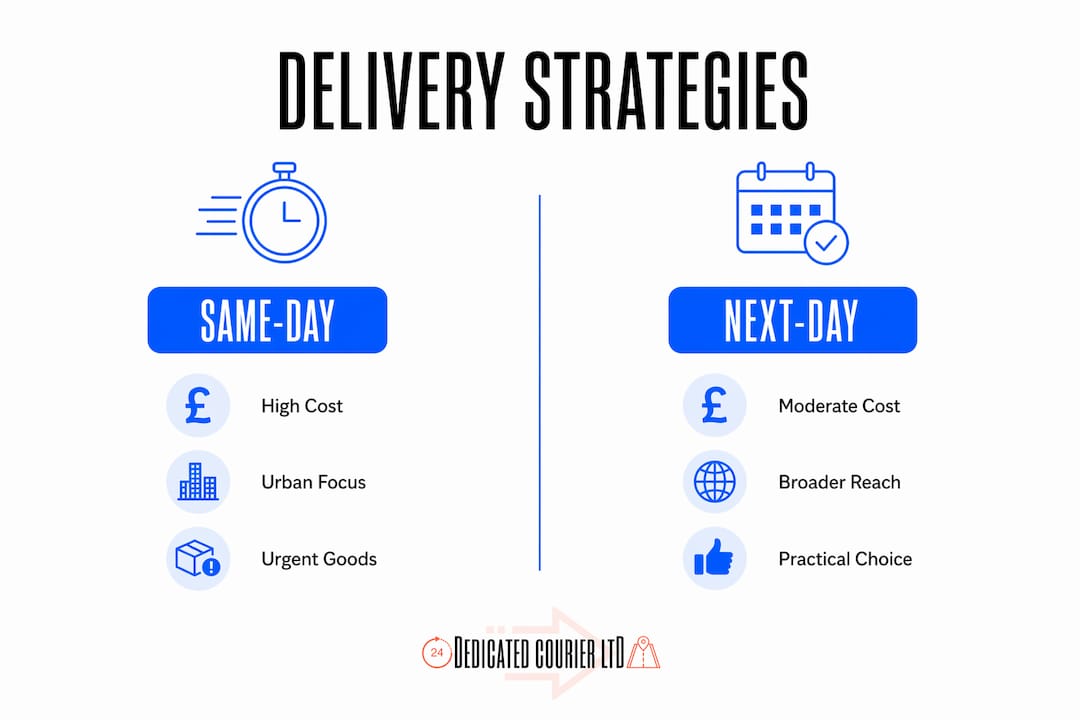
Rapid delivery models are not one-size-fits-all. The right choice depends on your product type, customer location, and order volume. Each model carries distinct cost and operational requirements, as covered in detail in the 2026 practical guide to rapid parcel shipping.
Delivery Model | Typical Cost | Best For | Key Consideration |
Same-day | Highest | Urgent, high-value items | Requires local inventory or dedicated courier |
Next-day | Moderate | Most e-commerce orders | Widely available; strong customer satisfaction |
Express (2–4 hour) | Premium | Medical, legal, time-critical goods | Needs dedicated vehicle and driver |
Same-day delivery suits businesses selling urgent or high-value goods in urban areas. Next-day delivery is the most practical option for the majority of e-commerce operators, offering strong customer satisfaction at a manageable cost. Express services, covering delivery within two to four hours, are best reserved for goods in transit where time is genuinely critical, such as legal documents, medical supplies, or replacement parts.
The advantages of timely parcel service apply across all three models. The key is matching the model to the customer expectation and the product value, not defaulting to the fastest option regardless of cost.
Key takeaways
Rapid parcel delivery directly increases sales, reduces cart abandonment, and builds customer loyalty, but only when speed is matched with reliable, consistent fulfilment.
Point | Details |
Speed drives conversions | Same-day delivery influenced 67% of e-commerce purchases in 2025 and cut cart abandonment by nearly 50%. |
Reliability outranks raw speed | Predictable delivery windows build more long-term trust than the fastest possible promise you cannot consistently keep. |
Cost control is achievable | Out-of-home collection points reduce last-mile costs by 30%–40%; route optimisation cuts the largest cost component in fulfilment. |
Pilot before scaling | Test rapid delivery in your top two or three postcodes before committing to a national rollout. |
Match model to product | Same-day suits urgent high-value goods; next-day covers most e-commerce needs at a more manageable cost. |
Why i think most small businesses get rapid delivery wrong
From working closely with businesses across the UK logistics space, the most common mistake is treating rapid delivery as a marketing promise rather than an operational commitment. A business will advertise same-day delivery, win the order, and then scramble to fulfil it with a carrier that was never set up for that volume or geography. The result is a late delivery, a refund request, and a customer who does not return.
The businesses that get it right start smaller. They pick one or two product lines, one or two cities, and one reliable courier partner. They measure everything for 60 days. Only then do they expand. This approach is less exciting than a full launch, but it produces a delivery operation that actually works.
The other mistake I see regularly is chasing speed at the expense of communication. Customers are more forgiving of a slightly longer delivery window than they are of silence. A tracking update at collection, one at dispatch, and one 30 minutes before arrival costs nothing and reduces inbound customer service queries significantly.
Swift parcel delivery is no longer optional for competitive e-commerce. But the businesses that win are not necessarily the fastest. They are the most consistent. Build that first, then push the speed.
— andrew
How Dedicatedsamedaycourier supports your rapid delivery needs
If you are ready to offer faster delivery without building your own fleet, Dedicatedsamedaycourier provides same-day courier services designed specifically for urgent, time-critical requirements across the UK.
[
Dedicatedsamedaycourier operates 24/7, with dedicated vehicles ranging from small vans to larger goods vehicles, so your parcels travel on an exclusive vehicle rather than sharing space with other consignments. Coverage is nationwide, and quotes are available by phone, email, or online form. Whether you need a one-off urgent collection or a regular rapid delivery arrangement, the service scales to your requirements. Explore the full range of courier services or request a delivery quote to get started.
FAQ
What is rapid parcel delivery?
Rapid parcel delivery refers to the fulfilment of orders within same-day or next-day timeframes, also known as express or time-critical delivery in the logistics industry.
How does delivery speed affect customer satisfaction?
Same-day delivery influenced 67% of e-commerce purchases in 2025, and businesses offering fast fulfilment see cart abandonment fall by nearly 50%.
Is same-day delivery affordable for small businesses?
Using dedicated courier networks and out-of-home collection points keeps costs manageable. Out-of-home drop-offs reduce last-mile costs by 30%–40% compared to standard doorstep delivery.
Should i prioritise speed or reliability in my delivery promise?
Reliability produces better long-term results. Executives from Macy’s and Ulta Beauty confirm that predictable delivery windows retain customers more effectively than the fastest possible timeframe.
What delivery model suits a small e-commerce business best?
Next-day delivery covers most e-commerce needs at a manageable cost. Same-day is best reserved for urgent or high-value goods where the customer expectation and product margin justify the additional expense.
Recommended


Comments