
What is scheduled delivery? A clear guide for 2026
- Andrew Buttrick
- Jun 22
- 7 min read

TL;DR:
Scheduled delivery involves prearranged delivery dates and specific time windows, ensuring items arrive within a defined period. It offers predictability, lower costs, and aligns with UK law obligations, making it ideal for planned, high-value, or bulky shipments. In contrast, same-day services prioritize speed and are suited for emergencies or urgent deliveries, often at a higher premium.
Scheduled delivery is defined as a prearranged arrangement where a specific delivery date and time window is agreed upon in advance by the sender, courier, or recipient. Unlike standard shipping, which delivers when convenient for the carrier, scheduled delivery gives both parties a defined window for arrival. This matters for businesses managing staff rotas, and for customers who cannot wait in all day. Understanding how it works, where UK law applies, and how it compares to urgent options helps you make better logistics decisions.
What is scheduled delivery and how does it work?
Scheduled delivery means the shipper or receiver pre-arranges a delivery date and time window before the shipment departs. The customer selects an available time window at checkout or booking, and the fulfilment system schedules the order accordingly. This is not a guarantee of arrival at a precise minute. It is a promise that the item will arrive on or before the end of the agreed window.
Operationally, the process works in numbered steps:
Time slot selection. The customer or business chooses from available windows, typically displayed as two to four hour bands such as 9am–1pm or 2pm–6pm.
Capacity check. The booking system verifies that the chosen slot has available driver and vehicle capacity. Booking systems that skip capacity checks cause increased failed deliveries and exceptions.
Reservation confirmation. The slot is reserved and locked, preventing overbooking of that window.
Route planning and driver assignment. The courier integrates the booking into a planned route, grouping nearby deliveries for efficiency.
Dispatch and tracking. The item is collected and tracked against the agreed window, with notifications sent to the recipient.
Platforms like Instacart use API systems that return ETA and scheduled time slots with defined delivery windows, treating each slot as a start and end timestamp. The delivery promise applies to the end time, not the start. That distinction matters when managing customer expectations.
Pro Tip: Align your internal processing cutoffs, picking, packing, and dispatch, with your published delivery windows. Misaligned internal cutoffs cause SLA breaches and customer complaints even when the courier schedule is correct.

Scheduled vs same-day courier services: what is the difference?
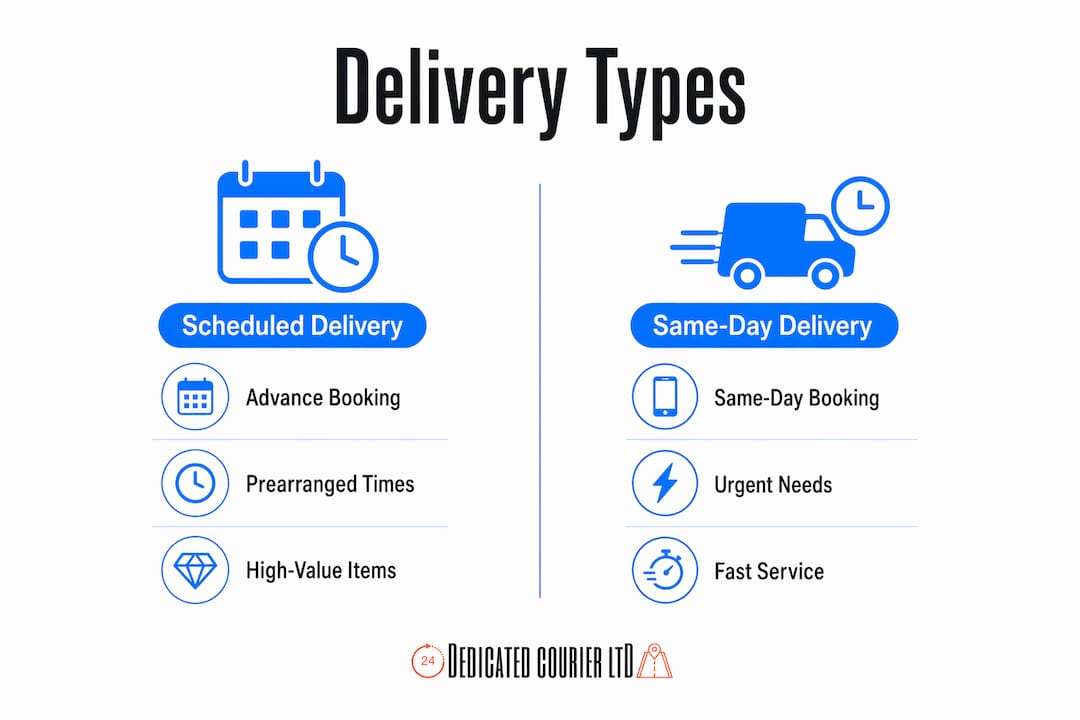
Scheduled delivery and same-day courier services solve different problems. Scheduled delivery focuses on planned timing and predictability rather than speed alone. Same-day and urgent delivery prioritise getting an item from A to B as fast as possible, often within hours, regardless of a pre-agreed window.
The key differences break down as follows:
Timing flexibility. Scheduled delivery is booked in advance for a future window. Same-day delivery is typically requested on the day, with collection often within the hour.
Cost. Scheduled delivery is generally lower cost because routes can be planned and consolidated. Urgent and same-day services carry a premium for immediacy.
Reliability. Scheduled delivery offers a predictable arrival window. Same-day delivery offers speed but the exact arrival time is less certain.
Use case. Scheduled delivery suits regular business replenishment, furniture, fresh groceries, and any shipment where the recipient needs to be present. Same-day suits emergencies, legal documents, and time-critical parts.
Feature | Scheduled delivery | Same-day / urgent delivery |
Booking timing | In advance | On the day |
Arrival window | Pre-agreed, defined band | As fast as possible |
Cost | Lower | Higher premium |
Predictability | High | Variable |
Best for | Planned, high-value, or bulky items | Emergencies, urgent documents |
Scheduled delivery suits high-value or bulky items such as furniture or fresh groceries that need precision and personalisation. Same-day courier services remain the right choice when speed is the only metric that matters. Knowing which to use saves money and reduces failed deliveries.
UK legal rights and scheduled delivery obligations
UK law treats scheduled delivery commitments as contract terms. The Consumer Rights Act 2015 requires sellers to deliver within agreed time frames, or within 30 days if no time frame is agreed. That is not a guideline. It is a statutory obligation.
When a seller or courier misses an agreed scheduled window, the consequences are clear:
The consumer may treat the contract as cancelled and claim a full refund.
The seller bears responsibility even if the failure lies with the courier they appointed.
Repeated or significant delays give the consumer the right to reject goods entirely.
UK consumer law treats scheduled delivery time commitments as contract terms, making it critical for sellers to meet these to avoid cancellation risk. This applies to both B2C and many B2B transactions depending on contract terms.
Shipping policies must also be precise about when delivery time frames begin counting. Delivery time frames should start from dispatch, not order placement, and this must be stated clearly. Customers who assume the clock starts at checkout will feel misled if the item takes two days to leave the warehouse.
Pro Tip: State in your shipping policy whether your delivery window begins at order placement or at dispatch. This single clarification reduces customer service queries and protects you legally under the Consumer Rights Act 2015.
Best practices for using scheduled delivery effectively
Scheduled delivery provides greater control and planning for businesses and customers, reducing missed delivery risks. Getting the most from it requires preparation on both sides of the transaction.
For businesses, the priorities are:
Know the receiving constraints. Staff availability, loading bay access, and site access hours all affect whether a delivery can be accepted. Knowing the receiving party’s constraints is essential for successful scheduled delivery planning.
Confirm proof of delivery. Always obtain a signed or photographic proof of delivery. This protects both the sender and courier in any dispute.
Communicate proactively. Send the recipient a reminder the day before and a tracking notification on the day. Missed deliveries drop significantly when recipients are reminded.
Match vehicle to load. A small van is appropriate for documents and parcels. Larger consignments need a transit or luton van. Choosing the wrong vehicle causes delays and additional costs.
For individual customers, the advice is simpler. Select a window when you know you will be available. If your plans change, contact the courier as early as possible to rearrange. Most couriers can adjust a booking with sufficient notice at no extra charge.
MIT research shows that customers prefer narrower delivery windows and specific days, and will wait longer for a delivery if those conditions are met. That finding has a direct implication for businesses. Offering a two-hour window rather than an all-day slot increases customer satisfaction and reduces failed first attempts. For further guidance on managing time-sensitive shipments, the delivery optimisation tips resource covers operational strategies in detail.
Key takeaways
Scheduled delivery is the most effective way to reduce missed deliveries and meet UK legal obligations for agreed time frames.
Point | Details |
Scheduled delivery definition | A prearranged delivery date and time window agreed in advance by sender, courier, or recipient. |
Capacity management matters | Booking systems must check slot availability to prevent overbooking and failed deliveries. |
UK legal obligation | The Consumer Rights Act 2015 requires delivery within agreed time frames or within 30 days. |
Scheduled vs same-day | Scheduled delivery offers predictability and lower cost; same-day offers speed at a premium. |
Internal alignment is critical | Picking, packing, and dispatch cutoffs must align with published delivery windows to avoid SLA breaches. |
Scheduled delivery in 2026: a practical perspective
Scheduled delivery has shifted from a premium feature to a baseline expectation. Customers who ordered furniture or appliances ten years ago accepted all-day waits without question. Today, a four-hour window feels generous, and anything wider risks a negative review before the item even arrives.
What I find underappreciated is the operational discipline required to deliver on that promise. The technology for slot booking and route planning is widely available. The failure point is almost always internal. A warehouse that processes orders in batches twice a day cannot credibly promise a morning delivery window if orders placed at 11pm are not picked until noon the following day.
The businesses that get scheduled delivery right treat it as a cross-functional commitment, not just a courier instruction. Warehousing, customer service, and logistics teams all need to work to the same cutoffs. That coordination is harder than it sounds, but the payoff in reduced failed deliveries and stronger customer retention is measurable. For businesses that want to understand the broader value of reliable delivery, the importance of reliable delivery for UK businesses is worth reading alongside this guide.
— andrew
Scheduled and same-day delivery with Dedicatedsamedaycourier
Dedicatedsamedaycourier provides dedicated courier services across the UK for businesses and individuals who need reliable, time-specific delivery. Every consignment travels on an exclusive vehicle, which means no shared loads, no depot delays, and no missed windows caused by other customers’ freight.
[
Whether you need a pre-booked scheduled delivery or an urgent same-day collection, Dedicatedsamedaycourier operates 24 hours a day, seven days a week. The fleet covers small vans through to larger vehicles, matched to the size and nature of your goods. Quotes are available by phone, email, or online form, with nationwide coverage and a network built for time-sensitive work. For a full overview of available services, visit the courier services UK page, or explore same-day courier options if your requirement is urgent.
FAQ
What is scheduled delivery in simple terms?
Scheduled delivery is when a delivery date and time window is agreed in advance between the sender, courier, and recipient. The item is guaranteed to arrive within that window, not at a precise minute.
How does scheduled delivery differ from regular delivery?
Regular delivery arrives when convenient for the carrier, often with no defined window. Scheduled delivery commits to a specific date and time band agreed before dispatch.
Is a missed scheduled delivery a legal issue in the UK?
Yes. Under the Consumer Rights Act 2015, sellers must deliver within agreed time frames. A missed scheduled window gives the consumer the right to cancel the contract and claim a full refund.
When should I choose same-day delivery over scheduled delivery?
Choose same-day delivery when speed is critical, such as for urgent documents, emergency parts, or time-sensitive goods. Use scheduled delivery when you need predictability and the recipient must be present at a specific time.
Can businesses benefit from scheduled delivery services?
Scheduled delivery reduces missed deliveries, improves staff planning, and supports compliance with UK consumer law. It suits regular replenishment, high-value goods, and any delivery where recipient availability must be confirmed in advance.
Recommended


Comments