
Best practices for urgent couriers: 2026 guide
Updated: May 20

TL;DR:
Poor documentation and inadequate planning often cause urgent delivery failures, leading to missed deadlines and damaged reputations. Implementing accurate instructions, real-time communication, and dedicated courier models enhances reliability and prevents costly errors. Regular performance tracking and contingency planning ensure continuous improvement in urgent courier operations.
Urgent deliveries go wrong for predictable reasons. Poor documentation, vague instructions, wrong courier selection, and no contingency planning are the most common culprits. When a time-sensitive shipment fails, the cost is not just the rebook fee. It is a missed deadline, a frustrated client, and damage to your reputation. The best practices for urgent couriers covered in this guide address these problems directly, giving you a practical framework for preparation, execution, and continuous improvement across same-day, next-day, and overnight deliveries.
Table of Contents
Key takeaways
Point | Details |
Accurate documentation matters | Precise address data and delivery instructions reduce failed first attempts and avoidable delays. |
Dedicated beats on-demand | Dedicated courier models offer fixed costs, trained drivers, and greater reliability for high-frequency urgent shipments. |
Real-time communication is critical | Centralised dispatch and live tracking keep drivers, dispatchers, and customers aligned throughout the delivery. |
Measure delivery performance | Tracking on-time rates, failed delivery rates, and cost per delivery helps you identify and fix weak points. |
Match courier to the job | Selecting a courier based on vehicle type, service tier, and coverage area directly affects delivery success. |
Best practices for urgent couriers: preparation first
Getting an urgent delivery right starts before the driver collects the goods. The preparation phase is where most costly mistakes are made, and also where they are easiest to prevent.
Documentation and delivery instructions
Every urgent shipment needs a complete and accurate delivery brief. This means the full recipient address, contact number, access instructions, and any special handling notes. Vague instructions like “leave at reception” fail when reception is unstaffed. Be specific. If a building has a goods entrance, state it. If there is a gate code, include it.
Accurate address data and confirming recipient availability significantly improve first-attempt delivery success. A failed first attempt on an urgent job does not just waste time. It can break the entire delivery deadline.
Setting realistic delivery expectations
One of the most useful urgent courier tips is to build warehouse processing time into your quoted delivery date. Adding processing time to carrier transit time gives customers an accurate delivery date rather than a vague window. If your warehouse takes 24 hours to process, a same-day collection service does not mean same-day receipt for the end customer unless the order is placed and collected early.
Tools and materials needed
Item | Purpose |
Protective packaging | Prevents goods in transit from damage during handling |
Printed delivery labels | Ensures correct routing and reduces handling errors |
Tracking software | Provides live visibility of shipment progress |
Recipient contact details | Enables pre-delivery confirmation and access coordination |
Contingency courier contact | Allows fast rebooking if primary courier encounters an issue |
Confirm the courier has hire and reward insurance before the job starts
Use tamper-evident packaging for high-value items
Keep a copy of the delivery manifest for your records
Pro Tip: Prepare a standard urgent delivery checklist and run through it for every time-sensitive shipment. Consistency in preparation prevents the kind of last-minute errors that cause delays.
Executing urgent courier deliveries step by step
Once preparation is complete, the execution phase determines whether the delivery succeeds or fails. Efficient courier strategies at this stage depend on choosing the right service model and managing the process actively.
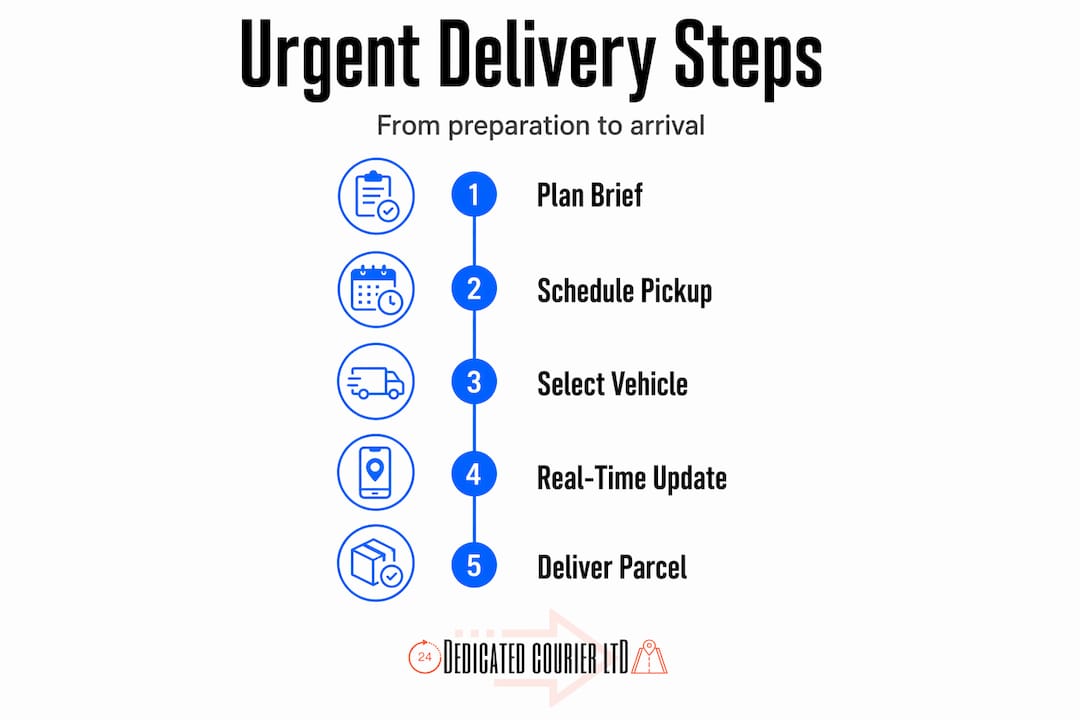
Step 1: Choose the right courier model
Dedicated courier services offer fixed drivers, defined routes, real-time tracking, and stable costs. On-demand services are more flexible but come with variable pricing and less operational accountability. For businesses with regular urgent delivery needs, a dedicated model is the more reliable choice. For one-off collections, on-demand may be sufficient.
Factor | Dedicated courier | On-demand courier |
Cost predictability | Fixed, contractual pricing | Variable, often surge-priced |
Driver familiarity | Same driver on known routes | Varies by availability |
Real-time tracking | Standard | Available on most platforms |
Best for | High-frequency urgent deliveries | Infrequent or unpredictable needs |
Accountability | High, defined SLAs | Lower, platform-dependent |
Step 2: Schedule with cut-off times in mind
Same-day courier services work on a tiered basis: same-day within hours for local urgent parcels, next-day or overnight for high-value time-sensitive goods, and two to three day expedited for general premium needs. Know which tier applies to your job and book with enough lead time to meet the collection cut-off.
Step 3: Match vehicle and driver to the job
Not every van is right for every delivery. A large pallet going to an industrial site needs a different vehicle than a fragile document pouch going to a city centre office. Check the courier vehicle options before booking and confirm the driver has experience with your goods type.
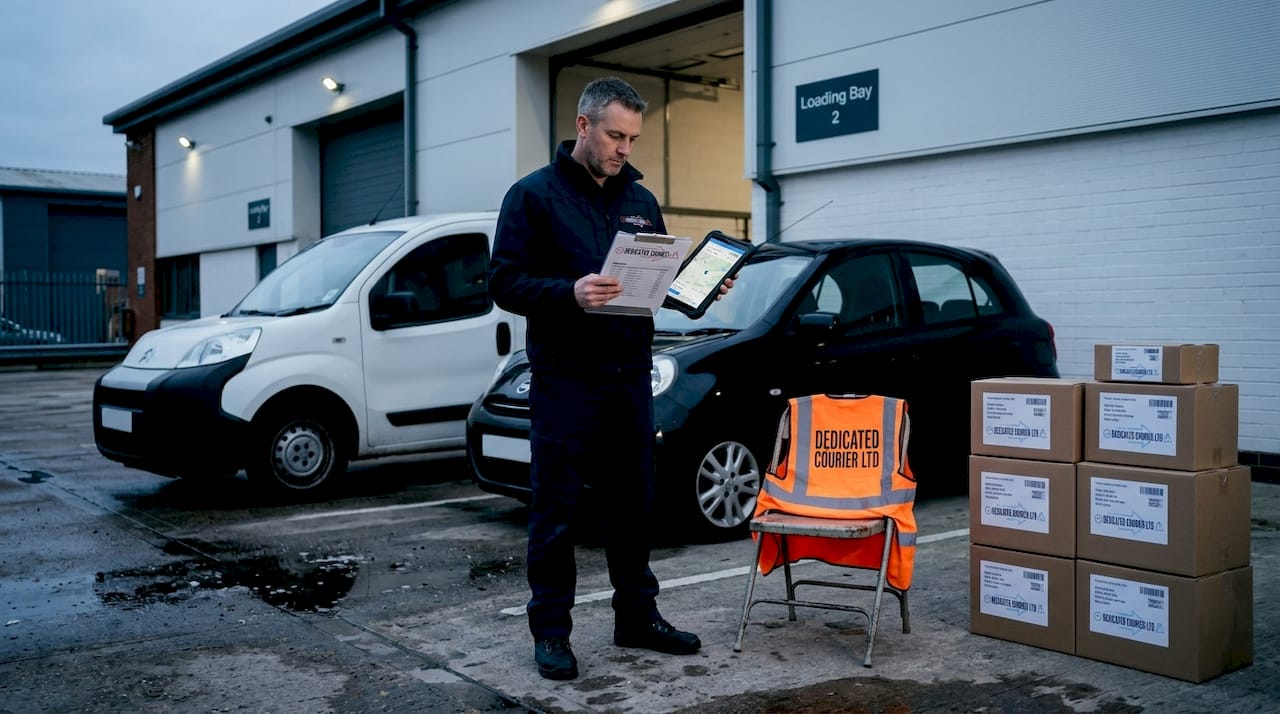
Step 4: Maintain real-time communication
Centralised communication platforms reduce delays and errors by ensuring drivers receive instant route updates and customers are informed promptly. Do not rely solely on end-of-day status emails. Use a platform that gives live visibility to all parties.
Pro Tip: For high-value or time-critical jobs, call the recipient 30 minutes before estimated arrival. This one step alone reduces failed deliveries on first attempt.
Troubleshooting common delivery challenges
Even well-planned urgent shipments encounter problems. The difference between a recoverable delay and a failed delivery is usually having a clear response process in place.
Real-world factors beyond GPS estimates
Automated routing tools do not account for everything. Experienced couriers adjust dynamically based on local conditions such as building access controls, one-way street configurations, and construction zones. When selecting a courier for an urban delivery, ask specifically about their knowledge of the area. A driver unfamiliar with a city centre site can lose 30 minutes on a 2-hour job.
Preventing failed deliveries
The most common reasons for failed urgent deliveries are wrong address details, an unavailable recipient, or restricted building access. All three are preventable. Verify address data before despatch, confirm recipient availability on the day, and pass any access codes or instructions directly to the driver.
A failed delivery on an urgent job rarely ends with just a rebook. It triggers a chain of problems: missed SLAs, additional costs, and often a difficult conversation with the end client. Prevention is significantly cheaper than recovery.
Managing unexpected delays
Have a contingency plan written before the job starts. This means knowing which backup courier you will use, at what point you will escalate, and who has authority to make rebooking decisions. Waiting until a delay occurs to figure this out costs time you do not have on an urgent shipment. You can also find guidance on handling urgent delivery workflows to build a consistent response process.
Measuring performance and improving over time
Applying courier delivery best techniques consistently requires tracking how well your current processes are performing. Without data, you are making decisions based on gut feel rather than evidence.
Key metrics to track
On-time delivery rate: the percentage of urgent jobs delivered within the agreed timeframe
Failed delivery rate: how often first-attempt deliveries do not succeed
Cost per delivery: total spend divided by number of successful deliveries
Average resolution time for delays: how long it takes to recover from a problem
Using technology to gather insights
Automated dispatch and routing reduce errors from manual handling and allow instant adjustments. When your dispatch system is centralised and integrated with order management, you can see where delays originate and act on them before they affect the customer.
Real-time tracking technologies are becoming fundamental to scaling urgent courier operations while maintaining high service levels. Businesses that rely on manual check-ins and phone calls cannot scale urgent delivery operations reliably.
Metric | Target benchmark | Review frequency |
On-time delivery rate | 95% or above | Weekly |
Failed delivery rate | Below 3% | Weekly |
Cost per delivery | Tracked against budget | Monthly |
Delay resolution time | Under 60 minutes | Per incident |
Standardising your workflows
Optimising urgent delivery processes requires consistency. Document your end-to-end process, from order receipt to delivery confirmation, and review it quarterly. When a failure occurs, trace it back to the step where it originated and update the process. Over time, this turns individual incidents into permanent improvements.
My take on dedicated couriers and why most clients undervalue them
I have worked with enough businesses managing urgent shipments to see a clear pattern. Most clients focus almost entirely on price when choosing a courier for a time-sensitive job, and they end up paying more in the long run through rebooks, delays, and the management time spent chasing updates.
The data is direct: dedicated couriers reduce delays by up to 30% compared to ad-hoc arrangements, because fixed routes, trained drivers, and defined accountability produce consistently better outcomes. I believe that for any business running more than a handful of urgent deliveries per month, the dedicated model is not a luxury. It is the operationally correct choice.
What most clients overlook is the cost predictability aspect. Dedicated courier contracts eliminate surge pricing and reduce financial risk compared to variable on-demand models. When you are managing a business, predictable costs are a genuine operational benefit, not just a nice-to-have.
The uncomfortable reality is that on-demand couriers work well when urgency is occasional. When urgency is frequent, they introduce exactly the kind of unpredictability you are trying to avoid.
— andrew
How Dedicatedsamedaycourier can support your urgent deliveries
[

Dedicatedsamedaycourier operates a nationwide dedicated courier service built specifically for time-sensitive deliveries. Whether you need a same-day collection for urgent documents or a larger vehicle for pallets, the service covers the full range of urgent shipping needs across the UK, 24 hours a day, seven days a week.
Every booking uses an exclusive vehicle, meaning your goods in transit are not shared with other consignments. This directly reduces handling risk and keeps delivery times predictable. You can review the full range of available courier vehicles to match the right option to your load size and delivery environment. Quotes are available by phone, email, or online form, with rapid response for urgent same-day requests.
FAQ
What are the most important best practices for urgent couriers?
Accurate documentation, correct courier selection, real-time communication, and contingency planning are the core practices. Preparing complete delivery instructions and confirming recipient availability before despatch prevents the majority of failed deliveries.
How do I choose between a dedicated and on-demand courier?
Dedicated couriers offer fixed costs, trained drivers, and greater reliability, making them better suited to high-frequency urgent deliveries. On-demand services work for occasional one-off needs where cost flexibility is the priority.
What metrics should I track for urgent delivery performance?
Track on-time delivery rate, failed delivery rate, cost per delivery, and average delay resolution time. Reviewing these weekly gives you the data needed to identify problems and improve your urgent shipping practices.
Why do urgent deliveries fail even with good planning?
Urban delivery complexities such as building access restrictions, one-way streets, and recipient unavailability cause failures that no amount of planning fully eliminates. Experienced couriers and clear pre-delivery communication reduce these incidents significantly.
How can real-time tracking improve urgent courier outcomes?
Real-time tracking gives dispatchers and customers live visibility of shipment progress, allowing instant responses to route changes or delays. Businesses that use centralised tracking platforms consistently achieve higher on-time delivery rates than those relying on manual updates.
Recommended


Comments