
Courier for construction companies: what you need to know
- Andrew Buttrick
- 3 days ago
- 7 min read
TL;DR:
Construction couriers deliver materials and documents quickly and reliably to building sites. They require diverse vehicle fleets, site-specific knowledge, and compliance with government procurement rules. Building relationships with trusted, compliant providers ensures timely, secure deliveries for complex construction projects.
A courier for construction companies is a specialised delivery service that transports materials, tools, and documents to building sites with speed, security, and reliability. Construction projects run on tight schedules, and a delayed delivery of drawings, fixings, or structural components can halt an entire crew. The right construction delivery service handles everything from urgent same-day runs to scheduled bulk drops, adapting to the unpredictable nature of site logistics. For projects tied to government or corporate contracts, compliance requirements add another layer of complexity that a general parcel carrier simply cannot meet.
What delivery services and vehicles does a construction courier need?
Construction sites do not operate like warehouses. Deliveries arrive at shifting locations, access is often restricted, and the loads range from a single envelope of signed drawings to a pallet of structural fixings. A capable same-day delivery service covers all of these scenarios.
Service levels that matter on site include:
Rush delivery: Rush services in metropolitan areas typically achieve delivery within 30 minutes in a city centre and within one hour in suburban zones. That speed is the difference between a crew waiting and a crew working.
Same-day scheduled: Booked in advance for predictable material drops, allowing site managers to plan receiving without disrupting other trades.
Early morning and out-of-hours: Critical for sites that start at 6:00 AM or require deliveries before other contractors arrive.
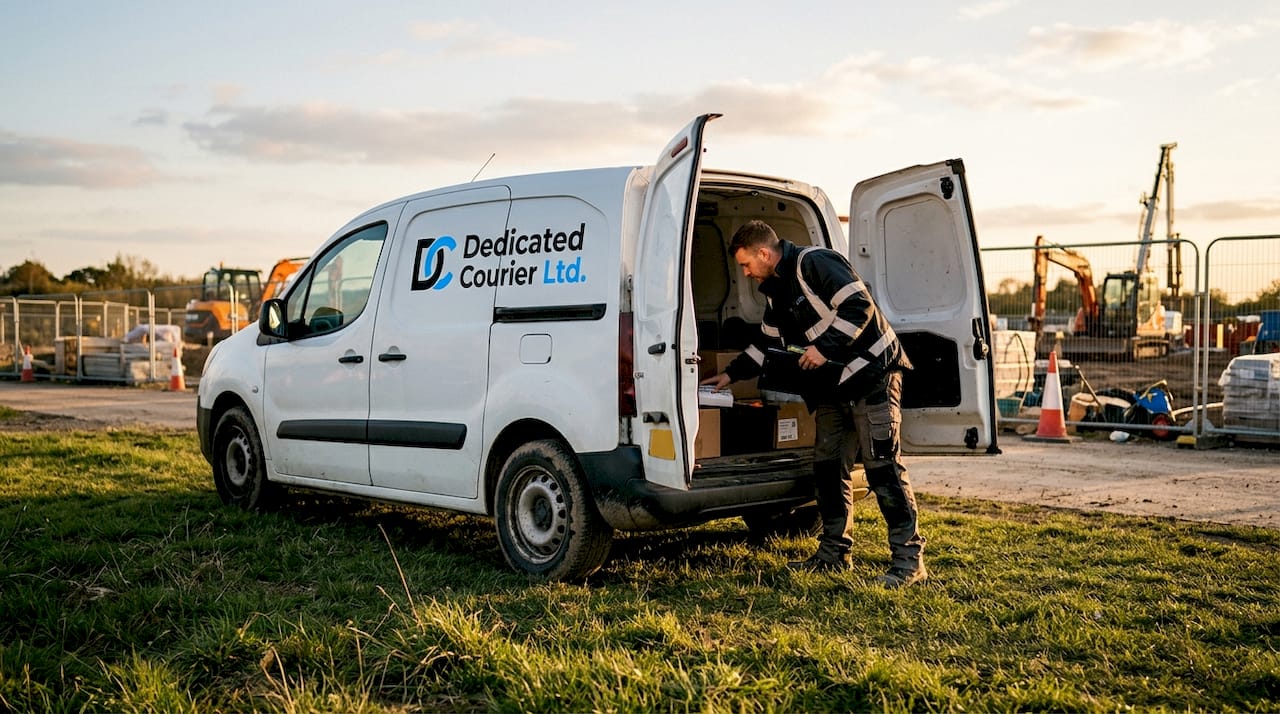
Vehicle choice is equally important. Couriers using diverse vehicle fleets, from small vans to large trucks, can accommodate parcels ranging from urgent documents to heavy freight. A small van suits tight urban sites with restricted access. A luton or flatbed handles longer lengths of pipe or timber that a standard van cannot carry.
Pro Tip: Before booking, confirm the site’s access restrictions, including height barriers, weight limits, and any requirement for a banksman. Matching the vehicle to the site avoids failed deliveries and wasted costs.
Why does government contract compliance matter for construction couriers?
Not every courier qualifies for government-funded construction work. Federal and public sector contracts carry specific procurement rules, and using a non-compliant courier creates billing problems and audit risk.
SAM.gov registration: Couriers performing federal work must register in SAM.gov with NAICS code 492110. Registration provides a Unique Entity ID (UEI) and confirms the courier meets federal contractor requirements including chain-of-custody protocols and billing audits. Without it, invoices cannot be processed through standard government procurement channels.
NAICS code 492110: This code specifically classifies courier and express delivery services. Couriers registered with SAM.gov and holding NAICS code 492110 can be matched directly to federal procurement opportunities linked to construction contract work. Registration simplifies audit and billing cycles considerably.
Driver vetting and bonding: Government contract couriers require bonded, insured, and background-checked drivers with experience in secure site access. Sites such as government buildings, military installations, and public infrastructure projects demand chain-of-custody documentation at every handover point.
24/7 availability: Federal deadlines and project schedules do not adhere to standard business hours. A courier for government contracts must offer continuous dispatch capability, not just a 9-to-5 service window.
The practical takeaway is straightforward. Using a SAM.gov registered courier with the correct NAICS codes significantly reduces procurement and compliance friction on public sector projects. Choosing an unregistered carrier creates delays that no project manager wants to explain to a client.
How to choose the right courier for your construction site
Selecting a courier for a construction project is not the same as choosing a parcel service for an office. The criteria are more demanding, and the consequences of a poor choice are measured in idle labour costs.
Key factors to assess before committing to a provider:
Insurance: Confirm the courier holds goods in transit insurance and hire and reward insurance. These are non-negotiable for any commercial delivery, particularly when carrying expensive materials or sensitive contract documents.
Driver vetting: Ask whether drivers are background-checked and trained in site safety awareness. A driver who does not understand construction site protocols creates risk for everyone on site.
Vehicle availability: A provider with a range of courier vehicles can respond to changing load requirements without you needing to source a different supplier mid-project.
24/7 dispatch: Construction schedules shift constantly. A courier that only operates during office hours cannot support early starts, late finishes, or emergency material runs.
Tracking and communication: Real-time tracking and direct driver contact reduce the anxiety of waiting for a critical delivery. Knowing exactly where a consignment is allows you to manage your crew’s time.
Experience with site logistics: Ask specifically whether the courier has delivered to active construction sites. Experience with restricted access, signing-in procedures, and coordinating with site managers is not something a courier learns on the job at your expense.
Pro Tip: Request references from at least two similar construction projects before signing any ongoing agreement. A courier who has delivered to comparable sites will handle your logistics far more reliably than one learning the sector for the first time.
What challenges do couriers face on construction sites and how are they resolved?
Construction sites present delivery problems that standard logistics providers are not built to handle. Understanding these challenges helps you assess whether a courier is genuinely prepared.
Challenge | Courier strategy |
Sites without fixed postcodes | Use of GPS coordinates and direct liaison with site managers for precise location confirmation |
Last-minute schedule changes | 24/7 dispatch and flexible booking systems that allow same-day amendments |
Bulky or awkward loads | Specialist vehicle selection matched to load dimensions and site access constraints |
Restricted site access | Pre-arranged driver inductions and coordination with site security or the site foreman |
Sensitive or high-value materials | Chain-of-custody documentation and dedicated vehicles with no shared loads |
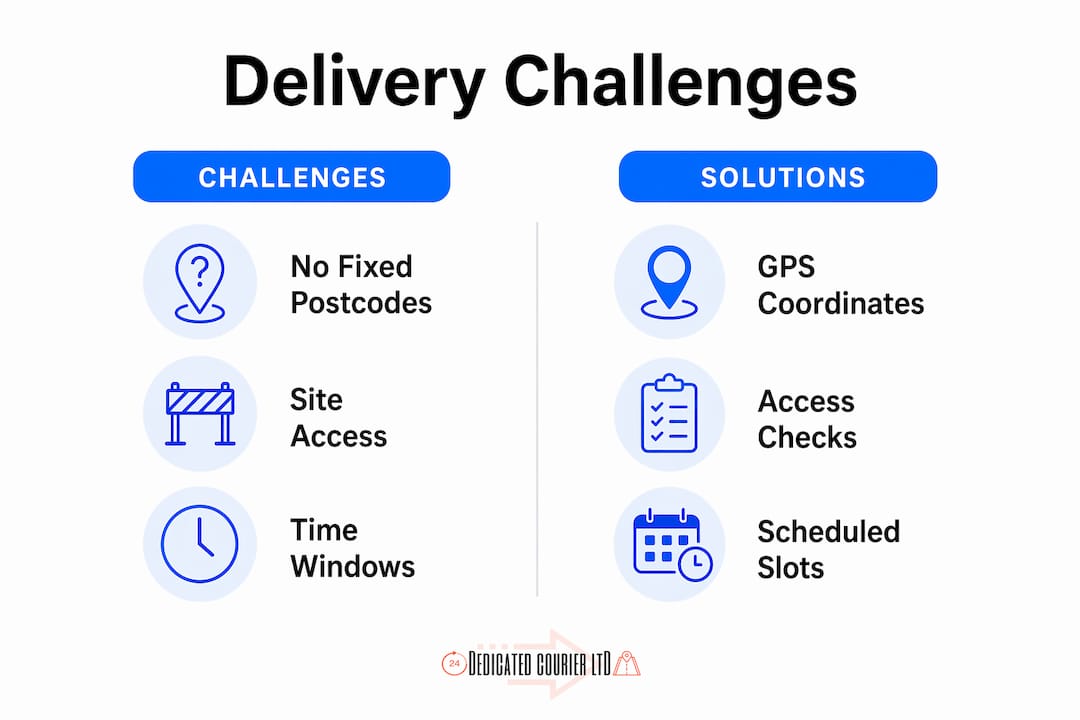
Specialised couriers liaise directly with on-site fitters and contractors to confirm delivery windows and resolve access issues before the vehicle arrives. That coordination prevents the most common cause of failed deliveries: a driver turning up at a locked gate with no one expecting them. For construction logistics that involve multiple trades and shifting timelines, this level of communication is not optional.
Key takeaways
A reliable courier for construction companies must combine same-day speed, appropriate vehicle capacity, site-specific experience, and compliance credentials to protect both project timelines and contract obligations.
Point | Details |
Match vehicle to site requirements | Confirm access restrictions and load dimensions before booking to avoid failed deliveries. |
Verify compliance credentials | For government projects, use a SAM.gov registered courier with NAICS code 492110. |
Prioritise 24/7 availability | Construction schedules shift constantly; your courier must operate outside standard business hours. |
Demand driver vetting | Background-checked, site-aware drivers reduce risk and meet government contract requirements. |
Coordinate before arrival | Couriers who liaise directly with site personnel prevent access failures and wasted journeys. |
What I have learned from working with construction couriers
Construction managers often treat courier selection as an afterthought, booking whoever is cheapest on the day. That approach costs far more than it saves. A failed delivery on a critical pour day or a missing set of drawings before a structural inspection creates delays that ripple through the entire programme.
The couriers who perform consistently well on construction projects share one quality: they ask the right questions before the job, not after. They want to know the site address format, the access procedure, the contact name on site, and whether there are any load restrictions. That preparation is what separates a professional logistics partner from a parcel carrier who happens to have a van.
I would also caution against assuming that a courier who handles your office documents can handle your site deliveries. The two environments are completely different. An active construction site requires a driver who understands basic site safety, knows how to sign in, and can communicate clearly with a site foreman under pressure. That experience is worth paying for.
Build a relationship with one or two trusted providers rather than shopping around for the lowest price on every job. Couriers who know your sites, your team, and your typical loads will consistently outperform a new provider who is learning your requirements from scratch.
— andrew
Dedicatedsamedaycourier: built for construction logistics
Construction projects need a courier that is ready when the site is, not just when an office is open.
[
Dedicatedsamedaycourier operates 24 hours a day, seven days a week, with nationwide courier coverage across the UK. The service offers a full range of specialist courier vehicles, from small vans suited to tight urban sites through to larger vehicles capable of carrying heavy or awkward construction materials. Each delivery uses a dedicated vehicle, meaning your load travels alone with no shared drops to slow it down. Whether you need an urgent same-day run for contract documents or a scheduled material delivery to a remote site, Dedicatedsamedaycourier provides a quote by phone, email, or online form, with drivers available around the clock.
FAQ
What is a courier for construction companies?
A courier for construction companies is a specialist delivery service that transports materials, tools, and documents to building sites, often with same-day speed and vehicles suited to site access constraints.
Do construction couriers need special insurance?
Construction couriers must hold goods in transit insurance and hire and reward insurance. These cover the cargo and the commercial nature of the delivery, protecting both the courier and the client.
What is NAICS code 492110 and why does it matter?
NAICS code 492110 classifies courier and express delivery services for federal procurement purposes. Couriers registered in SAM.gov with this code can fulfil government construction contracts and process invoices through official billing channels.
How quickly can a same-day construction courier deliver?
Rush courier services in metropolitan areas typically deliver within 30 minutes in a city centre and within one hour in suburban areas, making them suitable for urgent on-site material needs.
What should I check before booking a courier for a construction site?
Confirm the courier holds the correct insurance, uses background-checked drivers, offers 24/7 dispatch, and has experience coordinating deliveries with active construction site personnel.
Recommended


Comments