
Why fast delivery matters for your business in 2026
TL;DR:
Fast delivery usually means fulfilling orders within two days, which 86% of consumers expect. It influences purchasing, reduces cart abandonment, and boosts customer loyalty through reliable, predictable service. Operational challenges include balancing speed, reliability, and costs, with strategies like tiered options and proactive communication improving satisfaction.
Fast delivery is defined as the ability to fulfil and transport an order within a timeframe that meets or exceeds customer expectations, typically two days or less. 86% of consumers define fast delivery as two days or fewer. That single statistic tells you everything about where the bar sits. Why fast delivery matters is no longer a theoretical question for logistics teams. It is a direct commercial concern for any business that ships goods, whether that means documents, parcels, or pallets. Speed shapes purchasing decisions, reduces cart abandonment, and determines whether a customer returns. The industry term for this operational priority is rapid fulfilment, and it sits at the centre of modern logistics strategy.
How does fast delivery affect customer behaviour?
Speed changes what customers buy and when they buy it. 42% of consumers aged 25–44 are more likely to purchase from retailers offering same-day delivery. That group represents a core spending demographic, so losing them to a faster competitor carries real revenue consequences.

The importance of quick shipping also shows up in cart abandonment data. Between 23% and 43% of shoppers abandon their carts because of slow or inadequate delivery options. Abandonment at that scale is not a minor friction point. It is a structural leak in your sales funnel.
Fast delivery also unlocks a category of purchase that slower logistics cannot serve: last-minute buying. 27% of consumers say rapid delivery increases the likelihood of last-minute purchases. That behaviour drives incremental revenue that would otherwise go unspent or go to a local shop.
The benefits of fast delivery extend to customer loyalty as well. Businesses that offer urgent courier services in retail operations report stronger repeat purchase rates. Speed, when delivered consistently, builds the kind of trust that keeps customers from shopping around.
Key drivers of fast delivery demand:
Same-day and next-day options increase purchase likelihood among 25–44-year-olds
Slow delivery options are a leading cause of cart abandonment
Last-minute purchase behaviour depends entirely on rapid fulfilment capability
23% of consumers will pay extra for delivery within three hours
Is delivery reliability more important than speed?
Reliability and speed are not the same thing, and conflating them is one of the most common mistakes in logistics planning. Executives at major retailers including Ulta Beauty and Macy’s have stated publicly that delivery reliability creates higher satisfaction than raw speed alone. That finding should reframe how businesses think about their delivery promise.
Customers who order high-value or bulky items want to know exactly when their goods will arrive. Predictable delivery windows are often preferred over the fastest possible option because they allow customers to plan receipt. A delivery that arrives within a communicated two-hour window on day two is more satisfying than a delivery that might arrive any time on day one.
“Speed is a marketing lever to acquire customers. Reliability is the operational foundation that retains them. Businesses that confuse the two end up fast but unpredictable, which is the worst outcome of all.”
The operational implication is clear. Businesses must build systems that deliver on time, every time, before they chase faster transit times. Predictability influences reorder rates and long-term loyalty more than raw speed does.
Pro Tip: Communicate a specific delivery window at checkout rather than a vague “next-day” promise. Customers who know exactly when to expect their parcel report higher satisfaction, even if the window is not the fastest available.
What are the operational challenges of fast delivery?
Rapid fulfilment is not simply a matter of choosing a faster carrier. Fast delivery challenges are often operational, caused by inadequate workflows and lack of automation rather than transit speed alone. When in-store or warehouse staff pick and pack orders without dedicated zones or process separation, efficiency degrades quickly under volume pressure.
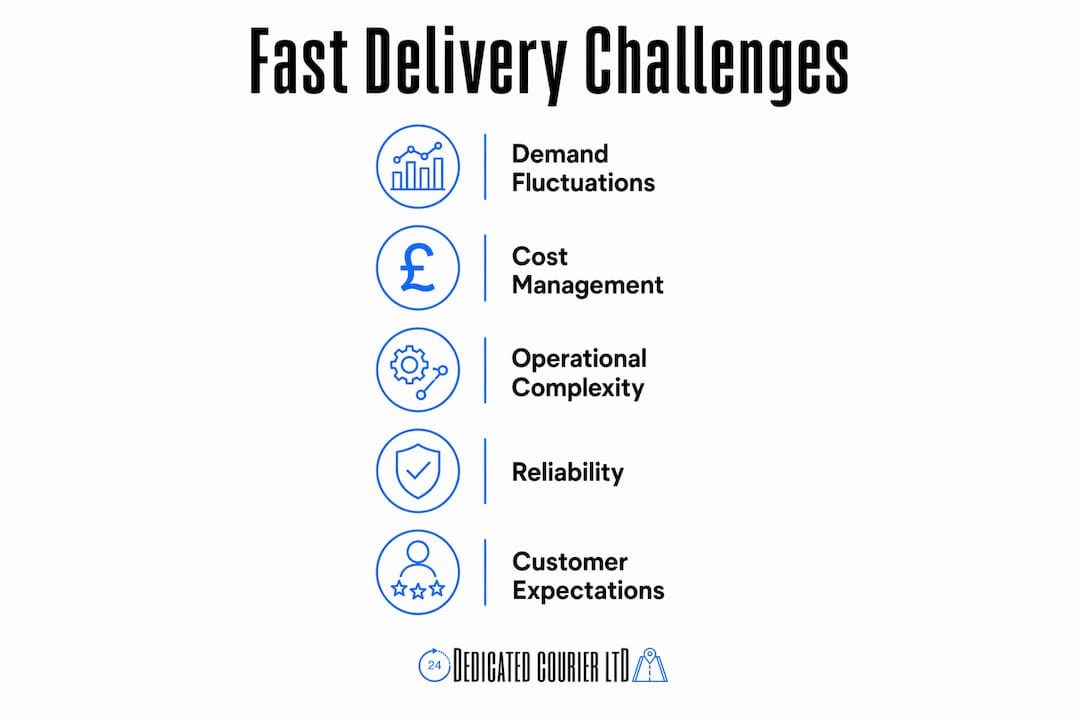
Cost is the other constraint. 40% of consumers will pay more than £2 for faster delivery, but willingness drops sharply above £5. That narrow price band means businesses cannot simply pass the full cost of rapid fulfilment to customers. Margins must be managed carefully.
The table below shows how operational approaches differ by fulfilment model:
Fulfilment approach | Speed potential | Cost pressure | Reliability risk |
Manual pick and pack, no zones | Low | High per unit | High |
Dedicated fulfilment zones, manual | Medium | Moderate | Medium |
Automated sorting with dedicated courier | High | Lower per unit | Low |
Dedicated same-day courier, exclusive vehicle | Highest | Variable | Very low |
Walmart has noted that accelerated fulfilment drives growth by increasing purchase frequency and acting as an engine of operating leverage. The cost of speed is offset when customers buy more often. That dynamic only works when the operational infrastructure supports consistent, reliable output.
Practical strategies to improve delivery speed and satisfaction
Businesses that manage delivery speed well do not simply move faster. They make deliberate choices about when to be fast, when to offer alternatives, and how to communicate both.
Offer no-rush delivery incentives. More than 80% of consumers will accept slower shipping in exchange for incentives such as discounts or loyalty points. This smooths demand peaks and improves carrier utilisation without sacrificing customer goodwill.
Separate fulfilment from other operations. Dedicated picking and packing zones prevent order processing from competing with other warehouse or retail activity. This single change reduces errors and speeds up dispatch times significantly.
Use dedicated courier services for urgent shipments. For time-critical goods, an exclusive vehicle means no shared loads, no depot delays, and a direct route. Dedicatedsamedaycourier operates on this model, which is why it suits urgent or high-value consignments.
Communicate tracking and windows proactively. Customers who receive real-time updates report higher satisfaction regardless of delivery speed. Proactive communication reduces inbound queries and builds confidence in your fulfilment process.
Segment your delivery offer by urgency. Not every order needs same-day speed. Offering tiered options lets customers self-select and lets you allocate premium capacity where it generates the most value.
Pro Tip: Review your delivery optimisation approach regularly. Small process changes at the dispatch stage often reduce transit time more than switching carriers.
Key takeaways
Fast delivery drives sales, loyalty, and operational efficiency when it is built on reliable, well-communicated fulfilment rather than speed alone.
Point | Details |
Speed drives conversion | Between 23% and 43% of shoppers abandon carts due to slow delivery options. |
Reliability retains customers | Predictable delivery windows build loyalty more effectively than raw transit speed. |
Cost sensitivity is real | Most consumers will not pay more than £5 extra for faster delivery, so margins matter. |
Operational gaps cause delays | Lack of automation and dedicated fulfilment zones is the primary cause of slow dispatch. |
No-rush options add flexibility | Over 80% of consumers accept slower delivery for incentives, improving carrier efficiency. |
Speed without reliability is a short-term win
I have spoken with enough logistics managers to know that the businesses chasing the fastest possible delivery times are not always the ones with the happiest customers. The ones that get it right are the ones that promise a window and hit it, every single time.
The pattern I see repeatedly is this: a business invests in speed, cuts transit times, and sees a short-term lift in conversion. Then reliability slips because the operational infrastructure was not built to sustain the pace. Returns go up, complaints follow, and the gains disappear. Speed without a reliable foundation underneath it is a liability, not an advantage.
What I advocate for is a customer-centric delivery promise. Tell customers exactly when their goods will arrive. Build your operations around hitting that window consistently. Then, once reliability is solid, look at where you can genuinely reduce transit time without compromising the promise. That sequence matters. Getting it backwards is expensive.
The trend I expect to see more of in 2026 and beyond is businesses using dedicated courier services for their most urgent shipments while managing standard orders through tiered, incentivised options. That split approach protects margins and keeps the highest-value customers satisfied.
— andrew
Urgent delivery, handled properly by Dedicatedsamedaycourier
When a shipment cannot wait, the logistics model behind it matters as much as the vehicle carrying it. Dedicatedsamedaycourier provides same-day courier services across the UK, using exclusive vehicles so your goods travel directly without shared loads or depot delays.
[
The service operates 24/7 and covers nationwide collections and deliveries, including urgent same-day, next-day, and overnight options. Businesses can request a quote by phone, email, or online form for tailored solutions. Whether you need a dedicated courier vehicle for a single urgent consignment or a reliable partner for regular time-sensitive runs, Dedicatedsamedaycourier is built around punctuality and direct service. Contact the team to discuss your delivery requirements.
FAQ
Why does fast delivery matter for sales?
Fast delivery reduces cart abandonment and increases purchase likelihood. Between 23% and 43% of shoppers abandon carts when delivery options are too slow.
Is same-day delivery worth the cost for businesses?
Same-day delivery increases purchase frequency and customer lifetime value, which offsets higher fulfilment costs over time. Walmart’s experience shows that rapid fulfilment drives measurable growth in repeat buying.
What do customers value more: speed or reliability?
Customers value reliability over raw speed for long-term satisfaction. Predictable delivery windows allow customers to plan receipt and build trust in a brand.
How can businesses reduce delivery time without raising costs?
Separating fulfilment into dedicated zones, using automation, and offering no-rush incentives to smooth demand all reduce effective delivery time without proportionally increasing cost per order.
What is the consumer price threshold for faster delivery?
Most consumers will pay more than £2 for faster delivery, but willingness drops sharply above £5. Rapid delivery works best when positioned as accessible convenience rather than a premium add-on.
Recommended


Comments