
Courier safety checklist: 5 essential steps for UK deliveries
Updated: May 14
TL;DR:
Regular vehicle checks and load securing are essential to prevent accidents and legal penalties.
Managing driver fatigue through proper scheduling reduces the risk of road collisions and errors.
Proper PPE, lone worker protocols, and high-risk site measures ensure staff safety and compliance.
Neglecting courier safety is not just a compliance risk, it is a direct threat to your business. Accidents, damaged goods in transit, and regulatory fines from bodies like the DVSA and HSE can derail operations and erode customer trust fast. For small businesses and corporate clients managing urgent logistics, a structured safety checklist is the most reliable way to protect drivers, cargo, and your reputation. This article covers every critical step, from daily vehicle checks to lone worker protocols, giving you a practical framework you can implement immediately.
Table of Contents
Key Takeaways
Point | Details |
Check vehicles daily | Daily legal inspections keep drivers safe and avoid fines. |
Secure and load smartly | Proper handling and securing of goods prevent injuries and damage. |
Manage fatigue risk | Enforcing breaks and legal driving hours dramatically reduces crash risk. |
Equip and protect lone workers | PPE and regular check-ins are vital for courier and business safety. |
Go beyond the basics | Real safety comes from addressing unique risks, not just ticking boxes. |
Daily vehicle inspection and legal checks
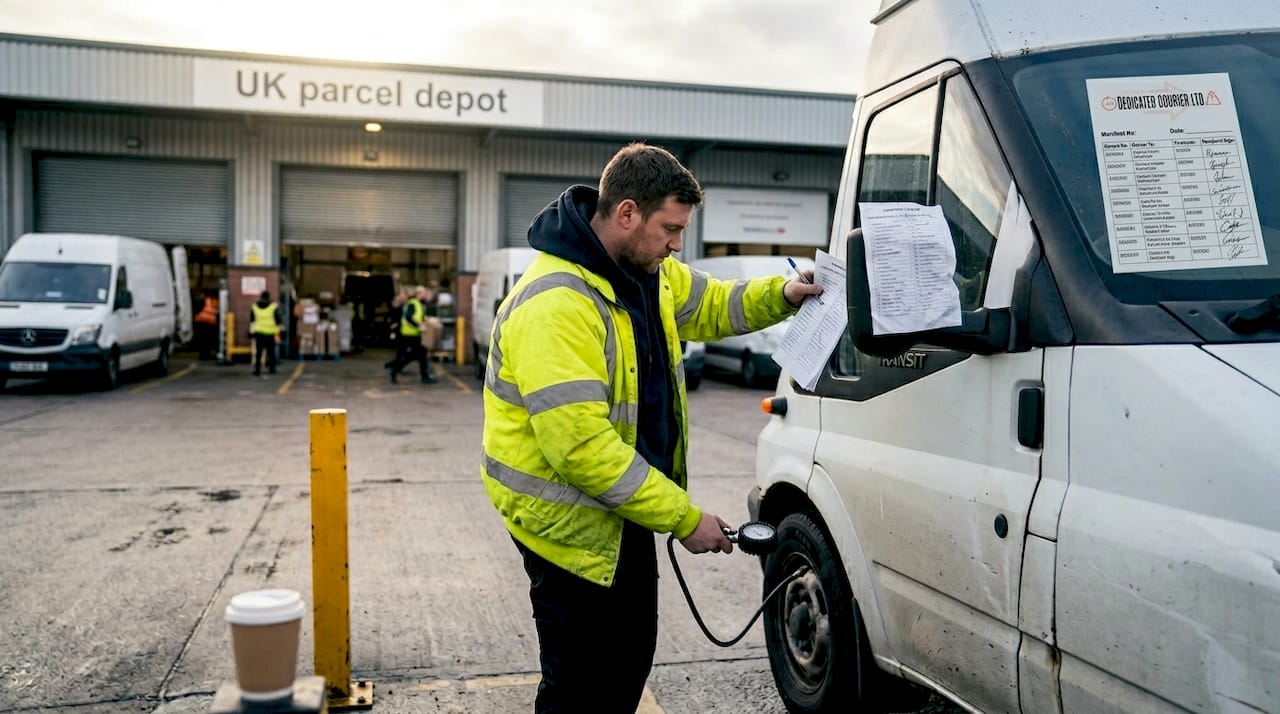
Before any parcel leaves the depot, the vehicle carrying it must be roadworthy. This is not optional. Daily walk-around checks are a DVSA requirement for all commercial drivers, and failure to comply can result in prohibition notices, fines, or worse, a serious road incident.
The HSE inspection checklist covers vehicle maintenance and suitability, requiring checks on mirrors, windscreens, fluids, brakes, tyres, and lights before every journey. These are not bureaucratic formalities. Each item on that list corresponds to a real failure mode that has caused accidents.
Here is what a proper daily check should cover:
Tyres: Correct pressure and legal tread depth (minimum 1.6mm)
Lights: All indicators, brake lights, and headlights functioning
Mirrors: Clean, correctly adjusted, and undamaged
Fluids: Oil, coolant, and screen wash at safe levels
Brakes: No unusual resistance or noise during a slow test
Windscreen: No cracks obstructing the driver’s field of vision
Component | Checked vehicle | Unchecked vehicle |
Tyres | Road-legal, safe grip | Blowout risk, MOT failure |
Brakes | Reliable stopping distance | Collision risk |
Lights | Legal and visible | Fine, points, accident |
Fluids | Engine protected | Breakdown mid-route |
For further guidance on vehicle check guidelines and small van inspections, reviewing the full HSE checklist is strongly advised.
Pro Tip: Introduce a guided walkthrough process for drivers, using a printed or digital form they sign off each morning. Compliance rates improve significantly when checks are structured and documented.
Safe loading, securing, and manual handling
With vehicles checked, the focus shifts to preventing injuries and damaged goods during loading. This stage carries significant legal weight and practical consequence for your operations.

Manual Handling Operations Regulations 1992 require employers to conduct risk assessments for any lifting task. Back injuries are the most common result of poor manual handling, and they are largely preventable.
Follow these principles during every loading operation:
Do bend at the knees, not the waist
Do keep the load close to the body
Do use mechanical aids or team handling for heavy items
Don’t twist the torso while carrying
Don’t rush lifts or skip risk assessments for unfamiliar loads
Cargo securing is equally critical. Load securing prevents instability and accidents; spread weight evenly, use ratchet straps, and ensure nothing slides under braking, as required by DVSA and DfT Code of Practice.
Injury or incident | Common cause | Prevention |
Back strain | Incorrect lifting posture | Bend knees, keep load close |
Cargo damage | Unsecured items shifting | Ratchet straps, even distribution |
Driver collision | Unbalanced load affecting steering | Proper load spreading |
Review best practices for securing freight and LWB van safety before handling larger consignments. The HSE load securing guidance provides detailed standards.
Pro Tip: Use the HSE’s MAC (Manual Handling Assessment Charts) or RAPP (Risk Assessment of Pushing and Pulling) tools to conduct thorough, documented risk assessments. These are free, practical, and legally defensible.
Driver fatigue and duty schedules
Cargo secured, the next checklist priority is ensuring drivers stay rested and alert throughout their routes. Fatigue is one of the most underestimated risks in courier operations.
Driver fatigue contributes to 20% of road collisions, and UK law sets clear limits: a maximum of 9 to 10 driving hours per day, a minimum of 11 hours rest between shifts, and a 15-minute break every 2 hours under Domestic Drivers’ Hours Rules.
Key steps to manage fatigue effectively:
Schedule routes to avoid excessive back-to-back driving hours
Use fatigue monitoring apps to flag high-risk shift patterns
Build mandatory rest stops into route plans, not just driver discretion
Avoid scheduling overnight or early-morning starts without adequate prior rest
Train drivers to recognise early signs of fatigue: yawning, slow reaction times, lane drifting
For businesses managing essential fatigue management, the legal and operational case is clear. Tired drivers make errors. Errors cost money, damage goods, and put lives at risk.
Defensive driving training and route planning that accounts for weather and traffic conditions can also reduce the cognitive load on drivers, meaning they arrive at each stop more alert and better prepared.
Pro Tip: Review driver schedules weekly, not just reactively after incidents. Patterns of early starts and late finishes often go unnoticed until an accident forces a review.
For practical fatigue safety tips, the guidance is clear and worth bookmarking for your operations team.
PPE, lone working, and high-risk situation protocols
Beyond daily routines, staying compliant means preparing staff for both everyday and exceptional risks. PPE and lone working protocols are two areas that many businesses treat as secondary, when they should be standard.
PPE Regulations 2002 require a risk assessment and provision of appropriate equipment. For courier drivers, this means:
High-visibility clothing for roadside and warehouse environments
Non-slip footwear to prevent falls during loading and delivery
Gloves for handling sharp, heavy, or hazardous items
Lone working is a significant risk for couriers. Over 1.5 million company vans operate in the UK, and many drivers spend entire shifts without direct supervision or colleague contact. HSE classifies lone workers as potentially at risk, particularly in isolated or unfamiliar locations.
Follow these steps for lone worker safety:
Provide all drivers with a GPS-enabled device or tracking app
Establish mandatory check-ins every 2 hours
Use a communications app that flags missed check-ins automatically
Brief drivers on what to do if they feel unsafe at a delivery location
Maintain an up-to-date emergency contact list for each driver
For high-risk protocols involving valuable goods, add dashcam recording, a safe parking policy, and a formal refusal procedure for deliveries that cannot be completed safely. Review optimising urgent deliveries for further operational guidance. The courier PPE advice from Courier Exchange is also a useful reference.
A real-world view: What most courier safety lists overlook
Regulatory checklists set the baseline, but they rarely capture what actually goes wrong in fast-moving courier operations. After working through countless delivery scenarios, the gaps become obvious.
Legally compliant does not always mean operationally safe. HSE emphasises cooperation between suppliers, carriers, and recipients for site safety, yet most checklists focus entirely on the driver. What happens at the receiving site matters just as much.
Vehicle choice is another area where assumptions cause problems. Motorised two-wheelers carry higher crash risks than light vans, despite being perceived as nimble and efficient. Businesses choosing motorbikes for speed may be trading safety for convenience without realising it. For guidance on vehicle type safety, the implications are worth reviewing carefully.
Extra protocols for high-value goods and unfamiliar delivery sites should be standard, not exceptional. These are the scenarios where incidents cluster, and where a checklist alone is not enough.
Secure your urgent deliveries with experts
If your business needs peace of mind and proven safety practices on every delivery, here is where to start.
[

At DedicatedSameDayCourier.co.uk, every step in this checklist is built into how we operate. Our sameday courier service covers urgent collections and deliveries nationwide, with insured, tracked, and dedicated vehicles. Explore our full range of van courier options or contact the team via dedicatedsamedaycourier.co.uk to discuss your specific requirements. Safe, compliant, and fast delivery is not a compromise you need to make.
Frequently asked questions
What daily checks must a UK courier complete by law?
DVSA and HSE require daily checks on mirrors, tyres, brakes, fluids, lights, and windscreens to ensure commercial vehicles are roadworthy before each journey.
What is the best way to prevent manual handling injuries for couriers?
Use correct technique including bending the knees, keeping loads close, and avoiding twisting, and conduct risk assessments using HSE tools like MAC before handling unfamiliar or heavy loads.
How often do lone couriers need to check in for safety?
Mandatory check-ins every 2 hours are advised, particularly for high-risk or isolated deliveries where drivers have no direct supervision.
Which PPE is compulsory for courier drivers in the UK?
High-visibility clothing, non-slip footwear, and gloves are required following a PPE risk assessment under the PPE Regulations 2002.
Recommended


Comments