
Declared value for UK shippers: what to declare and when
- Andrew Buttrick
- 12 hours ago
- 12 min read

Declared value is the monetary figure you give a carrier as its maximum payout if your goods are lost or damaged. It is also the figure customs authorities use to calculate import duty and VAT. Declare the commercial transaction value, attach proof of that value, and check the carrier’s terms before dispatch. Those three steps cover most situations.
Before you hand over any consignment, run through this short list:
Declare the commercial transaction value (what the buyer actually paid, or the fair market value for non-sale items).
Attach a commercial invoice or receipt as proof.
Read the carrier’s terms and conditions for liability caps and per-item limits.
If the goods are worth more than the carrier’s cap, arrange goods-in-transit (GIT) insurance before collection.
For non-commercial shipments (gifts, samples, returns), use the replacement or fair market value, not a token figure.
Pro Tip: If you regularly send lightweight, high-value items such as electronics or jewellery, check the per-item limit on your GIT policy before accepting a job. Standard policies often cap individual items at moderate amounts, which may leave you significantly exposed.
Key takeaways
Declared value sets the carrier’s payout ceiling and feeds customs duty calculations, so declaring the correct transaction value with documentary proof is the single most important step before any high-value shipment.
Point | Details |
Declare the transaction value | Use the actual price paid, not a token or estimated figure, for both carrier and customs purposes. |
Keep proof of value | Retain commercial invoices, payment records, and appraisals for at least four years. |
Check carrier liability caps | RHA weight-based limits can produce negligible payouts for lightweight, high-value goods. |
Arrange GIT insurance separately | Full-value GIT covers the actual declared value; carrier liability alone rarely does. |
Use Dedicatedsamedaycourier for high-value runs | Exclusive vehicles, direct routing, and documented insurance cover reduce risk for valuable consignments. |
Table of Contents
What declared value actually means for courier liability and customs
How HMRC and UK customs assess shipment value and calculate duty
How carrier liability compares with goods-in-transit insurance
When a dedicated courier is the right choice for high-value consignments
An editorial view on declared value: the gap nobody talks about
High-value shipments handled with the right cover from the start
What declared value actually means for courier liability and customs
The phrase “declared value” does two distinct jobs, and confusing them is one of the most common and costly mistakes shippers make.
For the carrier, declared value is a contractual cap. It sets the ceiling on what the carrier will pay if goods are lost or damaged in transit. It does not guarantee full replacement; it simply defines the maximum the carrier has agreed to be liable for under its conditions of carriage.
For customs, declared value is a statutory input. HMRC and border authorities use it to assess import duty and VAT on goods entering the UK. This is a legal obligation, not a commercial negotiation.
Authority | How they use the declared figure | Consequence of getting it wrong |
Carrier | Sets the payout ceiling for loss or damage claims | Underdeclare and your claim payout is capped at the lower figure |
HMRC / UK customs | Calculates import duty and VAT | Underdeclare and you risk penalties, delays, or seizure |
A brief example shows how the two can diverge. Suppose you ship a £2,000 laptop. The carrier operates under RHA Conditions of Carriage, which cap liability at £1,300 per tonne. A 500g parcel under that formula produces a payout of roughly 65 pence. Customs, meanwhile, will assess duty and VAT on the full £2,000 transaction value. The carrier’s liability and the customs figure are calculated entirely separately, and neither automatically protects your financial position.
Key distinctions to keep in mind:
Declared value for carrier purposes is contractual and governed by the carrier’s T&Cs.
Declared value for customs is statutory and governed by HMRC rules and international agreements.
The two figures should usually be the same (the transaction value), but the consequences of error differ entirely.
Which value should you declare for different shipment types
The right figure depends on the nature of the shipment. The starting point is always the transaction value: what the buyer paid, inclusive of any charges that form part of the price. HMRC and the WTO treat this as the primary method of valuation, and carriers generally expect it too.
Commercial sale: Declare the invoice price the buyer paid. Include freight and insurance if they form part of the contract price. Keep the commercial invoice, payment confirmation, and any purchase order.
Gift: Declare the fair market value or replacement cost of the item. Never write a token figure such as £1 — customs will reassess and may impose penalties. Gifts sent between private individuals may be eligible for relief, but the value must still be accurate.
Sample or return: Declare the commercial value of the goods, not zero. A sample has a production cost; a return has the value at which it was originally sold. Customs will not accept “no commercial value” for goods that clearly have one.
Insurance replacement value: Use this when goods have no recent purchase price (antiques, bespoke items). Get a written valuation from a qualified appraiser and keep it on file.
Pro Tip: Keep all proof of value for at least four years. HMRC can raise a customs query well after the shipment has been delivered, and a missing invoice at that stage can turn a minor query into a formal investigation.
For documentation, you need at minimum: a commercial invoice showing the transaction value, a packing list, and proof of payment (bank transfer record, card receipt, or purchase order). For high-value or unusual items, a written appraisal or insurance schedule adds a further layer of protection.
Where to put the declared value on your shipping documents
Getting the value right is only half the job. Entering it in the wrong field, or omitting it from a required document, can cause the same delays as a wrong figure.
Courier waybill or consignment note: Look for a field labelled “Declared Value,” “Goods Value,” or “Value for Carriage.” This is the carrier’s contractual figure. Enter the transaction value here.
Commercial invoice: This document travels with the goods and is the primary customs document. It must show the seller’s name and address, buyer’s name and address, a full description of the goods, quantity, unit price, total value, and currency. For UK exports and imports, this is mandatory for any commercial shipment.
CN22 or CN23 (postal customs forms): Used for Royal Mail international shipments. CN22 covers goods up to £270 in value; CN23 covers higher values. Both require a description, quantity, weight, and declared value. Since January 2021, electronic customs data submitted via the carrier’s system has largely replaced paper forms for commercial parcels, but the data fields are identical.
Electronic customs declaration (CDS/CHIEF): For formal UK customs entries, the declared value feeds directly into the Customs Declaration Service. Your freight forwarder or customs broker will enter it, but you are responsible for supplying the correct figure.
Documents to attach to every high-value consignment:
Commercial invoice (signed and dated)
Packing list (item-by-item breakdown)
Proof of payment (bank statement extract or card receipt)
Insurance confirmation or GIT policy schedule
Any special handling instructions in writing
For guidance on how courier services work and what paperwork to expect at each stage, that overview covers the full workflow from booking to delivery.
How HMRC and UK customs assess shipment value and calculate duty
HMRC follows the same valuation hierarchy as the WTO: transaction value first, with defined fallback methods applied in sequence when the transaction value is unavailable or unreliable.
The fallback order, in brief:
Transaction value of identical goods (same goods, same origin, same period)
Transaction value of similar goods
Deductive value (working back from the UK selling price)
Computed value (cost of production plus profit margin)
Fall-back method (reasonable means consistent with WTO principles)
In practice, customs will use your declared transaction value for the vast majority of commercial shipments. Problems arise when the declared figure is inconsistent with the goods description, when the relationship between buyer and seller may have influenced the price, or when the figure is implausibly low.
Worked example — duty and VAT on a £500 declared value:
Duty rates vary by commodity code (tariff heading), so always check the UK Global Tariff for the correct rate before shipping. HMRC requires you to keep customs records for at least four years; for VAT purposes, six years is the standard.
How carrier liability compares with goods-in-transit insurance
The financial gap between what a carrier will pay and what your goods are actually worth can be significant. Understanding that gap before dispatch is the point at which most shippers either protect themselves or leave themselves exposed.
Under standard RHA Conditions of Carriage, carrier liability is capped by weight at £1,300 per tonne. For a 500g parcel, that produces a theoretical maximum payout of around 65 pence, regardless of the goods’ actual value. Many carriers also impose per-item and per-load caps in their own T&Cs, which may be more generous than the RHA formula but are still contractual limits, not full-value cover.
Full-value GIT insurance pays on the actual declared or insured value of the goods. Standard GIT policies typically set modest per-item limits and per-load limits suitable for many deliveries. Extended or specialist policies can raise per-item limits substantially to accommodate higher-value items. For a self-employed courier, full-value GIT cover in the £10,000–£25,000 band can cost as little as £100–£250 per year, making it economical against the risk of a single uninsured loss.
For a deeper look at types of goods-in-transit cover and when to choose full-value versus weight-based policies, that guide covers the options in detail.
Cover type | Basis of payout | Typical limit | Best suited to |
RHA weight-based carrier liability | Weight of goods | £1,300 per tonne | Low-value, heavy freight |
Standard GIT (per-item cap) | Declared/insured value up to cap | £100–£500 per item | General parcels |
Full-value GIT | Full declared or insured value | £10,000–£25,000+ per load | High-value, lightweight goods |
Public liability | Third-party injury or property damage | £1m–£5m (often £2m–£5m required by contracts) | All courier operations |
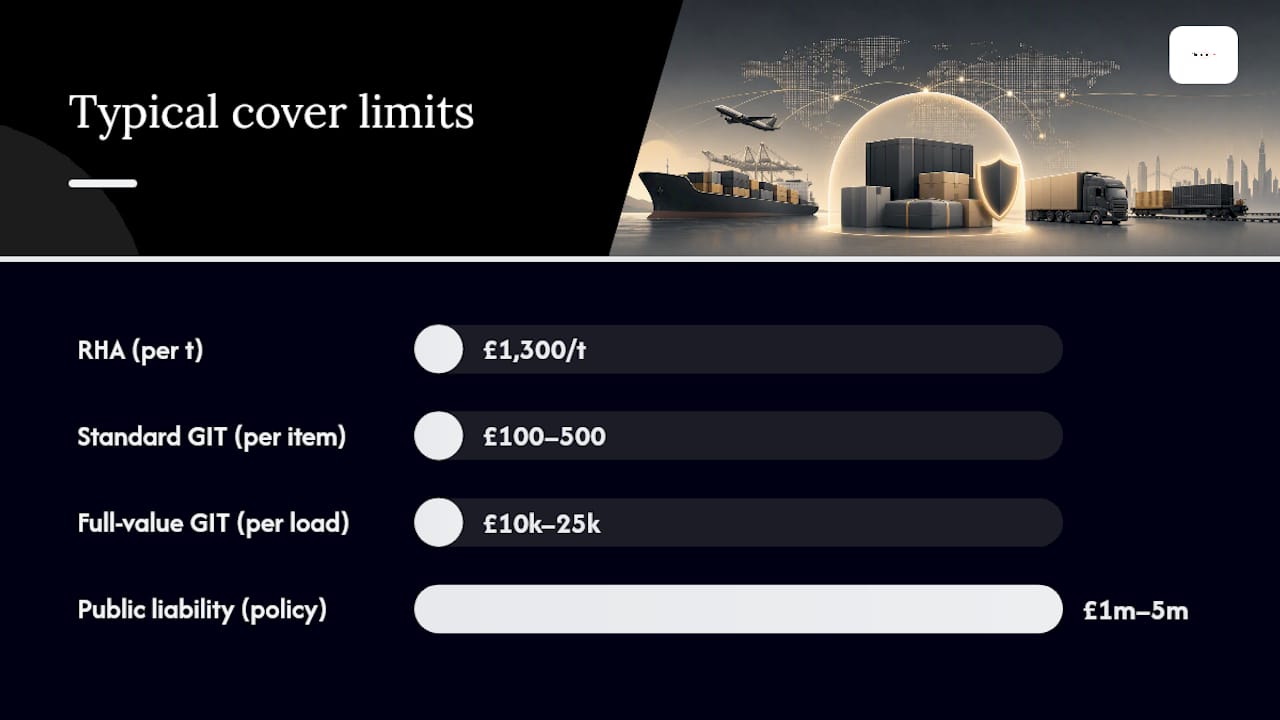
Public liability cover for couriers is typically recommended at £1m–£5m, with many commercial contracts requiring at least £2m–£5m. This covers third-party claims, not the goods themselves.
Before accepting a high-value consignment, check:
The carrier’s per-item and per-load liability caps in their T&Cs
Whether your GIT policy covers the specific goods category (some policies exclude electronics, jewellery, or cash)
Whether you need to notify your insurer before collection for high-value single items
Pro Tip: For couriers handling high-value single consignments, notify your insurer before collection and get written confirmation of the increased per-item limit. Do not assume ad hoc acceptance will be covered.
What happens when declared value is wrong
Undervaluing is the more common error, and the consequences scale with how far the declared figure departs from reality.
Likely consequences of an inaccurate declared value:
Customs delay or reassessment: HMRC may hold the shipment while it queries the value, adding days to transit time.
Additional duty and VAT charges: If customs reassesses upward, you owe the difference plus interest.
Fines or penalties: Deliberate undervaluation is a customs offence. Civil penalties can be substantial; criminal prosecution is possible in serious cases.
Reduced or denied compensation: If goods are lost and the declared value was lower than the actual value, your claim payout is capped at the declared figure. You cannot retrospectively increase it.
Seizure: Goods that appear to be deliberately misdescribed or undervalued can be seized by Border Force.
If you discover an error after dispatch, act quickly:
Contact the carrier immediately and request a correction to the consignment note before customs clearance.
Notify your insurer if the error affects your GIT cover.
Contact your customs broker or freight forwarder to amend the customs declaration before the goods are released.
Prepare the correct documentation (revised invoice, proof of payment) to support the amended figure.
If the goods have already cleared customs at an incorrect value, consult a licensed customs broker about a voluntary disclosure to HMRC.
For further guidance on courier accountability and what carriers are contractually responsible for, that article covers the liability framework in detail.
Pro Tip: Keep a copy of every customs declaration and commercial invoice for at least four years. HMRC’s standard enquiry window for customs matters is four years from the date of acceptance of the declaration.
Pre-dispatch checklist for declared value shipments
Work through this in order before handing goods to any courier.
Confirm the transaction value and cross-check it against the commercial invoice.
Complete the commercial invoice with full seller and buyer details, goods description, quantity, unit price, total value, and currency.
Enter the declared value on the carrier’s waybill or online booking form in the correct field.
Attach supporting documents: commercial invoice, packing list, proof of payment, and insurance confirmation.
Check the carrier’s T&Cs for per-item and per-load liability caps.
Confirm GIT cover is in place and adequate for the consignment value. Notify your insurer if the item value exceeds your standard per-item limit.
Pack appropriately: use double-walled boxes, internal padding, and tamper-evident sealing for high-value items. Photograph the packed goods before sealing.
Choose the right service level: for high-value or time-critical goods, a direct dedicated run eliminates co-loading and reduces handling risk.
Request a tracking reference and share it with the recipient.
File all documents in a single folder (physical or digital) and retain for at least four years.
For high-value consignments, additional measures worth considering:
Discreet outer packaging with no branding that signals valuable contents
Signature-on-delivery as a minimum; consider photo-on-delivery for proof
Real-time tracking with notifications to both sender and recipient
Written special handling instructions attached to the outer packaging
When a dedicated courier is the right choice for high-value consignments
Standard parcel networks co-load goods, pass them through multiple depots, and handle hundreds of parcels per vehicle. For most shipments that is perfectly adequate. For high-value, time-critical, or sensitive consignments, it introduces risk at every transfer point.

A dedicated courier runs exclusively for your consignment. The vehicle goes directly from collection to delivery with no intermediate stops, no co-loading, and no depot handling. That single-handling model reduces the number of occasions on which goods can be lost, damaged, or misdirected.
Practical scenarios where a dedicated run makes clear sense:
Urgent replacement parts for a manufacturing line where downtime costs more per hour than the courier fee
Medical samples or prescription medication requiring temperature control and chain-of-custody documentation
High-value retail returns (jewellery, electronics, luxury goods) where loss would exceed standard GIT per-item limits
Legal documents or signed contracts where the original must arrive by a specific time
Engineering prototypes that are irreplaceable and cannot be recreated quickly
Dedicatedsamedaycourier operates 24/7 with a nationwide network, typically collecting within 60–90 minutes of booking. Each job uses an exclusive vehicle, direct point-to-point routing, and bespoke handling arrangements. For consignments where the declared value is high enough to warrant specialist attention, the service also supports flexible insurance arrangements and can provide documentation confirming GIT and public liability cover on request.
Operational checks to request from any specialist provider before booking:
Confirmation of GIT cover limit and per-item cap
Public liability limit (minimum £2m for most commercial contracts)
Whether the driver carries proof of insurance on the vehicle
Whether the service provides a signed proof of delivery and photographic confirmation
Pro Tip: For any consignment where the declared value exceeds your standard GIT per-item limit, request a bespoke quote that includes confirmation of the insured value in writing. A verbal assurance is not sufficient for a claim.
For sector-specific requirements such as prescription medication courier services or best practices for urgent courier runs, those guides cover the additional compliance and handling requirements in detail.
An editorial view on declared value: the gap nobody talks about
Most guidance on declared value focuses on customs compliance, which matters. What gets less attention is the carrier liability gap, and it catches experienced shippers as often as it catches first-timers.
The RHA weight formula is not a quirk or an edge case. It is the standard condition under which most UK road freight moves. A £3,000 camera in a 400g box, shipped on a standard courier account, may be covered for less than £1 under the carrier’s default terms. The shipper who declared £3,000 on the booking form and assumed that figure was protected has made a reasonable but incorrect assumption.
The fix is straightforward: treat declared value and GIT insurance as two separate decisions. Declared value tells the carrier what you think the goods are worth. GIT insurance is what actually pays out if something goes wrong. They are complementary, not interchangeable, and the difference between freight insurance and carrier liability is worth understanding before you need to make a claim.
The other error worth flagging is documentation timing. Shippers who lose goods and then try to reconstruct proof of value after the fact rarely recover the full amount. The invoice, the payment record, the insurance schedule: these need to exist before the van leaves, not after the claim is filed.
High-value shipments handled with the right cover from the start
When the declared value is high enough to matter, the courier arrangement needs to match. Dedicatedsamedaycourier provides dedicated same-day delivery across the UK with exclusive vehicles, direct point-to-point routing, and no co-loading. Every run is a single-client job, which means fewer handling points and a clear chain of custody from collection to delivery.
[

For declared-value shipments, the practical advantages are concrete: documentation confirming GIT and public liability cover is available on request, bespoke handling instructions travel with the driver, and collections typically happen within 60–90 minutes of booking, 24 hours a day. Whether you are moving high-value retail stock, urgent engineering components, or sensitive legal documents, the service is built around consignments where getting it wrong is not an option. Request a quote via phone, email, or the online booking form, and ask for written confirmation of insurance limits at the point of booking.
Sources
Recommended


Comments