
Defining courier accountability for UK businesses
- Andrew Buttrick
- 20 hours ago
- 8 min read
TL;DR:
Courier accountability involves clearly assigning responsibility at each delivery stage, backed by documented proof. The chain of custody, including records of handoffs and verifiable delivery evidence, is essential for operational and legal accountability. Proper practices and technology help small businesses prevent disputes and ensure legal protection in parcel deliveries.
Most people assume courier accountability means a parcel either arrives or it does not. That misses most of what actually matters. Defining courier accountability properly covers who holds responsibility at each stage of a delivery, what proof is required, and what happens legally when something goes wrong. For small business owners and individuals sending or receiving goods in transit, this distinction matters enormously. Get it wrong and you may find yourself without legal recourse, without compensation, and without a clear answer about where your parcel actually went.
Table of Contents
Key takeaways
Point | Details |
Accountability is multi-party | Responsibility shifts between sender, courier, and retailer depending on the delivery stage and contract terms. |
Chain of custody is central | Every handoff must include a named person, location, and proof to create a defensible accountability record. |
UK law protects consumers | Under the Consumer Rights Act 2015, retailers bear primary responsibility until a parcel is properly received. |
Proof of delivery must be verifiable | A tracking status alone does not constitute valid proof; photographic or signature evidence is required. |
Technology closes accountability gaps | Intelligent tracking with milestone standardisation and proof capture reduces disputes and isolates losses. |
Defining courier accountability: what it actually means
Courier accountability is the clear assignment of responsibility for a shipment at every point in its journey, from collection to confirmed delivery. It is not simply about whether a parcel moves from A to B. It is about who is answerable if it does not, and what documented evidence exists to prove it.
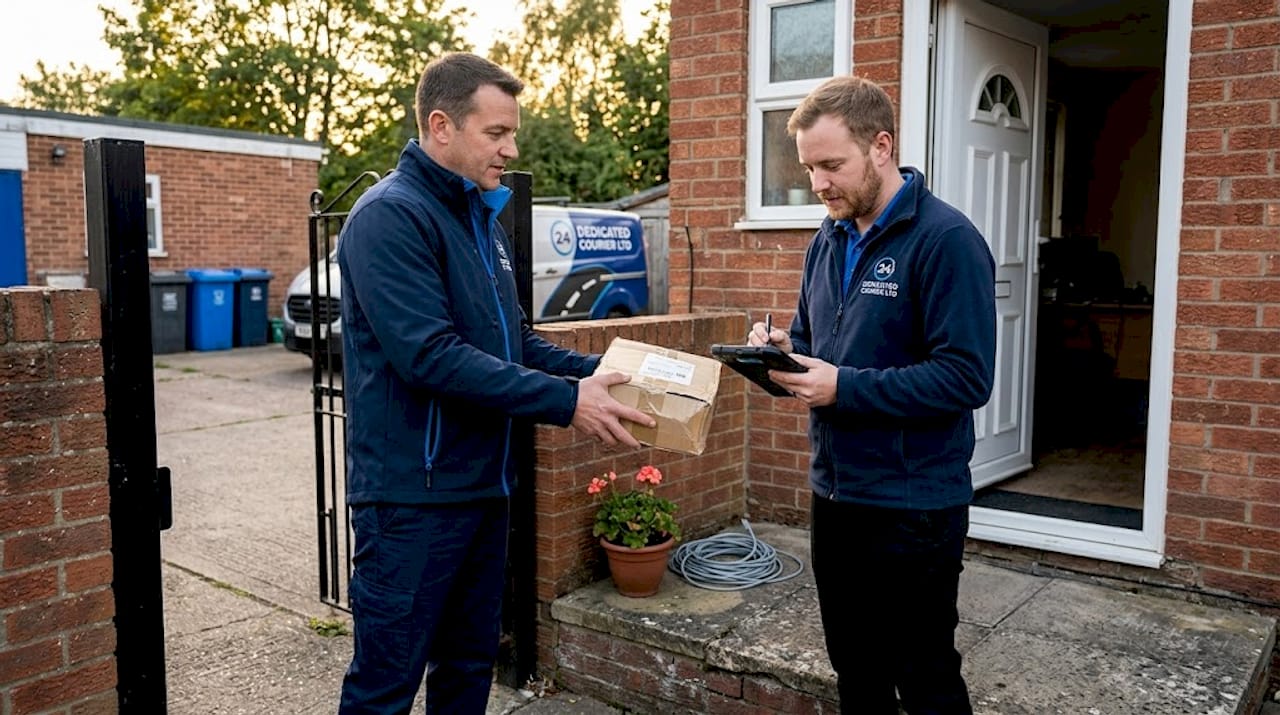
The key parties involved are the sender, the courier, the recipient, and in many retail scenarios, the retailer. Each carries a different level of responsibility depending on the stage of delivery and the terms of the contract in place. A courier’s responsibility typically begins at collection and ends when a valid delivery is made. The retailer’s responsibility under UK consumer law often extends further than that.
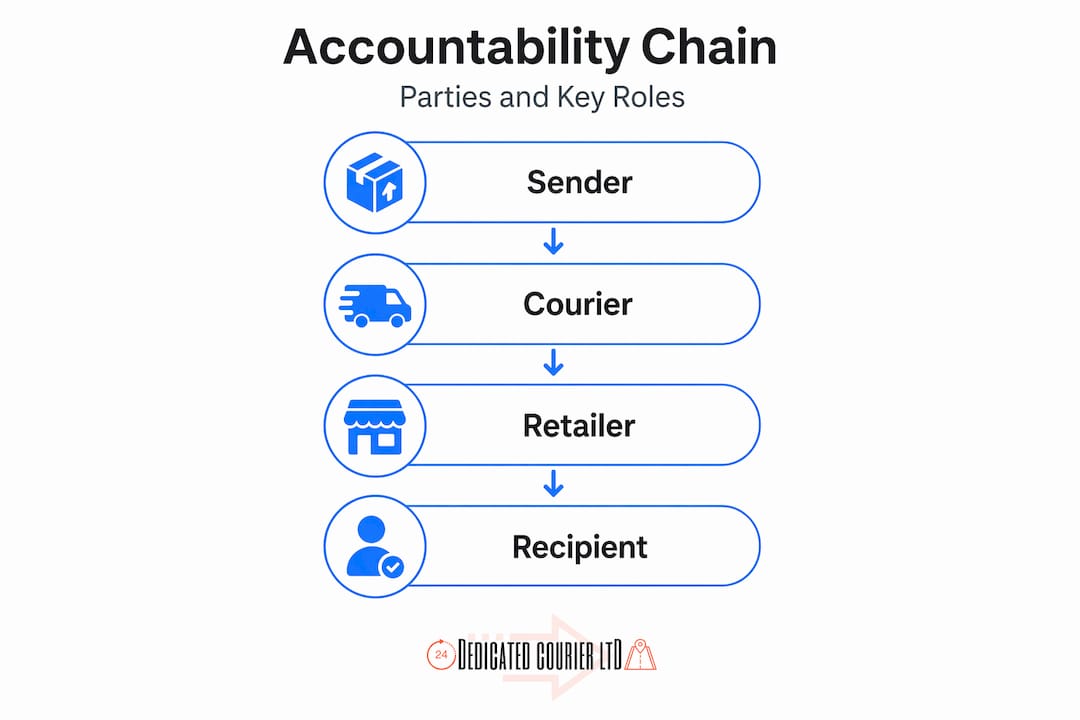
The mechanism that makes accountability operational is the chain of custody. Chain of custody records documenting every handoff create a clear accountability log showing who was responsible at each transfer point. Without that log, a missing parcel investigation quickly becomes a dispute between parties with no clear answer.
Pro Tip: When booking a courier, ask specifically how handoffs are recorded and whether each transfer is logged with a named person, location, and timestamp. If the courier cannot answer that clearly, the chain of custody is likely informal and unreliable.
Key elements that make courier responsibility measurable include:
Documented collection with timestamp and named courier
Scan events at each transit point or depot
Proof of delivery capturing signature, photograph, or GPS location
Consignment notes signed by the recipient or authorised party
The legal side of courier responsibility
Understanding the legal framework around accountability in delivery services protects you when things go wrong. The law does not treat all parties equally, and knowing where liability falls can save significant time and money.

Under the Consumer Rights Act 2015, the retailer holds responsibility for a parcel until it is properly received by the consumer. Courier liability is often secondary in the complaints process. This means if you ordered something online and it never arrived, your first legal claim is against the retailer, not the delivery company. The retailer must prove delivery was completed with a valid signature or photographic evidence. A tracking status marked “delivered” is generally not sufficient on its own.
The enforceability of liability limitation clauses in courier contracts is also worth understanding. Liability terms printed in small font without the sender’s signature may not be enforceable against the consumer. Courts have found that terms must be clearly brought to the consumer’s attention and genuinely agreed upon to hold legal weight.
“Liability in courier contracts requires genuine consumer consent and transparent communication to be enforceable, highlighting the importance of visible terms.” — TheLaw.Institute
Real case outcomes illustrate what poor accountability costs:
A consumer commission ordered a courier to pay ₹50,000 compensation for failing to deliver one of eight consignments, ruling it a clear deficiency of service.
Courts have found unsigned consignment notes mean liability clauses cannot be used to avoid compensation claims.
Retailers who rely solely on tracking data without photographic proof of delivery lose disputes at a significantly higher rate.
For UK small businesses sending goods on behalf of clients, understanding where courier and retailer responsibility diverges is not optional. It directly affects how you structure your contracts and manage claims.
Technology and operational practices that enforce accountability
Modern tracking has moved well beyond a dot on a map. Intelligent tracking combining milestone standardisation, proof capture, and ownership workflows turns visibility into genuine operational accountability. This is what separates a courier service that can defend its delivery record from one that cannot.
The table below shows the difference between basic tracking and accountability-grade tracking:
Feature | Basic tracking | Accountability-grade tracking |
Location updates | Yes | Yes |
Milestone standardisation | No | Yes |
Digital proof capture | No | Yes (photo, signature, GPS) |
Named responsible party | No | Yes |
Exception workflows | No | Yes |
Audit trail | Partial | Immutable and timestamped |
Chain of custody tracking with digital signatures and immutable audit trails strengthens accountability and regulatory compliance in product transport. This level of rigour is standard in sectors like healthcare, where medical specimen transport mandates rigorous digital tracking, condition monitoring, and auditability. The same principles apply to any high-value or time-sensitive courier service.
Pro Tip: Before committing to a courier for regular business shipments, request a sample proof of delivery record. It should show a photograph, GPS coordinates, timestamp, and a named recipient or authorised signatory. Anything less leaves you exposed in a dispute.
Formal handoff governance with a named responsible party, location, and proof reduces missing parcel incidents in courier workflows. Operationally, measuring courier performance through planned-versus-actual delivery comparisons and scan discipline metrics gives businesses a clear picture of where accountability is functioning and where gaps exist.
Common mistakes that undermine delivery accountability
Small businesses and individuals frequently undermine their own position when things go wrong. Most of these mistakes happen before a problem occurs, not after.
Relying on a tracking update that says “delivered” without requiring proof is one of the most common errors. Proper proof includes a verified address, photograph, GPS location, and a correct signature matching the delivery instructions. Without it, claims become very difficult to resolve and the burden of proof shifts back to the claimant.
Other frequent mistakes include:
Assuming the courier is always the party to pursue for a missing parcel, when UK law often places that obligation on the retailer first
Failing to provide specific delivery instructions in writing, which weakens any dispute if a parcel is left in an inappropriate location
Not retaining a copy of the consignment note or booking confirmation
Overlooking whether goods in transit insurance covers the full declared value of the shipment
Accepting verbal assurances about delivery proof instead of requesting documented confirmation
For practical guidance on reducing errors before a shipment leaves, reviewing common courier mistakes before booking saves considerable difficulty later. You should also review parcel preparation steps as poor packaging can contribute to damage disputes and complicate liability assessments.
Practical steps to protect yourself
Ensuring delivery accountability does not require legal expertise. It requires consistent habits and the right questions asked before a booking is confirmed.
Request the courier’s chain of custody procedure in writing before booking.
Confirm that proof of delivery includes photograph, GPS timestamp, and recipient name, not just a scan event.
Read the consignment note before signing and retain a copy.
Provide specific written delivery instructions, including what to do if the recipient is unavailable.
Check whether the courier holds goods in transit insurance appropriate for your shipment value.
Keep records of all correspondence, booking confirmations, and any delivery photographs provided.
Pro Tip: If you are a small business owner sending goods regularly, set a simple internal rule: no claim is pursued without a copy of the booking confirmation, the consignment note, and the delivery photograph. This three-document standard covers most dispute scenarios and saves time dealing with couriers or insurers.
For urgent or high-value shipments, secure parcel transportation guidance specific to UK businesses covers the legal and operational considerations in more detail.
My take on what accountability really demands
I have seen the gap between what couriers call accountability and what it actually looks like in practice. The phrase “delivered successfully” on a tracking screen tells you almost nothing on its own. It tells you a scan event occurred. It does not tell you who signed, where exactly the parcel was left, or whether the correct person accepted it.
The most overlooked failure in measuring courier performance is treating a status update as a delivery record. They are not the same thing. A defensible delivery record includes a named recipient, a photograph, a GPS-verified location, and a timestamp. Anything less is an assumption dressed up as evidence.
For small businesses, the practical consequence is this: if you cannot produce documented proof of what happened at the point of delivery, you have very limited ground to stand on in a dispute, regardless of how strong your case feels. Prioritise couriers who can show you exactly what their proof of delivery looks like. Ask before you book, not after something goes wrong.
— andrew
Accountable same-day delivery with Dedicatedsamedaycourier
[

Dedicatedsamedaycourier provides dedicated same-day courier services across the UK with 24/7 availability and exclusive vehicle transport for every shipment. Each delivery is handled on a dedicated vehicle, meaning your goods are not consolidated with other consignments, which simplifies the chain of custody and reduces the risk of mishandled handoffs. The service covers documents, parcels, and pallets nationwide, with full proof of delivery and customer support included. For businesses and individuals who need reliable, accountable courier vehicles matched to the size and urgency of their shipment, Dedicatedsamedaycourier offers a straightforward solution worth considering.
FAQ
What is courier accountability in plain terms?
Courier accountability is the clear assignment of responsibility for a shipment at every stage, from collection through to confirmed delivery, supported by documented proof at each handoff point.
Who is responsible for a lost parcel under UK law?
Under the Consumer Rights Act 2015, the retailer holds primary responsibility until the parcel is properly received. Consumers should raise complaints with the retailer first, not the courier.
What counts as valid proof of delivery?
Valid proof of delivery includes a photograph of the delivered item, a GPS-verified location, a timestamp, and a recipient name or signature matching the delivery instructions. A tracking status alone is not sufficient.
How does chain of custody improve courier accountability?
Chain of custody records document every handoff with a named person, location, and timestamp, creating an audit trail that isolates exactly where a loss or error occurred.
How can small businesses protect themselves in delivery disputes?
Retain the booking confirmation, consignment note, and delivery photograph for every shipment. Provide written delivery instructions and confirm the courier holds adequate goods in transit insurance before booking.
Recommended


Comments