
Urgent delivery explained: what you need to know
TL;DR:
Urgent delivery varies in meaning depending on industry context, from hourly pickups to next-day arrivals. It involves dedicated vehicles, priority routing, and higher costs, especially for last-mile logistics, which drive most expenses. Proper preparation, reliable courier selection, and understanding fee structures are essential for effective and efficient urgent shipments.
Urgent delivery is one of those terms that gets used loosely across e-commerce, courier services, and logistics platforms, yet what it actually means varies considerably depending on who you ask. For a business waiting on critical stock, urgent delivery might mean a dedicated vehicle collecting within the hour. For an online shopper, it might simply mean next-day. That gap in understanding causes real problems when time-sensitive shipments are on the line. This article covers urgent delivery explained in full: the definitions, the logistics behind it, the costs involved, and practical guidance for getting it right.
Table of Contents
Key takeaways
Point | Details |
Urgent delivery has no single definition | Terms like same-day, express, and next-day all differ in speed, cost, and service structure. |
Last-mile delivery drives the cost | Over half of shipping expense sits in the last-mile stage, making it the key cost driver in urgent logistics. |
Preparation prevents delays | Correct packaging, labelling, and documentation are what separate a smooth urgent delivery from a failed one. |
Dedicated vehicles offer the highest reliability | Exclusive vehicles eliminate shared-route delays, making them the most dependable option for time-critical goods. |
Cost can be managed with planning | Understanding surcharge structures and booking early where possible reduces the financial impact of urgent shipping. |
Urgent delivery explained: definitions and types
The term “urgent delivery” covers a spectrum of services, and understanding that spectrum is the starting point for making informed decisions. At its broadest, urgent delivery refers to any shipment that needs to arrive faster than standard transit times. But the industry uses several distinct terms, each with different characteristics.
Same-day delivery means the item is collected and delivered within the same calendar day, typically within a window of a few hours to eight hours depending on distance. Express delivery is often used interchangeably with same-day, though some couriers use it to mean next-day priority. Next-day delivery guarantees arrival the following business day and is the most widely available accelerated option. STAT delivery originates in medical and laboratory logistics, where STAT tests carry turnaround targets of 15 to 60 minutes. The term is now used in wider courier contexts to mean the absolute highest priority, processed ahead of everything else.
Delivery type | Typical timeframe | Common use case |
STAT / Priority urgent | Under 2 hours | Medical, legal, critical parts |
Same-day | 2 to 8 hours | Business documents, retail orders |
Express | Same day or next morning | E-commerce, perishables |
Next-day | 24 hours | General business freight |
Standard | 2 to 5 days | Non-time-sensitive parcels |
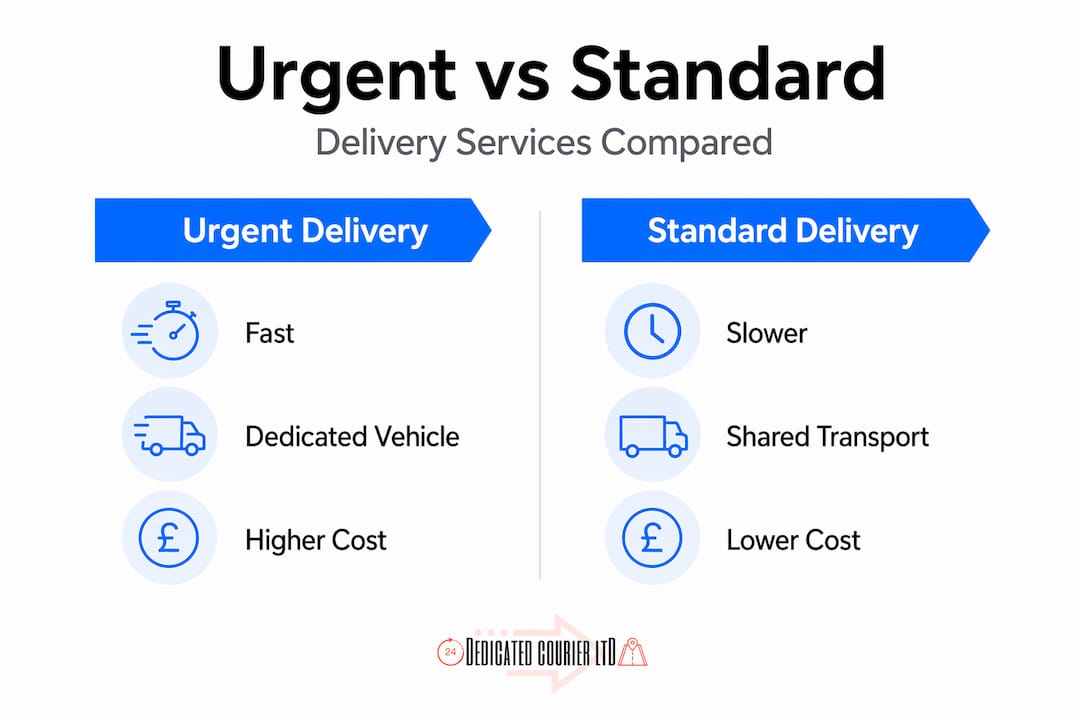
The distinction between urgent delivery vs standard delivery is not just about speed. Urgent services often involve dedicated vehicles, priority routing, and direct-to-door collection, none of which feature in standard multi-drop services. Knowing which category your shipment actually needs is what determines both the service you book and the cost you pay.
How urgent delivery works: the logistics behind it
Understanding how urgent delivery works means looking at what happens between the moment a booking is made and the moment the package lands at its destination.
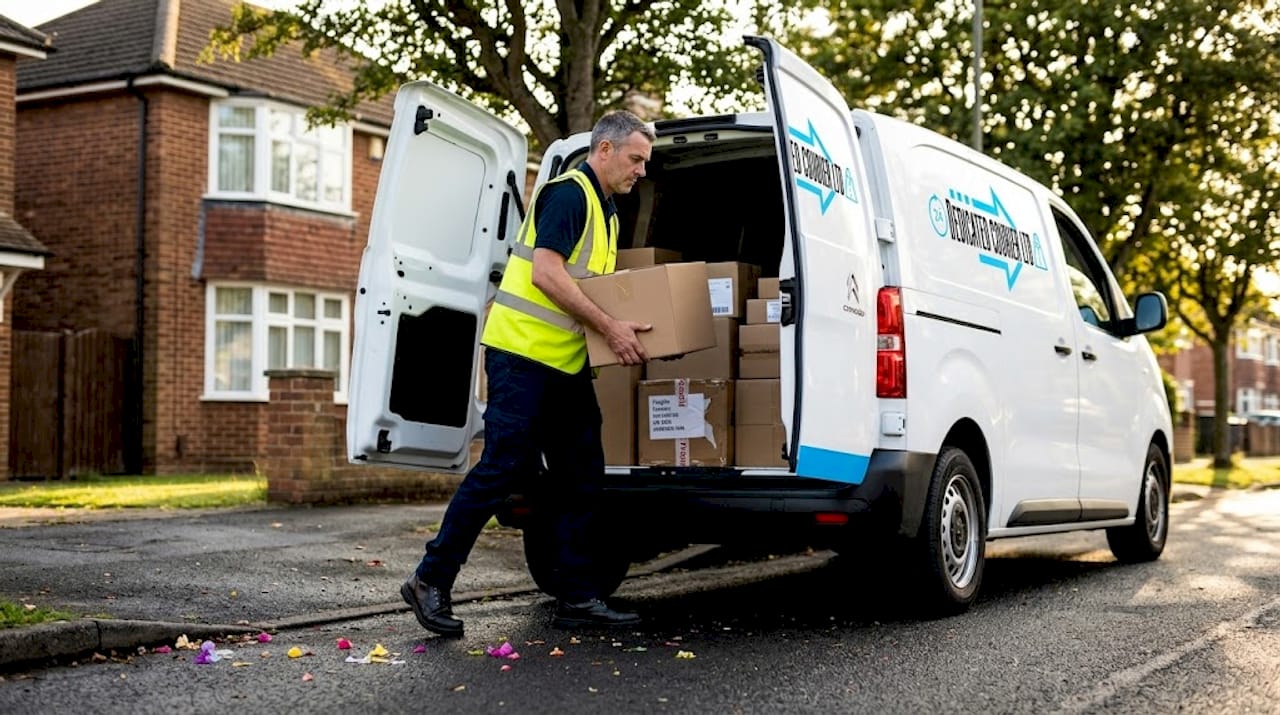
When an urgent delivery is booked, the courier network identifies the nearest available vehicle. For dedicated services, that vehicle is assigned exclusively to your consignment. There are no other stops, no shared loads. The driver collects directly from the point of origin and routes to the destination with minimal deviation. This is fundamentally different from the multi-drop model used in standard parcels.
Routing technology plays a significant role here. Providers like Dedicatedsamedaycourier use courier exchange platforms that match urgent requests to available drivers in real time, enabling coverage across multiple locations within a short timeframe. For larger operations, Amazon’s same-day fulfilment centres and delivery routing technology demonstrate how infrastructure positioning reduces transit time considerably, powering 1-hour and 3-hour delivery windows across hundreds of cities.
Last-mile delivery is where most of the operational complexity and cost sits. The final stretch from local depot or collection point to the recipient’s address accounts for over 50% of total shipping expense, which is why dedicated urgent couriers who focus exclusively on this stage can justify their premium.
Pro Tip: If you are sending urgent goods regularly, consider working with a courier that uses logistics optimisation technology to plan routes efficiently. This reduces transit time and improves delivery consistency, particularly for longer distances.
Real-time tracking and proactive communication are also central to how urgent delivery works in practice. Tracking and transparent communication reduce missed deliveries and maintain customer trust, which matters significantly when goods in transit carry high commercial or operational value.
Urgent shipping fees: what drives the cost
Urgent shipping fees are higher than standard rates, and they are structured differently. Rather than a flat rate based purely on weight and dimensions, urgent delivery pricing tends to reflect a combination of speed, distance, vehicle type, and the time of day the booking is made.
Fees rise significantly for same-day and sub-hour delivery options. As a reference point, Amazon charges Prime members $9.99 for 1-hour delivery and $4.99 for 3-hour delivery, with non-Prime customers paying nearly double those figures. For UK dedicated courier services, pricing is typically calculated per mile or per job, with surcharges applied for:
Out-of-hours collections (evenings, weekends, public holidays)
Oversized or unusually heavy consignments
Specialist handling requirements (fragile goods, refrigerated transport)
Short-notice bookings under one or two hours
The most effective way to manage urgent shipping fees is to understand exactly which surcharges apply before committing to a service. A courier that is transparent about its pricing structure and provides a fixed quote upfront gives you far more control than one that applies variable charges after delivery.
For businesses running frequent urgent shipments, negotiating an account-based arrangement with a dedicated courier can reduce per-job costs considerably compared to booking ad hoc.
Choosing and managing urgent delivery services
When selecting an urgent delivery service, the process matters as much as the price. A courier that is cheap but unreliable is a worse outcome than a more expensive one that delivers consistently.
Verify goods in transit insurance. Confirm the courier holds appropriate hire and reward insurance that covers the value of your consignment during transport.
Check collection lead times. Understand how quickly the courier can despatch a vehicle after your booking. Some services guarantee collection within 60 minutes; others operate a longer window.
Confirm nationwide or regional coverage. Not all urgent couriers operate across the UK. If your delivery spans multiple regions, confirm the provider has coverage at both ends.
Prepare packaging before booking. Delays caused by inadequate packaging are avoidable. Proper packaging and clear labelling are fundamental to preventing hold-ups on urgent consignments.
Ask about tracking and communication. A professional urgent courier will provide real-time tracking and a direct contact number for the driver or dispatcher.
Pro Tip: For regulated goods such as pharmaceuticals, temperature-sensitive items, or legal documents, check whether any documentation is required prior to transit. Missing paperwork is one of the most common reasons urgent deliveries are delayed at collection.
The importance of urgent delivery is well established for businesses that depend on reliable supply chains or same-day customer fulfilment. Getting the operational process right from the point of booking makes the difference between a service that works and one that creates more problems than it solves.
Benefits and limitations at a glance
Urgent delivery is not always the right option. Here is a clear summary of where it adds genuine value and where it does not.
Factor | Detail |
Benefit: customer satisfaction | Faster fulfilment increases loyalty and repeat business |
Benefit: competitive advantage | Businesses offering same-day stand out in markets where standard delivery is the norm |
Benefit: critical operations | Supports medical, legal, and manufacturing supply chains where delays carry real cost |
Limitation: cost | Urgent shipping fees are substantially higher than standard rates |
Limitation: availability | Not all postcodes or item types are eligible for all urgent service tiers |
Limitation: logistical risk | Short booking windows leave less time to resolve complications |
Urgent delivery makes commercial sense when the cost of delay exceeds the cost of the service. For routine, non-time-sensitive freight, standard delivery remains the more practical choice.
My perspective on urgent delivery in 2026
I’ve watched the expectations around urgent delivery shift considerably over the past few years. What used to be a premium service used sparingly by businesses is now something customers treat as a baseline expectation, particularly in retail and e-commerce.
What I’ve found, though, is that most problems with urgent delivery are not caused by the courier. They are caused by poor preparation on the sender’s side. Incorrect addresses, items that aren’t packaged properly, or missing documentation at the point of collection account for a disproportionate number of failed urgent deliveries. The logistics behind urgent delivery are well-managed by experienced operators. The weak link is almost always upstream.
My view is that businesses should treat urgent delivery as a planned capability, not a last resort. Having a reliable courier relationship in place before the emergency arrives means you are not scrambling to find cover when it matters most. The cost savings from preparation are real, and the reliability improvement is significant.
[

Dedicatedsamedaycourier provides urgent and same-day courier services across the UK, with 24/7 availability and dedicated vehicles that carry your consignment exclusively. Whether you need a document collected within the hour or freight moving overnight, the service is built around reliability and direct communication. For businesses and individuals who need a dependable urgent delivery solution with nationwide coverage, you can get a tailored quote directly through Dedicatedsamedaycourier. The team uses courier exchange technology to match your booking with the nearest available professional vehicle, ensuring rapid despatch and full transparency throughout.
FAQ
What is urgent delivery?
Urgent delivery refers to any courier service designed to transport goods faster than standard transit times, typically including same-day, express, or STAT-level options depending on how quickly the goods are needed.
How does urgent delivery differ from standard delivery?
Urgent delivery vs standard delivery comes down to speed, vehicle exclusivity, and cost. Urgent services often use dedicated vehicles with no other stops, whereas standard delivery uses shared multi-drop routes with longer timeframes.
What affects urgent shipping fees?
Urgent shipping fees are influenced by distance, speed of service, time of booking, item size and weight, and whether any specialist handling is required. Out-of-hours bookings typically carry additional surcharges.
Is same-day delivery the same as urgent delivery?
Same-day delivery explained simply: it is one type of urgent delivery, where collection and delivery occur within the same calendar day. Urgent delivery is the broader category that includes same-day, STAT, and priority express options.
How do I prepare a shipment for urgent delivery?
Preparation for urgent shipments includes secure packaging, clear and accurate labelling, confirmed recipient details, and any required documentation for regulated goods. Getting this right before the courier arrives avoids delays.
Recommended


Comments