
Pallet transportation checklist: ship smarter
TL;DR:
Getting pallet shipments right prevents costly damage, delays, and unexpected reclassification charges for UK businesses. Proper packing, accurate measurements, detailed labeling, and careful documentation are essential steps in ensuring goods arrive safely and on budget. Consistently applying these best practices and consulting with trusted couriers like Dedicatedsamedaycourier minimizes transport issues and enhances logistics efficiency.
Getting pallet shipments wrong is expensive. Damaged goods, rejected loads, surprise reclassification charges and delays cost UK businesses thousands every year. A thorough pallet transportation checklist removes the guesswork from logistics operations and gives you a clear process to follow every time. This guide covers everything from selecting the right pallet and packing materials through to booking transport and troubleshooting common problems, so your goods in transit arrive safely and on budget.
Table of Contents
Key takeaways
Point | Details |
Proper packing prevents damage | Up to 90% of damage is avoidable with correct packing procedures and adequate stretch film layers. |
Accurate data avoids surcharges | Inaccurate weight or dimensions trigger reclassification fees that can increase shipping costs by 15 to 30%. |
Documentation is a legal contract | The Bill of Lading is binding; errors in declared freight class or weight lead to post-delivery surprise charges. |
Wrap anchors to the pallet deck | Wrapping only boxes leaves the load free to slide off in transit; the film must encompass the pallet base. |
Carrier requirements vary | Know your carrier’s rules on liftgates, residential delivery, and weight limits before booking. |
1. Choose the right pallet type and size
The base your goods sit on matters more than most shippers realise. Standard UK and European pallets follow the EUR/EPAL format at 1,200 x 800 mm, while UK domestic pallets often measure 1,200 x 1,000 mm. North American 48 x 40 inch block pallets are common in US-originated freight. Choosing the wrong size creates overhang, which carriers will reject or charge extra to handle.
Before loading anything, inspect the pallet physically. No broken boards, cracked stringers, or protruding nails. A structurally compromised pallet can collapse under load, causing damage and potential injury to handling staff.
Common pallet types at a glance:
EUR/EPAL pallet. Widely accepted across Europe, repairable and inspected to strict standards. Best for regular domestic and European freight.
Block pallet. Four-way entry, strong, suitable for heavier loads. More expensive but more stable on uneven surfaces.
Disposable/one-way pallet. Cost-effective for single journeys but not suitable for heavy or high-value goods.
Plastic pallet. Hygienic, moisture-resistant, and consistent in weight. Good for food or pharmaceutical goods but costlier upfront.
For international shipments, wood pallets must carry ISPM 15 certification; absence can cause rejection at customs or expensive fumigation requirements before clearance.
Pro Tip: If you ship internationally with any regularity, keep a stock of ISPM 15-marked pallets separate from your domestic pool so there is no risk of mixing them up at the packing stage.
2. Prepare and pack your goods correctly
Before goods go on the pallet, each individual item should be packed in appropriate packaging. Boxes should be rated for the weight they will carry. Void fill inside boxes prevents internal movement that causes breakage even when the pallet itself is handled correctly.
Layer sheets placed between rows of boxes add horizontal stability and distribute compression load evenly across the stack. Corner boards along the vertical edges of the pallet load protect against strap pressure and forklift contact. These are low-cost additions that make a measurable difference to load integrity.
Proper packing procedures alone can prevent up to 90% of common pallet shipping damage, which makes the time spent at this stage a direct cost saving, not an overhead.
3. Stack and secure loads correctly
Weight distribution is the single most important factor in pallet stability during transit. Heavy items at the bottom lower the centre of gravity, which improves stability when the vehicle brakes or corners.
Column stacking vs pyramid stacking:
Column stacking places boxes directly above each other in vertical columns. It transfers load weight efficiently down to the pallet deck and is preferred for uniform box sizes.
Pyramid stacking steps each layer inward. Useful for mixed sizes but reduces the usable load height and creates uneven weight distribution if not done carefully.
Avoid any overhang beyond the pallet edge. Even a few centimetres of overhang creates a lever effect that can topple the load or cause rejection at the depot.
Once stacked, wrapping starts at the pallet base, works upward with tight tension, and comes back down to anchor the film to the pallet deck. Three to five passes is the standard recommendation. The film must include the pallet deck itself; wrapping only the boxes leaves the entire load free to slide off the pallet in transit.
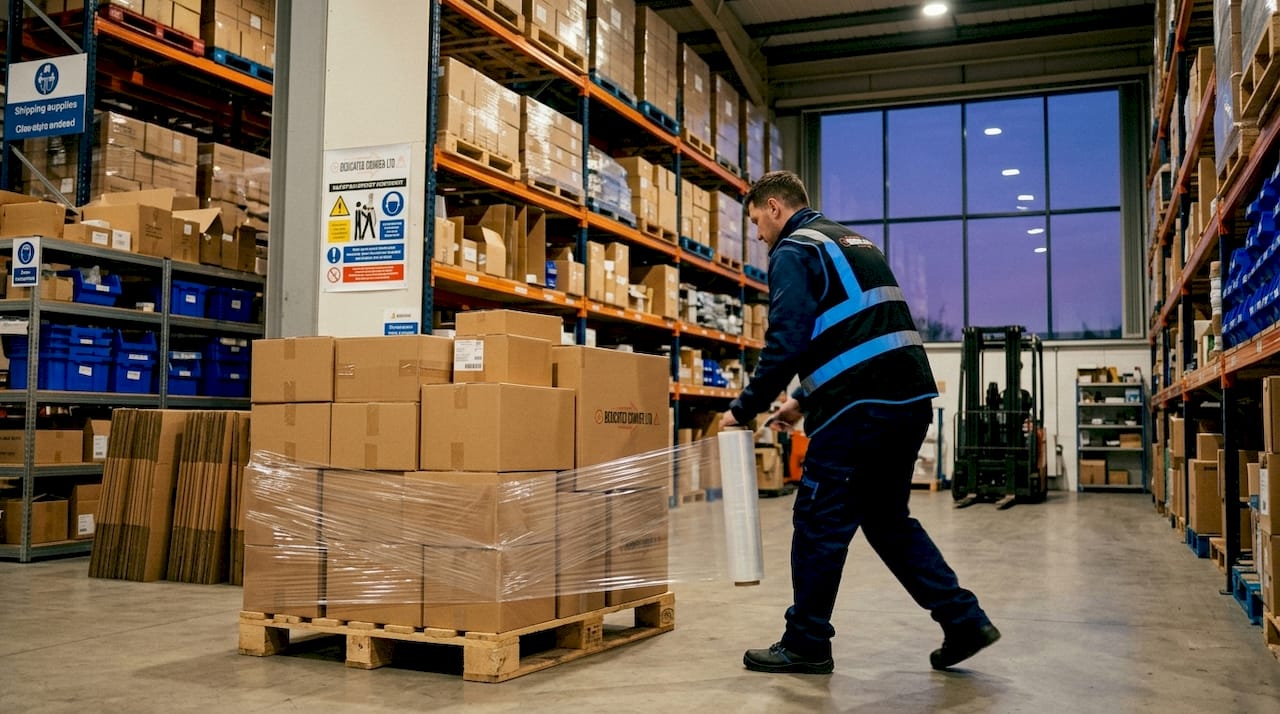
For heavy or mixed freight, straps used alongside stretch film significantly strengthen load stability and are worth the small additional time investment.
Pro Tip: Give the wrapped pallet a firm push from each side before signing off. If the load shifts noticeably, add another wrap pass or apply ratchet straps before handing it to the carrier.
4. Label accurately and place labels on multiple sides
Label placement is often rushed. Place labels on at least two visible sides of the pallet load, ideally all four, so handlers can read them regardless of how the pallet is positioned in a vehicle or warehouse.
Each label should include the recipient’s full address, your return address, declared weight, and any handling symbols such as fragile, this way up, or keep dry. If you use a third-party logistics label format, check that the barcode scans correctly before the driver collects.
For international pallet movements, include a commercial invoice, packing list, and country of origin documentation. International transit times by sea can run 20 to 40 days, and missing documentation can halt clearance entirely, adding further delays and storage charges at the destination port.
Key labelling checklist:
Full sender and recipient addresses on all visible sides
Declared gross weight and dimensions
Handling symbols where relevant
Pallet count and shipment reference number
ISPM 15 mark on wood pallets for international freight
Commercial invoice and customs documents for cross-border shipments
5. Declare accurate dimensions and weight
A 10 cm error in measuring pallet footprint can trigger freight reclassification, increasing shipping costs by 15 to 30%. That figure is not a theoretical risk. It happens regularly to shippers who measure in a hurry or rely on estimated figures from a previous shipment.
Measure height including the pallet deck. Weigh the complete pallet after packing and wrapping, not before. Declare the actual figures, not rounded-down estimates. Between 70% and 80% of LTL freight classifications now rely on density, which means dimensional accuracy directly determines your freight class and cost.
Shippers who invest in precise measurement data see fewer re-rates and more predictable carrier billing over time. It is one of the quickest ways to reduce logistics cost without changing anything else.
6. Complete the Bill of Lading carefully
The Bill of Lading is a binding legal contract between shipper and carrier. Incorrect weight, freight class, or commodity description gives the carrier grounds to reweigh, reclassify, and issue additional charges after delivery, with the shipper holding limited grounds for dispute.
Every BOL should include: shipper and consignee details, origin and destination addresses, number of pallets and handling units, declared weight, freight class, commodity description, and any special handling requirements. Keep a copy. If there is a discrepancy at delivery, the BOL is the document that resolves it.
7. Book the right transport and know the extra charges
Selecting the right carrier or third-party logistics provider (3PL) for your pallet shipment depends on your load size, destination, and timeline. Less-than-truckload (LTL) freight suits smaller pallet consignments sharing trailer space with other shippers. Full container load (FCL) or dedicated vehicle options suit larger volumes or high-value goods where exclusivity matters.
Before booking, confirm whether you need liftgate service at collection or delivery, particularly for sites without loading docks. Common additional charges in pallet shipping include liftgate fees, residential delivery surcharges, appointment scheduling fees, and reweigh or reclassification charges. Knowing these in advance prevents surprises on the invoice.
Booking checklist:
Confirmed pallet dimensions and weight
Number of pallets in the consignment
Origin and destination postcodes
Loading dock availability at both ends
Liftgate requirement confirmed
Freight class or service level agreed
Collection date and time window agreed with the carrier
Check out pallet delivery explained for a practical overview of how the UK pallet delivery process works from collection to final drop.
8. Troubleshoot common pallet transport problems
Most pallet transport failures trace back to a small number of recurring causes. Knowing them in advance means you can check for them before the driver arrives.
Problem | Common cause | Prevention |
Load shifts in transit | Insufficient wrap passes or no strap | Minimum 3 to 5 wrap passes; anchor to pallet deck |
Reclassification charges | Inaccurate declared dimensions or weight | Measure and weigh after full packing |
Customs delays | Missing ISPM 15 mark or documentation | Pre-check documentation against destination requirements |
Rejected load at depot | Overhang or damaged pallet | Inspect pallet before loading; check all edges |
Surprise delivery surcharges | Liftgate or residential delivery not declared | Confirm site requirements when booking |
Pro Tip: For sensitive or high-value pallet shipments, photograph the packed and wrapped pallet before collection. It takes thirty seconds and provides clear evidence of condition at dispatch if a damage claim arises later. You can also review the courier safety checklist for additional handling guidance.
My take on what actually matters in pallet transport
I’ve seen plenty of pallet shipments go wrong, and in nearly every case the problem started before the driver arrived. The most costly mistakes are not dramatic. They are small oversights: a pallet weighed before the stretch film went on, a BOL with a rounded-down weight, corner boards skipped to save five minutes.
What I’ve found is that load stability and accurate measurement deserve more attention than most pallet packing guides give them. Getting the wrap right, starting at the pallet deck and finishing with ratchet straps for anything over 500 kg, makes the difference between a clean delivery and a damage claim. And those claims take time to resolve, regardless of who is at fault.
On documentation, I’d say treat the BOL as carefully as you would a contract, because that is exactly what it is. If the declared freight class is wrong, the carrier is entitled to correct it and charge accordingly. Proactive communication with your carrier about site access, liftgate needs, and collection windows avoids the class of problem that custom crating services like Simple Moves Fargo are sometimes brought in to fix after the fact.
The checklist in this article is not complicated. The difficulty is in applying it consistently every time, under time pressure, with staff who may not have read it. That is where discipline and process make the difference.
— andrew
How Dedicatedsamedaycourier supports your pallet shipments
When you need a pallet collection urgently or require a dedicated vehicle to handle your goods in transit, Dedicatedsamedaycourier operates 24/7 across the UK with a network of trusted couriers and a range of vehicle sizes suitable for pallet transport.
[
Dedicatedsamedaycourier’s dedicated courier vehicles include small vans, large vans, Luton vans, and flatbed options, covering the full range of pallet sizes and weights. Each booking is exclusive, meaning your pallet travels on its own dedicated vehicle with no shared loads and no consolidation delays. For same-day and next-day pallet deliveries across the UK, request a quote directly through the website or by phone. Dedicatedsamedaycourier handles urgent pallet movements with the same care and compliance that this checklist recommends.
FAQ
What is the most important step in a pallet transportation checklist?
Accurate weight and dimension declaration is the single step that affects every other part of the shipment, from freight class to carrier acceptance. Errors here lead directly to reclassification fees and potential load rejection.
How many layers of stretch film does a pallet need?
A minimum of three to five tight wrap passes is standard, with the film anchored to the pallet deck at the base. Wrapping only the boxes without including the pallet deck leaves the load unstable in transit.
Do wood pallets need ISPM 15 certification for UK domestic shipments?
ISPM 15 certification is a requirement for international shipments only. For domestic UK freight, standard untreated wood pallets are generally acceptable, though you should confirm specific carrier requirements before dispatch.
What causes freight reclassification charges?
Inaccurate declared dimensions or weight are the most common triggers. A 10 cm measurement error on pallet footprint can increase shipping costs by 15 to 30% through reclassification, so weighing and measuring after full packing is the safest practice.
What documents are needed for international pallet shipping?
You will need a completed Bill of Lading, commercial invoice, packing list, country of origin certificate, and ISPM 15-marked pallets. Missing any of these can halt customs clearance and add significant delay and cost to the shipment.
Recommended


Dạo này mình hay lướt soi cầu miền Bắc trước giờ quay cho đỡ bị “tụt nhịp”, chủ yếu xem nhanh xu hướng mấy ngày gần đây thôi. Mình thích kiểu có phần dự đoán XSMB theo ngày (như 16 8 2026) để đối chiếu với dàn mình đang canh, chứ không phải ngồi mò lại từng kết quả. Giữa lúc đọc linh tinh nhiều nguồn, mình vẫn tạt qua soi cau xsmb vì cách trình bày khá dễ nhìn, không bị rối mắt quá. Có hôm mình xem thêm mục Rồng Bạch Kim cho vui, thấy họ ghi chú theo kiểu thống kê nên cũng dễ so sánh. Nói chung mình coi như một chỗ tham khảo thêm, đọc…
Mình chơi xổ số kiểu cho vui là chính, xem để giải trí chứ không đặt nặng chuyện trúng đậm. Trước đây nghe nhiều người bàn về “cầu” nọ “cầu” kia, mình cũng thử để ý xem có gì hay ho không. Theo dõi một thời gian thì thấy đôi lúc có vài chỗ lặp lại, nên mình bắt đầu ghi lại mấy ý ngắn gọn mỗi lần đọc nhận định rồi chờ kết quả để tự đối chiếu, coi có phải mình đang tự tin quá không. Có hôm trúng chút thì vui, nhưng cũng có bữa lệch hết, nên mình luôn nhắc bản thân giữ tỉnh táo và kiểm soát tiền bạc. Thỉnh thoảng mình lướt để có…
Mình chơi xổ số kiểu cho vui là chính, coi như giải trí sau giờ làm, trúng thì cười thêm chút còn không trúng cũng chẳng buồn. Trước đây nghe bạn bè nói chuyện “cầu” với “kèo” nghe hấp dẫn nên mình thử tìm hiểu, mà mới đầu thấy loạn hết cả lên. Theo dõi một thời gian, mình bắt đầu ghi lại vài nhận định mình đọc được rồi đem so với kết quả, để xem có phải mình đang tự tưởng tượng ra quy luật không. Thỉnh thoảng mình lướt soicauxsmb.io để có thêm chuyện bàn tán, nhưng luôn tự nhắc là đừng đặt niềm tin tuyệt đối. Có hôm trúng nhẹ thì vui, có hôm lệch xa…