
Why direct delivery matters: speed, trust and UK business success
TL;DR:
Delivery speed is now a vital factor influencing UK business revenue and customer retention. Direct delivery offers faster, more reliable transit by eliminating handling at hubs, thus enhancing customer satisfaction and trust. However, overpromising ultra-fast delivery windows can backfire, increasing delays and damaging reputation.
Delivery speed is no longer just a convenience for UK businesses. It is a direct driver of revenue and customer retention. Research shows that up to 70% of customers say delivery speed affects their decision to purchase, which means the logistics choices you make as a business have a measurable impact on your bottom line. Direct delivery, as a dedicated, point-to-point service, offers businesses a level of control over transit times and reliability that traditional shared logistics models simply cannot match. This article looks at what direct delivery really means, why it matters, and how to use it effectively without falling into common pitfalls.
Table of Contents
Key Takeaways
Point | Details |
Direct means control | Direct delivery lets businesses take charge of speed and reliability for their most critical shipments. |
Customer trust is won or lost | On-time delivery directly shapes customer experience and brand reputation in urgent logistics. |
Balance speed with realism | Overpromising speed without operational backing creates more harm than benefit. |
Benchmark for improvement | Tracking key KPIs like on-time delivery rate is essential for ongoing service excellence. |
What is direct delivery and how does it work?
To understand why direct delivery matters, it is crucial to clarify what it is and what makes it different from more traditional models.
Direct delivery means goods travel from the sender to the recipient without stopping at consolidation hubs, warehouses, or intermediate sorting facilities. There are no extra hands on the shipment, no waiting for other consignments to be bundled together, and no delays caused by processing at a central hub. As point-to-point shipping avoids consolidation and intermediate handling, the transit time is shorter and the risk of damage or loss is reduced.
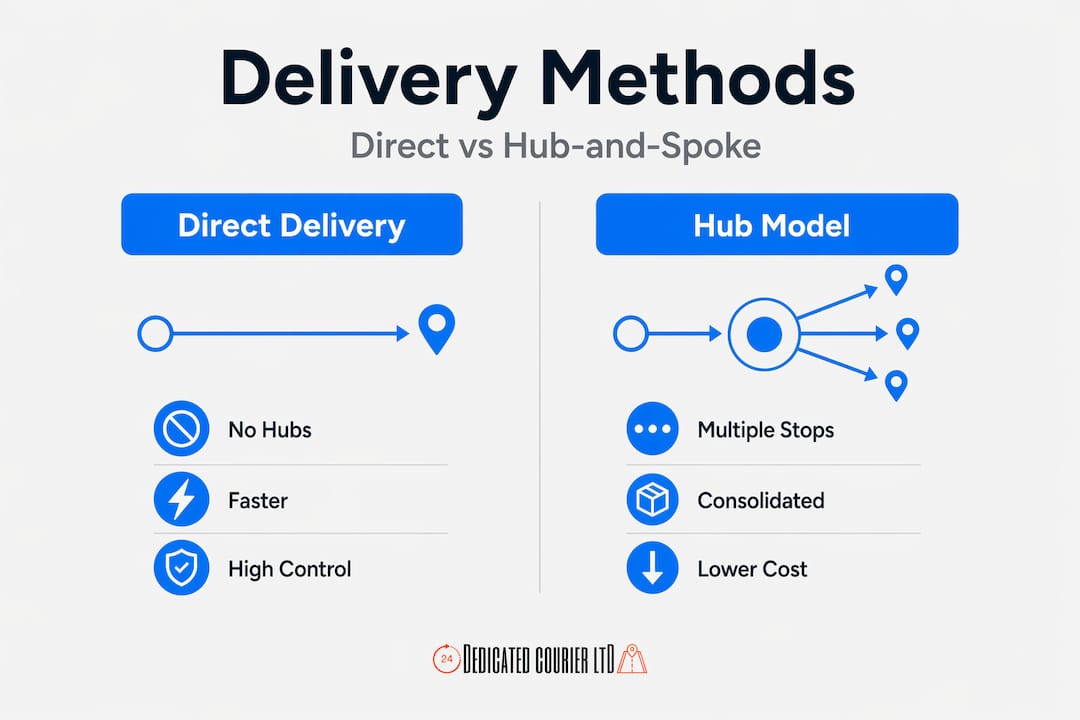
The alternative is hub-and-spoke logistics, which is the model most standard parcel carriers use. In that model, goods are collected and transported to a regional or national hub, sorted, then redistributed to local depots before final delivery. It is efficient at scale for non-urgent shipments, but it introduces delays that businesses with time-sensitive requirements cannot afford. A direct delivery service sidesteps this entirely.
Here is a direct comparison of both models:
Feature | Direct delivery | Hub-and-spoke |
Transit stops | None | Multiple |
Handling risk | Low | Higher |
Speed | Fastest available | Dependent on hub schedule |
Cost | Higher per shipment | Lower for high volumes |
Predictability | High | Variable |
Best for | Urgent, high-value, time-critical | Routine, bulk, non-urgent |
Common use-cases for direct delivery include:
Urgent legal or business documents
High-value goods in transit requiring secure, uninterrupted handling
E-commerce orders where delivery speed is a conversion factor
Medical or pharmaceutical supplies with strict time windows
Manufacturing parts needed to prevent production line stoppages
The main drawback of direct delivery is cost per shipment. Because the vehicle and driver are dedicated to a single consignment or customer, it is more expensive than shared logistics. However, for urgent or high-value shipments, the cost of delay often exceeds the cost of direct transit.
Why speed and reliability drive purchasing decisions
With the definitions clear, the next step is to understand why speed and reliability, enabled by direct delivery, are so critical in influencing business outcomes.
Delivery speed acts as a critical conversion factor for up to 70% of customers. For e-commerce businesses, this is not a marginal consideration. It means that a significant majority of potential buyers are evaluating your logistics capability as part of their purchasing decision. If a competitor can offer next-day or same-day delivery and you cannot, the customer may simply go elsewhere.
Beyond conversion, delivery reliability is directly connected to customer experience and trust. A customer who receives their order on time, every time, is more likely to return. A customer who experiences a missed delivery window is likely to leave a negative review, contact your support team, and reconsider their loyalty. For B2B clients, the stakes are even higher because a missed delivery can disrupt operations, delay project timelines, or damage supplier relationships.

Direct delivery gives businesses genuine control over speed. Because the vehicle is dedicated, there is no waiting for a hub schedule, no dependency on another business’s volume, and no shared risk with other consignments. This makes cutting delivery delays far more achievable than with shared or consolidated services.
Here are the key steps businesses should take to improve delivery reliability:
Audit your current delivery performance and identify where delays most commonly occur
Select a courier partner whose network matches your geographic delivery requirements
Set realistic delivery windows based on actual transit data, not aspirational targets
Communicate delivery timescales clearly to customers at the point of purchase
Monitor on-time delivery rates consistently and use the data to refine your approach
Build contingency into your booking process, especially for urgent or high-value shipments
For businesses looking to optimise their supply chain further, guidance on faster UK shipments can support more informed planning decisions.
Pro Tip: Always set realistic expectations based on your actual delivery capabilities. Promising next-day when your operational capacity only supports two-day delivery creates dissatisfaction even when no rules are broken. Accurate communication is itself a reliability tool.
The risks of overpromising: How ultra-fast windows can backfire
Aiming for very fast deliveries is not without risk. Here is what UK businesses need to know about the dangers of overpromising.
There is growing evidence that committing to extremely short delivery windows, without the operational infrastructure to support them, leads to more failures, not fewer. According to UK delivery research, ultra-fast promises are linked to a 104.5% increase in delivery delays. That is more than double the delay rate compared to standard promise windows. The pressure to fulfil an overly ambitious commitment creates bottlenecks, rushed handling, and higher rates of missed deliveries.
“Shorter delivery windows lead to a disproportionate rise in missed deadlines, suggesting that ultra-fast promises often exceed actual network capacity and create more operational failures than they prevent.”
Here is a comparison of how different delivery windows affect delay and missed-delivery rates:
Delivery promise | Average delay rate | Missed delivery rate |
Same-day (realistic) | Low | Low |
Same-day (overpromised) | High | High |
Next-day | Moderate | Low to moderate |
Two-day | Low | Low |
The lesson here is not to avoid speed, but to align your promises with your actual capabilities. Businesses that use a dedicated direct courier, where vehicle and driver are committed solely to that job, can make faster promises credibly because the operational model genuinely supports those timescales. Reviewing an urgent shipment checklist before committing to a window is a practical step that reduces the risk of failure.
The reputational cost of a missed ultra-fast promise is disproportionately high. Customers who expected same-hour delivery and received next-day delivery are more dissatisfied than those who expected next-day and received it on time. Managing expectations is as operationally important as managing the vehicle.
Direct delivery and service level benchmarks: Measuring what matters
Measuring and managing the right performance indicators gives businesses an edge in direct delivery. Here is how to set the right benchmarks.
The on-time delivery rate (OTD) is a primary KPI for direct delivery performance. It measures the percentage of shipments that arrive within the promised window. Industry leaders typically target an OTD of 95% or above. Businesses operating below this threshold need to examine whether their courier partner, internal processes, or delivery promises are contributing to the gap.
Key performance indicators (KPIs) that UK businesses should track for urgent and direct logistics include:
On-time delivery rate (OTD): The core measure of whether promised windows are being met
First-attempt delivery success: Percentage of shipments delivered without a failed attempt
Transit time accuracy: Actual transit times versus quoted times
Damage and loss rate: Particularly relevant for high-value goods in transit
Customer satisfaction score (CSAT) for deliveries: Direct feedback on the delivery experience
SLA compliance rate: Whether agreed service level agreements are being met consistently
Direct delivery makes it easier to meet and exceed SLA targets because each shipment has a dedicated resource behind it. There is no sharing of vehicle capacity, no risk of a higher-priority consignment taking precedence, and no dependency on hub processing schedules. For businesses with formal SLAs in place, particularly in B2B and corporate logistics, this consistency is not optional, it is contractually necessary.
Pro Tip: Use clear, proactive customer communications alongside on-time performance monitoring. Notifying customers of collection, departure, and expected arrival builds confidence even before delivery occurs, and it reduces inbound enquiry volume to your customer service team. For businesses handling multiple urgent shipments, reviewing urgent parcel tips can support better planning and SLA compliance.
The direct delivery paradox: Balancing speed, control and credibility
Putting all these lessons together, it is clear the real power of direct delivery lies beyond raw speed.
The most common misconception about direct delivery is that faster is always better. The data does not support this. A 104.5% increase in delay rates for overpromised ultra-fast windows shows that speed without operational credibility is counterproductive. The real advantage of direct delivery is control, and control only has value when it is exercised responsibly.
Point-to-point delivery is often chosen at the shipment level when handling needs and time windows are high. This is an important operational insight. Not every shipment needs to be a same-day job. Not every customer needs one-hour delivery. What every customer needs is for the promise to be kept. Businesses that understand this distinction will build stronger reputations than those chasing speed records.
Each shipment may deserve a tailored strategy. A high-value goods in transit consignment for a corporate client has different requirements than a routine e-commerce parcel. Using direct delivery selectively, for the moments when it genuinely matters, means you can commit credibly and deliver consistently. For businesses focused on streamlining urgent deliveries, this selective but reliable approach is what builds long-term client trust.
Credibility is the real currency here. A business that reliably delivers on its logistics promises earns repeat custom, positive reviews, and long-term supplier and client relationships. Direct delivery is the tool that makes those promises achievable, but only when the operational truth matches the commitment made.
Direct delivery solutions for your urgent UK needs
Now that you understand the real business impact of direct delivery, here is how you can secure time-critical logistics support across the UK.
Working with a specialist courier that operates dedicated vehicles makes a measurable difference for urgent and time-sensitive shipments. At DedicatedSameDayCourier.co.uk, every consignment travels on an exclusive vehicle, meaning no consolidation, no shared risk, and no dependency on hub schedules.
[
Whether you need a van courier for a large or awkward consignment, or a same-day courier service for urgent documents or high-value goods, the network covers the full UK with 24/7 availability. Quotes are available by phone, email, or online form, and vehicles can be matched to your specific shipment requirements. For businesses that need a consistent, reliable logistics partner, the dedicated courier service is built around operational credibility and transparent SLAs.
Frequently asked questions
What is the main advantage of direct delivery for urgent shipments?
Direct shipping eliminates intermediate handling, allowing faster and more predictable transit from sender to recipient, which significantly reduces delay risk for time-critical consignments.
How does direct delivery help e-commerce businesses increase sales?
Direct delivery gives businesses control over delivery speed, a factor that influences up to 70% of purchase decisions, making it a direct lever for improving conversion rates and reducing basket abandonment.
Does aiming for ultra-fast delivery always improve customer experience?
No. Promises that exceed operational limits are linked to a 104.5% increase in delivery delays, meaning overpromising can damage customer trust more than a realistic but slower window would.
What key metric should I track for direct delivery success?
Monitor your on-time delivery rate (OTD) as the primary benchmark, using it to assess SLA compliance and identify where delivery performance needs to improve.
Recommended


Comments