
Guide to pallet shipping: what SMEs need to know

TL;DR:
Pallet shipping consolidates goods onto standardized platforms for bulk transportation across various modes. Proper preparation, accurate measurement, and correct documentation are crucial to prevent delays, damage, and unexpected costs. Choosing between LTL and FTL depends on load size, with thorough wrapping and precise weight reporting ensuring smooth deliveries.
Pallet shipping is defined as the consolidation of goods onto a standardised platform for bulk transport by road, rail, or air freight. It is the dominant method for moving heavy or multi-item consignments, with approximately 5 billion pallets in active use worldwide. This guide to pallet shipping covers everything from materials and documentation to cost control and carrier selection, giving small to mid-sized businesses a clear, practical framework for getting freight from collection point to destination without avoidable delays or fees.
What do you need to prepare a pallet for shipping?
Preparation is the stage where most pallet shipments succeed or fail. Getting the materials and conditions right before a single item is stacked saves money, prevents damage, and keeps carriers happy.

Choosing the right pallet type
Three pallet types dominate UK freight: wooden, plastic, and EUR/EPAL. EUR/EPAL pallets measure 1,200 mm × 800 mm and are the standard for European road freight. Wooden pallets destined for international shipment must comply with ISPM-15, the international phytosanitary standard that requires heat treatment to prevent pest transfer. Plastic pallets are lighter and easier to clean, making them the preferred choice for food and pharmaceutical goods.
Essential packaging materials
Every well-prepared pallet requires the following:
Stretch wrap: Applied from the base upward to bind the load to the pallet
Corner protectors: Fitted to all four vertical edges to absorb impact during transit
Strapping: Polypropylene or steel banding adds a secondary layer of restraint for heavy or tall loads
Cushioning: Foam, bubble wrap, or cardboard void fill protects individual items from vibration damage
Labels: Each pallet must display total weight, destination address, and handling instructions such as “fragile” or “this way up”
Pro Tip: Check your pallet for cracked boards, missing blocks, and protruding nails before loading. A damaged pallet is a liability, not a cost saving.
Material | Purpose | Notes |
Stretch wrap | Binds load to pallet | Start at base; include pallet itself |
Corner protectors | Absorbs edge impacts | Fit all four vertical corners |
Strapping | Secondary load restraint | Use for loads over 500 kg |
Cushioning | Protects individual items | Fill all voids to prevent shifting |
ISPM-15 pallet | International compliance | Required for non-EU export |
How do you ship a pallet step by step?
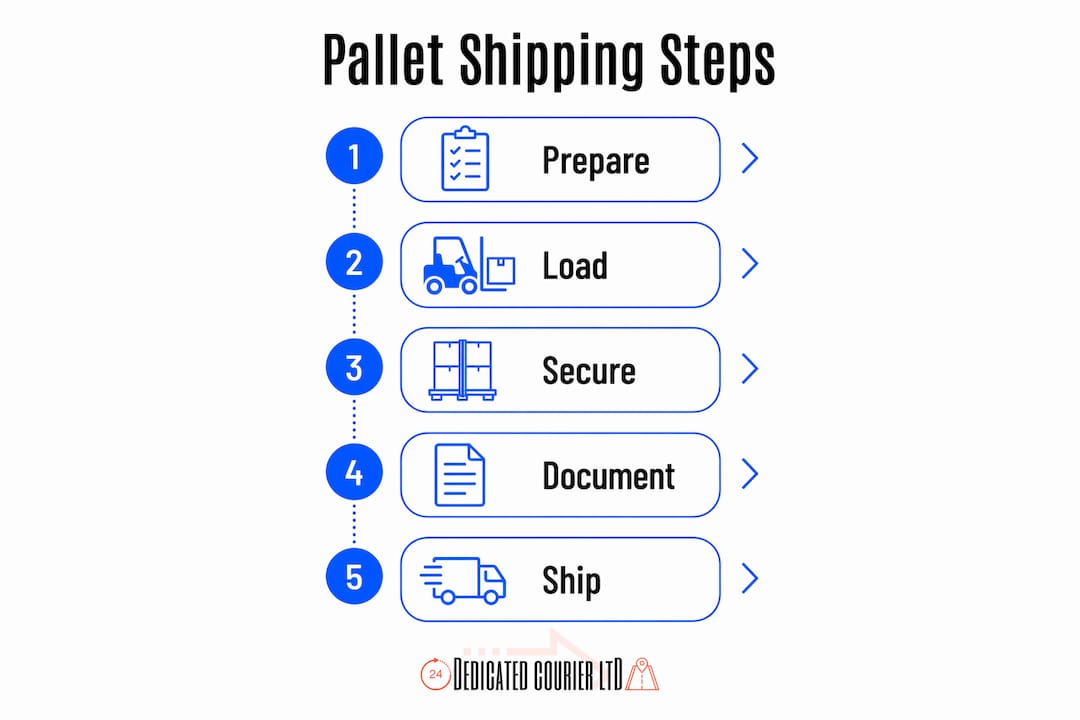
Small to mid-sized businesses typically follow a six-step pallet shipping process: palletising, measuring and weighing, generating the Bill of Lading, arranging pickup, transit, and delivery. Errors at any of these stages generate surcharge fees or delays.
Stack and distribute weight evenly. Place the heaviest items at the base and lighter items on top. Use vertical, staggered column stacking with corner protectors on all four vertical edges to maintain stability during braking and vibration.
Measure and weigh accurately. Record the total height, width, depth, and weight of the loaded pallet. Include the pallet’s own weight, which typically runs 15–22 kg, plus all packaging materials. Omitting these figures is the most common cause of reweigh fees at carrier terminals.
Apply stretch wrap correctly. Begin at the base of the pallet and wrap the film around the pallet itself before moving upward. Experts recommend 3–5 full rotations at the base, stretching the film to 200–250% of its original length to maintain tension. Work upward in overlapping layers, then return to the base for a final anchor pass.
Generate the Bill of Lading (BOL). The BOL is a legally binding contract that records freight class, NMFC codes, dimensions, weight, and any special handling requirements. Inaccurate BOL details are the primary trigger for billing disputes and reclassification fees.
Choose between LTL and FTL. Less than truckload (LTL) shipping shares trailer space with other consignments and suits 1–6 pallets where cost saving outweighs handling risk. Full truckload (FTL) dedicates an entire vehicle to your freight, reducing handling touchpoints and damage risk. LTL cargo passes through multiple terminals, which increases the chance of damage compared to a dedicated FTL run.
Arrange collection and confirm delivery details. Book your carrier with accurate pallet dimensions and confirm access requirements at both collection and delivery addresses.
Pro Tip: Take timestamped, high-resolution photos of the pallet from at least four angles before the carrier collects. These images are your primary evidence if a damage claim arises.
Factor | LTL | FTL |
Cost | Lower for small loads | Higher upfront cost |
Handling risk | Higher (multiple terminals) | Lower (direct transport) |
Best suited for | 1–6 pallets | 7+ pallets or full loads |
Transit time | Longer | Shorter and more predictable |
What drives pallet shipping costs?
Pallet freight pricing is calculated from four primary variables: freight class, dimensional weight, actual weight, and distance. Freight class is assigned using the National Motor Freight Classification (NMFC) system, which rates goods from class 50 (dense, low-value items) to class 500 (low-density, high-value items). A higher freight class means a higher rate per 100 kg.
The most avoidable cost in pallet shipping is the reweigh fee. Many shippers underestimate total shipment weight by excluding the pallet and packaging, which triggers automatic reweighing and reclassification at the terminal. This adds both a reweigh charge and a potential rate adjustment to your invoice.
Additional cost drivers include:
Fuel surcharges: Applied as a percentage of the base rate and adjusted weekly by most carriers
Residential delivery fees: Deliveries to non-commercial addresses attract a surcharge
Liftgate fees: Required when neither the collection nor delivery address has a loading dock
Documentation errors: Incorrect BOL details result in correction fees and possible shipment holds
To obtain an accurate quote, provide your carrier with the exact loaded weight (including pallet and packaging), precise dimensions, freight class, and both postcode areas. For pallet load securing guidance that helps you avoid reclassification, review your stacking and wrapping method before booking.
Best practices for pallet shipping: what to avoid
The most damaging mistakes in pallet shipping are predictable and preventable. Following these practices consistently reduces damage rates, avoids surcharges, and protects you in the event of a dispute.
Anchor the wrap to the pallet base. Wrapping only around the cargo without including the pallet itself risks the entire load sliding off during transit. Always start the wrap at the base and loop it around the pallet deck.
Use corner protectors on every shipment. Corner protectors distribute impact forces across a wider surface area. Without them, strapping and stretch wrap cut into box edges under load shift.
Weigh the complete assembly. Weigh the pallet after all goods, cushioning, and wrapping are in place. This single step prevents the majority of reweigh fees.
Photograph before handover. Timestamped pre-shipment photos from multiple angles are the most reliable way to substantiate a damage claim. Without them, liability disputes are difficult to resolve in your favour.
“A pallet that arrives damaged costs far more than the time it takes to prepare it correctly. The wrap, the photos, and the accurate BOL are not optional extras. They are the job.”
For a full preparation checklist before your next shipment, see this pallet transportation checklist from Dedicatedsamedaycourier.
Key takeaways
Accurate documentation, correct wrapping technique, and complete weight measurement are the three factors that determine whether a pallet shipment runs smoothly or generates avoidable fees and disputes.
Point | Details |
Wrap from the base | Anchor stretch wrap to the pallet itself to prevent load shift during transit. |
Include full weight | Always weigh the loaded pallet with packaging to avoid reweigh fees at terminals. |
Complete the BOL accurately | Incorrect freight class or dimensions on the Bill of Lading triggers reclassification charges. |
Choose LTL or FTL deliberately | LTL suits 1–6 pallets on cost; FTL reduces handling risk for larger or fragile loads. |
Photograph before collection | Pre-shipment photos from multiple angles protect you in any damage claim. |
What I have learned from watching pallet shipments go wrong
andrew
The mistakes I see most often are not about equipment or carrier choice. They are about documentation and weight. A business will spend time and money wrapping a pallet correctly, then submit a BOL with an estimated weight that excludes the pallet itself. The carrier reweighs at the terminal, reclassifies the freight, and the invoice arrives 30% higher than expected. That is not a carrier problem. That is a preparation problem.
The second pattern I see regularly is businesses choosing LTL purely on price without accounting for the handling complexity. LTL freight passes through multiple terminals and is handled by multiple teams. For robust, dense goods, that is fine. For fragile or irregularly shaped loads, the additional handling touchpoints create real damage risk. FTL costs more per shipment, but for the right load, it is the cheaper option once you factor in claims and replacements.
My practical advice: treat the BOL as the most important document in the process, not an afterthought. Get the freight class right, include every dimension, and confirm the weight on a calibrated scale. For businesses shipping pallets regularly, reviewing your pallet delivery process against a structured checklist is worth doing at least once a quarter.
— andrew
Ship your pallets with Dedicatedsamedaycourier
Dedicatedsamedaycourier provides dedicated vehicle solutions for pallet shipments across the UK, operating 24 hours a day, seven days a week. Every consignment travels on an exclusive vehicle, which means no shared trailer space, no multiple terminal transfers, and no handling by unknown third parties.
[
Whether you need a Luton van for pallets or a larger dedicated vehicle for bulk freight, Dedicatedsamedaycourier matches the right vehicle to your load. Same-day collection is available nationwide, with quotes provided by phone, email, or online form. For time-sensitive pallet freight where damage and delay are not acceptable, explore the full range of dedicated courier services available through Dedicatedsamedaycourier.
FAQ
What is pallet shipping?
Pallet shipping is the process of loading goods onto a standardised platform, securing them with stretch wrap and strapping, and transporting the consolidated unit by road, rail, or air freight. It is the standard method for moving heavy or multi-item consignments in commercial logistics.
How do I calculate pallet shipping costs?
Pallet shipping costs are calculated from freight class, actual weight, dimensional weight, and distance. Always include the pallet’s own weight (typically 15–22 kg) and all packaging in your total weight figure to avoid reweigh fees.
What is the difference between LTL and FTL pallet shipping?
LTL (less than truckload) shares trailer space with other consignments and suits smaller loads of 1–6 pallets. FTL (full truckload) dedicates the entire vehicle to your freight, reducing handling risk and transit time for larger or more fragile shipments.
How many times should I wrap a pallet?
Apply a minimum of 3–5 full rotations of stretch wrap at the base of the pallet, stretching the film to 200–250% of its original length. Work upward in overlapping layers and finish with a final anchor pass at the base.
Do I need a Bill of Lading for every pallet shipment?
Yes. The Bill of Lading is a legally binding contract required for every commercial pallet shipment. It must include freight class, NMFC codes, accurate dimensions, total weight, and any special handling instructions to avoid billing disputes and reclassification fees.
Recommended


Comments