
Guide to pallet transport UK: ship smarter in 2026
- Andrew Buttrick
- 11 minutes ago
- 7 min read
TL;DR:
Palletised shipping is the most cost-effective way to move bulky goods across the UK without damage. Choosing the right pallet type, packing correctly, and complying with regulations ensure smooth delivery and avoid delays. Dedicated courier services offer fast, exclusive transport options suited for sensitive or urgent shipments.
Palletised shipping is the most cost-effective and damage-resistant method for moving multiple or heavy goods across the UK. A guide to pallet transport UK covers everything from choosing the right pallet size to selecting a courier network that matches your delivery timeline. Pallet delivery is safer and more cost-effective than parcel shipping for bulky or multi-item consignments when goods are properly prepared and declared. Services like PalletOnline and Palletline operate national networks that collect, sort, and deliver palletised freight to businesses and residential addresses across Great Britain. Getting the basics right from the start saves time, money, and avoids refused collections.
What are the standard pallet types and sizes used in UK transport?
The UK standard pallet measures 1200mm by 1000mm with a maximum load rating of 1,000kg. That dimension is the benchmark most UK courier networks and warehouses are built around, so using a non-standard size can complicate handling and pricing.
Pallet type | Dimensions (mm) | Max load | Best use |
UK standard | 1200 x 1000 | 1,000kg | General freight, UK domestic routes |
Euro pallet | 1200 x 800 | 1,500kg | EU cross-border, racking systems |
Half pallet | 600 x 1000 | 500kg | Smaller consignments, retail |
Plastic pallet | 1200 x 1000 | 1,000kg | Food, pharmaceutical, hygiene-sensitive cargo |
Wooden pallet | 1200 x 1000 | 1,000kg | Standard freight, one-way shipments |
Euro pallets measure 1200mm by 800mm and carry up to 1,500kg, making them popular for racking systems and EU routes. Plastic pallets suit food and pharmaceutical cargo where hygiene standards apply. Wooden pallets remain the most widely used option for domestic UK freight.
Pro Tip: Match your pallet type to the destination, not just the cargo. Sending goods to an EU country on an uncertified wooden pallet triggers compliance checks that delay delivery. Use plastic or ISPM 15-stamped wooden pallets for cross-border shipments.
How to prepare and pack pallets correctly for UK pallet transport
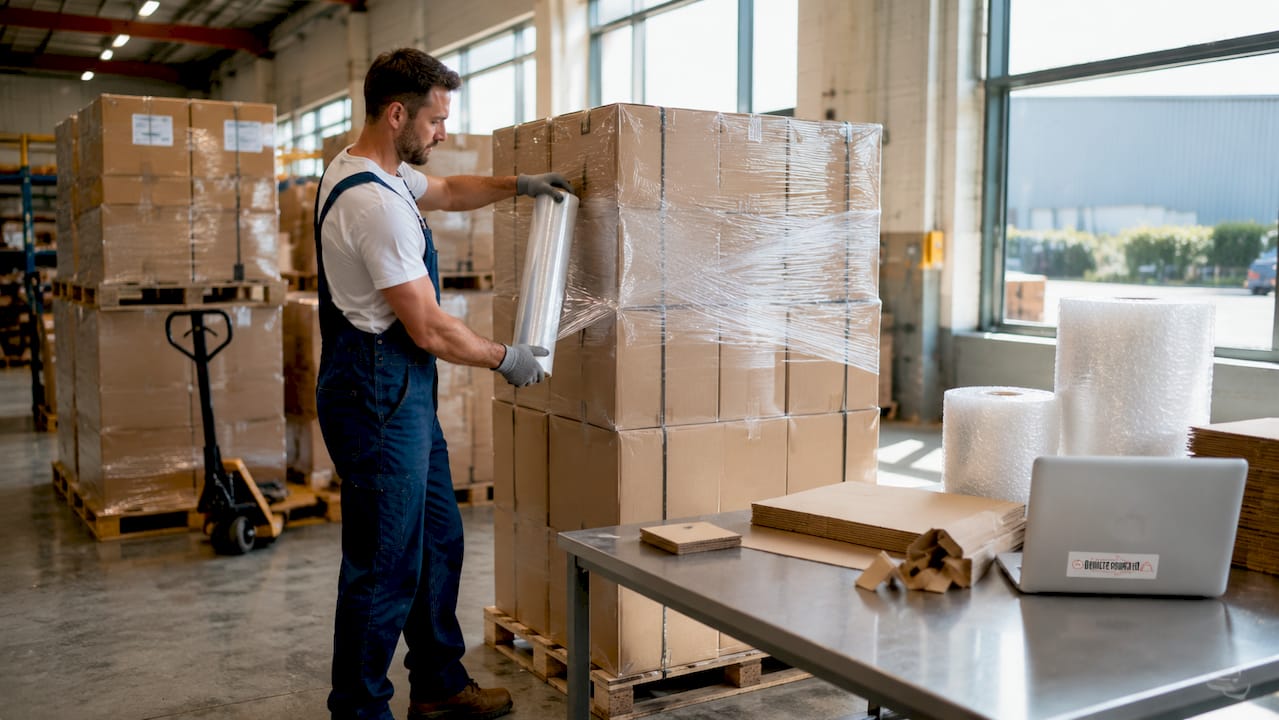
Correct packing prevents damage and keeps your goods in transit compliant with courier requirements. The materials you need before you start are stretch wrap, pallet strapping, corner boards, and clear printed labels.
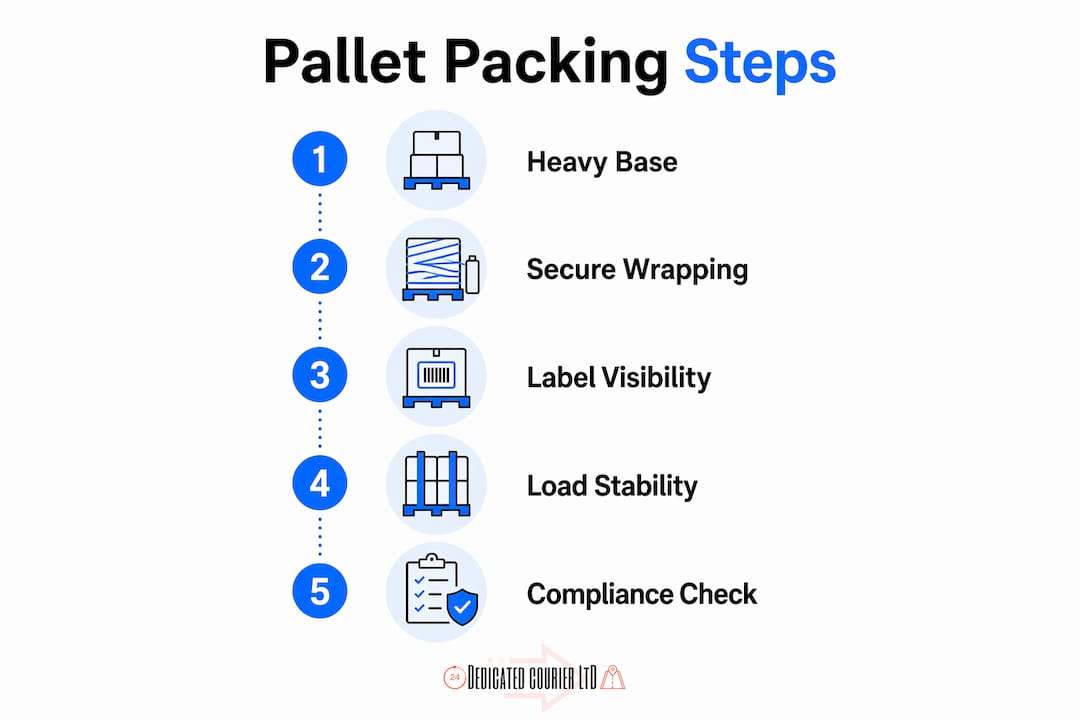
Follow these packing steps in order:
Place the heaviest items at the base of the stack to lower the centre of gravity
Stack lighter items on top, keeping the load even across the pallet surface
Avoid any overhang beyond the pallet edge
Apply corner boards to protect edges before wrapping
Wrap the entire load tightly with stretch wrap, covering the pallet base on the final pass
Apply strapping horizontally and vertically for loads over 200kg
Fix labels to at least two sides of the pallet
Heavy items placed at the bottom reduce the risk of toppling during transit. A low, stable centre of gravity is the single most important factor in preventing transport damage.
Labels on at least two sides prevent misrouting in busy sorting depots. Labels placed only on top get obscured when pallets are stacked, causing sorting errors that delay delivery.
Packing step | Why it matters |
Heavy items at base | Lowers centre of gravity, reduces toppling risk |
No overhang | Prevents damage during forklift handling |
Stretch wrap to pallet base | Secures load to pallet, stops shifting |
Labels on two sides | Avoids misrouting in stacked logistics environments |
Strapping on heavy loads | Adds structural integrity for long-distance routes |
Pro Tip: Pack for transport realities, not warehouse storage. Pallet stacking must account for vibration, braking, and forklift movements. A load that sits perfectly in a warehouse can collapse within the first 30 minutes on the road.
For further guidance on packing industry standards, current best practices cover material selection and securing methods for road freight.
What pallet delivery options are available in the UK?
UK pallet transport operates through two main models: shared pallet networks and dedicated courier vehicles. Each suits different priorities around speed, cost, and cargo sensitivity.
Pallet networks like Palletline collect freight from local depots, consolidate it at a hub, and redistribute to destination depots for final delivery. Choosing a strong national pallet network results in faster delivery with fewer handling points. Fewer handling points directly reduces the risk of damage and delay.
Dedicated courier vehicles carry your goods exclusively, with no shared handling. This suits time-sensitive or fragile palletised freight where you cannot afford delays or third-party handling.
Service factors to evaluate before booking:
Speed: Economy services typically take 2–3 working days; express options offer next-day or same-day collection
Cost: Shared networks are cheaper for non-urgent freight; dedicated vehicles cost more but guarantee exclusivity
Tail-lift access: Residential and small business sites often need a tail-lift vehicle for unloading
Tracking: Visible, real-time tracking reduces uncertainty for time-sensitive deliveries
Flexibility: Instant online pallet quotes with no contracts suit businesses that ship irregularly
Tail-lift requirements deserve particular attention. Standard HGVs cannot unload without a flat, hard surface or loading dock. Failing to request a tail-lift vehicle at booking leads to failed deliveries and re-delivery charges.
What are the regulatory requirements for UK and EU pallet shipping?
Wooden pallets moving between the UK and the EU must comply with ISPM 15 regulations. ISPM 15 requires heat treatment of the wood and an official stamp confirming compliance. Non-compliance causes 48–72 hour delays and return costs exceeding £200 per pallet. That is a significant cost for any small business shipping cross-border.
Key compliance requirements for UK pallet transport:
Wooden pallets for EU destinations must carry the ISPM 15 heat-treatment stamp
The stamp must show the country code, producer code, and treatment method (HT for heat treatment)
Pallets must be free from bark, pests, and visible damage before shipping
Post-Brexit customs declarations apply to all commercial goods moving between Great Britain and the EU
Plastic pallets are exempt from ISPM 15 and are the simplest option for regular EU routes
Check every wooden pallet for the ISPM 15 mark before booking. Couriers will refuse non-compliant pallets at collection, and the cost of sourcing replacement pallets at short notice is avoidable.
What common mistakes cause problems with pallet deliveries?
The most costly pallet shipping errors are preventable. Most arise from inaccurate declarations, poor packing, or inadequate site preparation.
Under-declaring weight or dimensions: Over or under declaring specifications leads to service refusal or surcharges applied after collection
Insufficient labelling: Labels on one side only cause misrouting in high-volume depots
Poor stacking: Loads built for warehouse storage, not road transit, collapse during transport
No tail-lift booked: Deliveries to sites without loading docks fail without a tail-lift vehicle
Ignoring ISPM 15: Wooden pallets without the correct stamp are refused at UK/EU border points
Pro Tip: Before booking, confirm your delivery site has a flat, hard surface for unloading. If it does not, request a tail-lift vehicle at the time of booking. Re-delivery fees cost more than the upgrade.
For a full breakdown of common courier mistakes and how to prevent them, the detail covers both pallet and parcel shipments.
Key takeaways
Successful pallet transport in the UK depends on accurate declarations, correct packing, the right pallet type, and a courier service matched to your delivery requirements.
Point | Details |
Use the correct pallet size | The UK standard pallet is 1200mm x 1000mm with a 1,000kg maximum load. |
Pack for road conditions | Stack heavy items at the base and wrap to the pallet base to prevent shifting in transit. |
Label on two sides | Labels on at least two sides prevent misrouting in busy pallet sorting depots. |
Check ISPM 15 compliance | Wooden pallets for EU destinations must carry a valid heat-treatment stamp or face delays over £200. |
Confirm tail-lift needs | Book a tail-lift vehicle upfront for any site without a loading dock to avoid re-delivery fees. |
What I have learned from watching pallet shipments go wrong
andrew here. After years of working in UK courier logistics, the pattern I see most often is not a lack of knowledge. It is a gap between knowing the rules and applying them under time pressure.
The single most common error I observe is weight under-declaration. Shippers estimate rather than weigh, and the difference between an estimate and the actual figure regularly triggers surcharges or refusals. Weigh every pallet before you book. It takes two minutes and removes the most frequent source of unexpected costs.
The second issue is site access. Businesses assume a courier will figure it out on arrival. They will not. A standard HGV arriving at a site without a loading dock cannot unload safely. The driver leaves, a re-delivery fee applies, and the goods sit in a depot. Confirm your site’s access requirements before you book, every time.
My advice for first-time shippers is to use a pallet transport checklist before every booking. It takes less time than resolving a failed delivery.
— andrew
Ship your pallets with Dedicatedsamedaycourier
Dedicatedsamedaycourier provides dedicated pallet transport across the UK, with vehicles ranging from vans to 7.5-tonne trucks for single or multiple pallets. Every booking uses an exclusive vehicle, meaning your goods are not consolidated with other freight or passed through multiple handling points.
[
The service operates 24/7 with same-day collection available nationwide. Quotes are available by phone, email, or online form, and there are no contracts required. For businesses that need a reliable dedicated courier service for time-sensitive pallet deliveries, Dedicatedsamedaycourier covers the full length of Great Britain. View available courier vehicles to match the right vehicle to your pallet size and weight.
FAQ
What is the standard pallet size in the UK?
The UK standard pallet measures 1200mm by 1000mm with a maximum load of 1,000kg. Most UK courier networks and warehouses are designed around this size.
Do wooden pallets need special treatment for EU shipments?
Yes. Wooden pallets moving between the UK and EU must comply with ISPM 15, requiring heat treatment and an official stamp. Non-compliance causes delays of 48–72 hours and return costs exceeding £200 per pallet.
What is a tail-lift and when do I need one?
A tail-lift is a hydraulic platform on the rear of a delivery vehicle that lowers goods to ground level. You need one if your delivery site has no loading dock or forklift access.
How do I get an accurate pallet delivery quote?
Weigh and measure your pallet before requesting a quote. Accurate dimensions and weight prevent surcharges and service refusals at collection.
Is dedicated pallet courier better than a pallet network?
Dedicated courier vehicles carry your goods exclusively with no shared handling, making them better for urgent or fragile freight. Pallet networks are more cost-effective for non-urgent, standard consignments.
Recommended


Comments