
How to optimise retail deliveries: a 2026 guide

TL;DR:
Retail delivery optimization involves reducing costs, time, and failures through smarter route planning and inventory placement. AI tools shorten routes, lower fuel expenses, and improve efficiency, especially when integrated with inventory and communication systems. Continuous data review and automation help retailers reduce costs, speed deliveries, and enhance customer satisfaction.
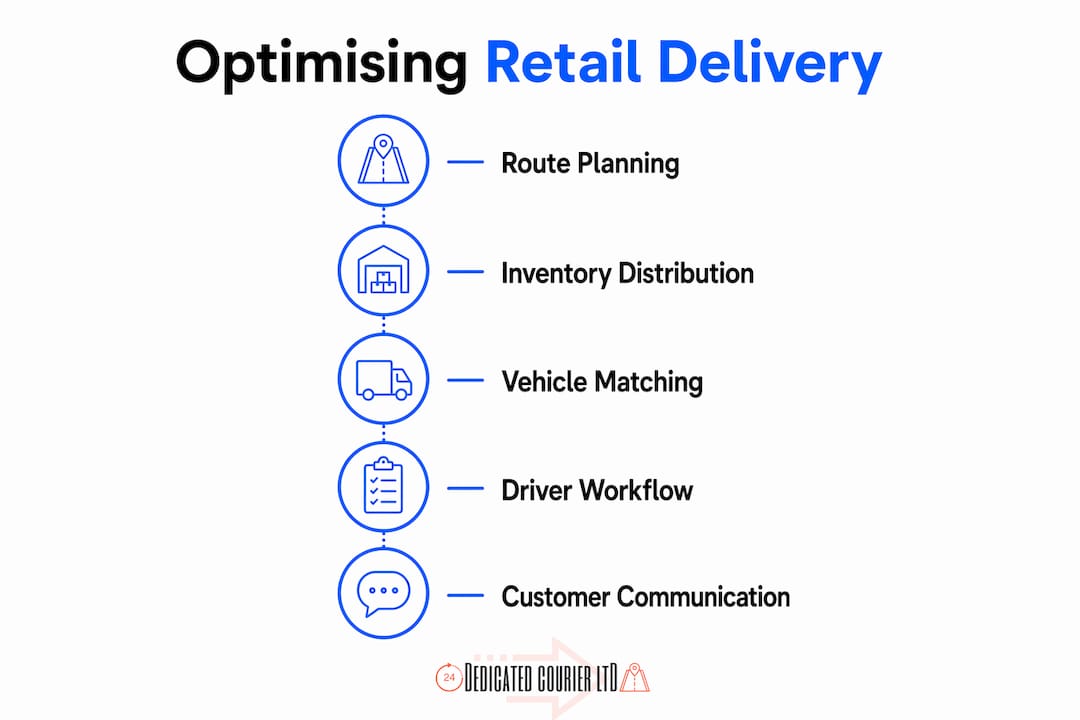
Retail delivery optimisation is defined as the process of reducing cost, time, and failure rates across the full delivery chain by aligning route planning, inventory placement, vehicle selection, and customer communication. Knowing how to optimise retail deliveries is no longer optional for retailers competing on speed and reliability. AI-powered route optimisation produces routes 15–20% shorter than manual planning within 90 days. Distributed inventory and automated notifications compound those gains further, cutting both per-shipment costs and support tickets at the same time.
What key tools and technologies enable retail delivery optimisation?
The right technology stack is the foundation of any serious delivery improvement programme. Without it, route decisions rely on guesswork and inventory sits in the wrong place.
Core tools every retail logistics operation needs:
AI route planning software. These platforms process traffic data, delivery windows, and vehicle capacity simultaneously. Manual planning cannot match that speed or accuracy.
Warehouse management systems (WMS). A WMS tracks stock levels in real time and directs fulfilment teams to pick and pack in the most efficient sequence.
Automated customer notification platforms. These send departure alerts, ETA updates, and delivery confirmations without any manual input from your team.
Vehicle and load management tools. These match vehicle size to route demand and flag when a vehicle is under or over capacity before departure.
Technology | Primary benefit | Impact area |
AI route optimisation | Shorter routes, fewer miles | Cost and speed |
Warehouse management system | Accurate stock and pick efficiency | Fulfilment accuracy |
Automated notifications | Fewer failed deliveries and support calls | Customer satisfaction |
Load management tools | Correct vehicle per route | Fuel and labour costs |
Pro Tip: Start with route optimisation software before investing in anything else. It delivers measurable cost reductions fastest and gives you clean data to inform every other technology decision.
For a deeper look at software adoption and reducing operational costs, the delivery optimisation tips guide covers advanced approaches for logistics managers.
How can route planning dramatically improve retail delivery efficiency?
Route planning is where most retail businesses leave the most money on the table. AI route planning reduces total miles driven by 12–20%, which directly lowers fuel spend, driver hours, and vehicle wear.
Manual route building by drivers is the single biggest source of inefficiency in last-mile logistics. Drivers optimise for familiarity, not distance or time windows. Centralising route building in dispatch, supported by AI tools, shifts that responsibility to a system that processes hundreds of variables at once.
Practical steps to improve route planning:
Feed real-time traffic data into your routing software so routes adjust dynamically to congestion.
Group deliveries by geographic density rather than by order time. Dense clusters reduce total distance significantly.
Schedule deliveries during off-peak hours where possible to avoid urban congestion windows.
Build routes around confirmed delivery time windows, not estimated ones, to reduce failed first attempts.
Real-world conditions such as traffic density, vehicle capacity, and delivery time windows must all feed into route planning for it to work in practice. A route that looks efficient on paper but ignores a known congestion point at 8:00AM will underperform every time.
Pro Tip: Review your route data weekly for the first three months after adopting AI routing. The software learns from completed deliveries, and your manual corrections accelerate that learning significantly.
For more on reducing delivery time through technology, the practical guide to reducing delivery time covers complementary strategies in detail.
Why does multi-node inventory distribution reduce delivery cost and improve speed?
Inventory placement determines shipping zone, and shipping zone determines cost. Transitioning to a bi-coastal inventory strategy drops average shipping zones from 5.8 to 3.2, reducing per-shipment costs by £3–£6 and cutting average transit times by 1.2 days. That is a structural cost reduction that no amount of carrier negotiation can replicate.
The key is knowing which products to distribute and which to centralise. The top 20% of SKUs that account for 60–70% of order volume should sit across multiple fulfilment nodes. Slow-moving SKUs should stay centralised to avoid tying up capital in distributed stock that rarely ships.
Fulfilment model | Best suited to | Key trade-off |
In-house multi-node | High-volume retailers with owned warehouses | High fixed cost, full control |
Third-party logistics (3PL) | Growing retailers needing flexible capacity | Lower control, faster to scale |
Hybrid | Retailers with mixed SKU velocity | Complexity in coordination |
Automation in ship-from-store fulfilment lowers operational costs by 20–40% and turns existing stores into micro-fulfilment hubs. For retailers with a physical footprint, this is one of the fastest ways to reduce last-mile distance without building new infrastructure.
How do vehicle selection and driver workflow impact delivery optimisation?
Vehicle matching is a straightforward lever that many retailers overlook. Matching vehicle profiles to route demands lowers fuel use, reduces extra trips, and cuts labour costs. Sending a large van on a 10-stop urban route wastes fuel and makes parking harder. Sending a small vehicle on a high-volume suburban run means a second trip.
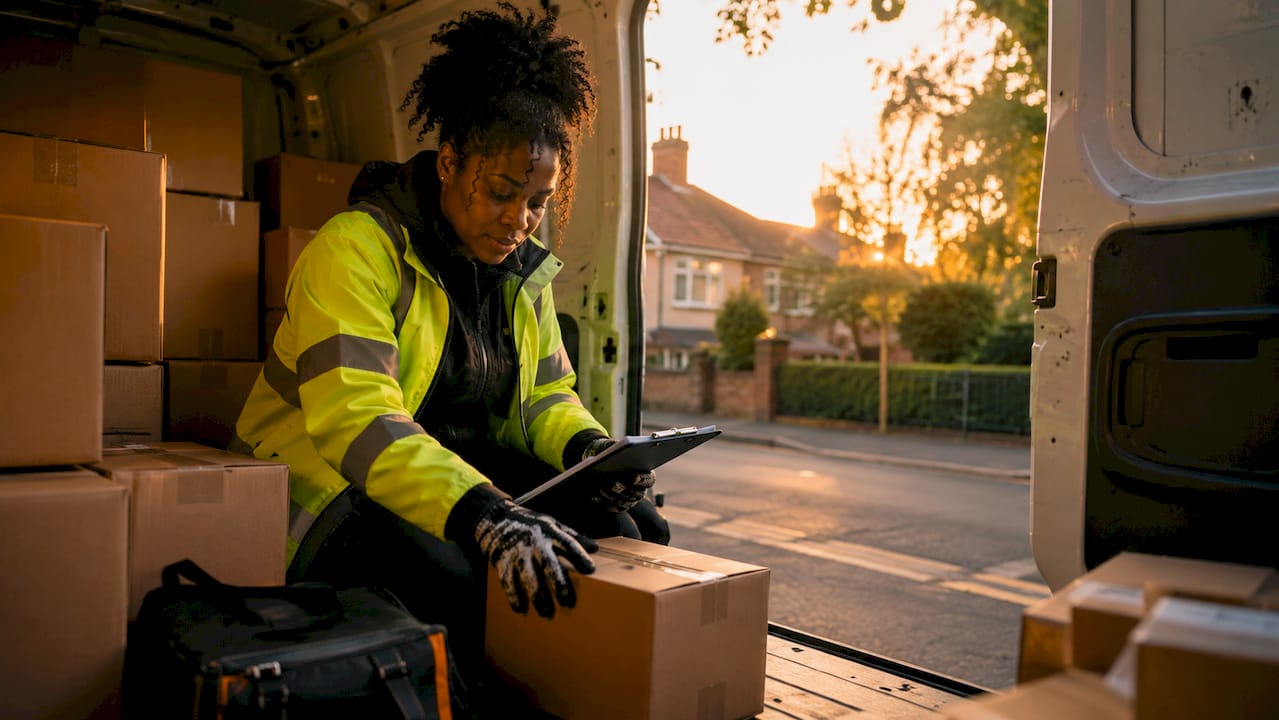
Shifting route-building from drivers to centralised dispatch using AI tools improves driver focus on deliveries and customer engagement. Drivers who build their own routes spend mental energy on logistics rather than on the customer interaction at the door.
Driver workflow improvements that deliver measurable results:
Load vehicles in reverse delivery sequence so the first stop is accessible without moving other parcels.
Train drivers to use routing apps actively, not just as a sat-nav. The app’s feedback loop improves future routes.
Use pre-departure vehicle checks to catch capacity or load issues before the driver leaves the depot.
Loading packages in delivery sequence recovers up to 90 minutes of driver productivity on a 30-stop route by eliminating time spent searching for parcels. That is nearly a full additional delivery run per driver per day.
Pro Tip: Pair vehicle matching with a fleet management review at least once per quarter. Route profiles change with seasons and order volumes, and your vehicle mix should reflect that. For broader fleet strategy, the fleet management best practices guide from Jagelo Haulage covers 2026 benchmarks in detail.
What customer communication practices minimise delivery exceptions?
Failed deliveries are expensive. They generate re-delivery costs, support tickets, and customer dissatisfaction in one event. Proactive communication prevents most of them.
Send departure alerts. Notify the customer the moment a driver leaves for their stop. This gives recipients time to be available or redirect the delivery.
Provide live ETA updates. A narrowing delivery window reduces the chance a customer steps out at the wrong moment.
Confirm delivery with photo proof. This eliminates disputes and reduces the volume of “where is my order” (WISMO) contacts.
Validate addresses at checkout. Address validation tools lower delivery exceptions by 1.5–2.5 percentage points. That reduction compounds across thousands of shipments per month.
Audit carrier invoices regularly. Businesses that audit carrier invoices for late deliveries and errors often recover 2–4% of total shipping spend. Automated claim tools make this process practical at scale.
Automated delivery delay communications reduce WISMO tickets by 20–35%. That is a direct reduction in customer service headcount or workload, with no change to the physical delivery operation.
Key takeaways
Retail delivery optimisation delivers the greatest returns when route planning, inventory placement, vehicle matching, and customer communication work together as a single system rather than separate initiatives.
Point | Details |
AI route planning cuts costs fast | Routes 15–20% shorter than manual planning reduce fuel, driver hours, and vehicle wear. |
Distributed inventory lowers zone costs | Moving top-volume SKUs to multiple nodes drops shipping zones and per-shipment costs measurably. |
Vehicle matching reduces wasted trips | Aligning vehicle size to route demand cuts fuel use and eliminates unnecessary second runs. |
Loading sequence saves driver time | Reverse-sequence loading recovers up to 90 minutes of productivity per 30-stop route. |
Proactive communication cuts exceptions | Automated notifications and address validation reduce failed deliveries and WISMO support tickets. |
What I have learned from watching retail logistics evolve
andrew here. I have spent years watching retail businesses invest heavily in carrier contracts and warehouse space while ignoring the two areas that move the needle fastest: route intelligence and communication automation. The results are predictable. Costs stay high, exceptions pile up, and the team spends its time firefighting rather than improving.
The retailers who get this right treat delivery data as a continuous feedback loop, not a monthly report. They review route performance weekly, adjust inventory placement quarterly, and test communication sequences the same way they test product pages. The technology is not the hard part. The discipline of acting on what the data shows is where most operations fall short. If you are serious about improving your delivery performance, start with one metric, measure it honestly, and build from there.
— andrew
Reliable retail delivery with Dedicatedsamedaycourier
Retail businesses that need dependable, time-sensitive delivery without the overhead of managing their own fleet have a practical option in Dedicatedsamedaycourier.
[
Dedicatedsamedaycourier operates 24/7 across the UK, with a range of dedicated courier vehicles matched to different load sizes and route profiles. Each delivery uses an exclusive vehicle, so your goods travel directly without shared loads or unnecessary stops. Whether you need same-day collection, next-day delivery, or overnight options, Dedicatedsamedaycourier provides a quote by phone, email, or online form. For retail businesses that need a reliable same-day courier service without long-term commitments, this is a practical and cost-effective solution.
FAQ
What is retail delivery optimisation?
Retail delivery optimisation is the process of reducing cost, time, and failed deliveries by improving route planning, inventory placement, vehicle selection, and customer communication across the full delivery chain.
How much can AI route planning reduce delivery costs?
AI route planning produces routes 15–20% shorter than manual methods within 90 days, directly reducing fuel spend, driver hours, and total miles driven.
What is a WISMO ticket and how do you reduce them?
WISMO stands for “where is my order.” Automated shipment notifications that include departure alerts, ETA updates, and delivery confirmations reduce WISMO tickets by 20–35%.
How does inventory distribution affect delivery speed?
Moving high-volume SKUs to multiple fulfilment nodes drops average shipping zones and cuts transit times. A bi-coastal strategy reduces average transit by 1.2 days per shipment.
How can retailers recover hidden shipping costs?
Auditing carrier invoices for late deliveries and billing errors recovers 2–4% of total shipping spend. Automated claim tools make this practical for businesses processing high shipment volumes.
Recommended


Comments