
How to optimise courier logistics for faster UK deliveries
Updated: May 15
Missed deliveries and late collections are not just inconvenient. They cost money, damage client relationships, and erode the trust you have spent years building. For UK businesses managing urgent same-day or next-day shipments, inefficient courier logistics can mean losing contracts and customers in a single afternoon. UK companies can cut delivery costs by 30-40% with proper route planning, yet many businesses still rely on outdated processes. This guide covers the practical steps, tools, and performance measures that will help you streamline courier operations and keep urgent deliveries on track.
Table of Contents
Key Takeaways
Point | Details |
Leverage technology | Route planning and tracking tools can reduce courier costs and improve delivery times. |
Focus on KPIs | Monitor on-time rates and cost-per-mile to keep logistics operations efficient. |
Use out-of-home options | Parcel lockers and micro-fulfilment boost success rates and reduce failed deliveries. |
Combine green and smart solutions | Pair electric fleets with parcel shops or lockers for the best cost and sustainability outcomes. |
Understanding the courier logistics landscape in the UK
The UK courier, express, and parcel sector is expanding at a significant pace. The CEP market is projected to grow from $12.05 billion in 2025 to $14.12 billion by 2030, driven largely by e-commerce growth and rising customer expectations for speed. Express and same-day services are the fastest-growing segment within that market. Businesses that cannot meet those expectations are already losing ground to competitors who can.
For logistics managers, this growth brings real operational pressure. Congestion in urban areas, failed first-delivery attempts, and increasing sustainability demands all add complexity to what should be a straightforward process. Understanding these pressures is the first step toward addressing them. You can read more about optimising urgent UK shipments to see how businesses are adapting in 2026.
Challenge | Impact on operations | Common cause |
Urban congestion | Delayed deliveries | Poor route planning |
Failed delivery attempts | Repeat costs, customer complaints | No live tracking or communication |
Sustainability pressure | Compliance risk, reputational damage | Outdated fleet and processes |
Rising customer expectations | Lost contracts | Slow or inflexible courier partners |
The benefits of same-day delivery for UK businesses go beyond speed. Reliability and consistency are what clients actually pay for. Knowing the landscape helps you make smarter decisions about where to invest and what to fix first.
Core requirements for optimising courier logistics
Before you change any process, you need the right foundations in place. Technology is the starting point. Route planning software, live tracking dashboards, and performance reporting tools are not optional extras in 2026. They are the baseline. UPS’s ORION system demonstrates how advanced logistics technology can reduce operational costs by up to 15%, and that figure is achievable for businesses of all sizes with the right tools.
Beyond technology, you need clearly defined roles. Someone must own dispatch, someone must manage driver communication, and someone must handle customer updates and exceptions. Without clear ownership, problems fall through the gaps.
Requirement | Basic setup | Optimised setup |
Route planning | Manual or spreadsheet | Automated software with live updates |
Tracking | Phone calls to drivers | Real-time GPS dashboard |
Booking | Email or phone only | Cloud-based platform with notifications |
Exception management | Reactive | Predictive alerts and rerouting |
Cloud-based booking systems reduce human error and allow your team to respond faster when something goes wrong. Real-time notifications keep customers informed without requiring manual updates. You can explore same-day delivery insights and practical guidance on choosing the right courier service to support your planning.
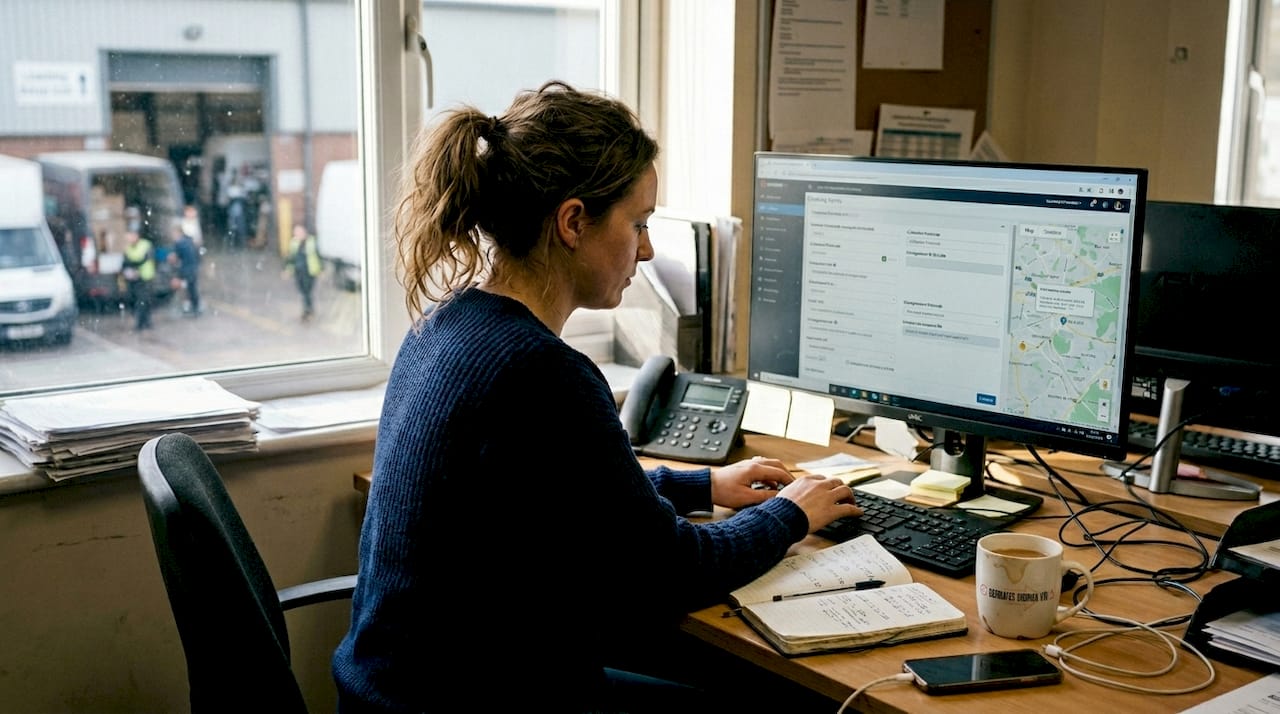
Pro Tip: Integrate your booking platform directly with your route planning tool. This single step eliminates duplicate data entry and reduces the risk of collections being missed or delayed.
Step-by-step process to optimise courier delivery operations
Optimising courier logistics is not a one-off project. It is an ongoing process that requires structured steps and regular review. Here is a practical sequence that works for UK businesses managing urgent deliveries.
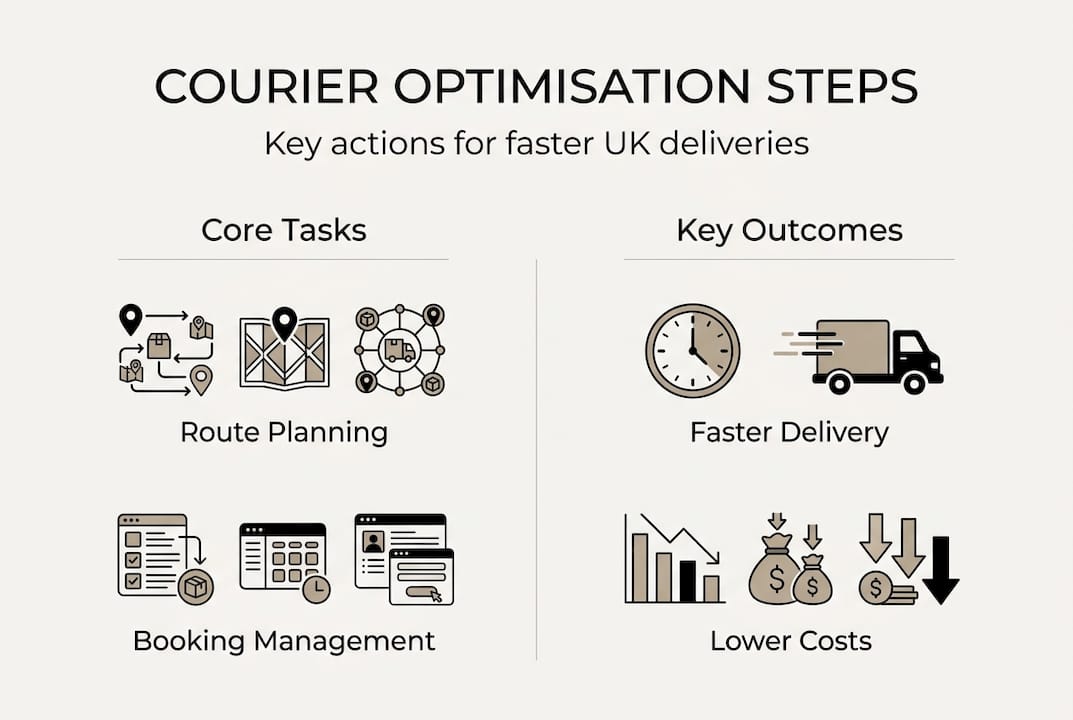
Analyse current operations. Map every stage of your delivery process and identify where delays, failed drops, or communication breakdowns occur most frequently. Data from your existing systems is the best starting point.
Implement or upgrade route optimisation tools. Route planning tools can cut delivery costs by 30-40% for UK couriers. If you are still planning routes manually, this is the highest-impact change you can make.
Set up predictive analytics and live communication. AI-led logistics systems deliver savings of 10-30% by enabling rerouting during delays before they become missed deliveries.
Train your team and establish standard operating procedures. Document the process for collections, deliveries, and customer support. Every team member should know exactly what to do when something goes wrong.
Introduce multi-modal delivery options. For dense urban areas, consider parcel lockers, out-of-home delivery points, and electric vehicles where infrastructure supports them.
Track KPIs daily. Set targets, review performance every day, and adjust processes based on what the data shows.
Step | Action | Expected outcome |
Analyse | Identify weak points | Clear picture of where costs and delays originate |
Upgrade tools | Route and fleet software | 30-40% cost reduction potential |
Predictive analytics | Live rerouting | 10-30% savings on logistics spend |
Train team | SOPs for all scenarios | Fewer errors, faster resolution |
Multi-modal options | Lockers, EVs, out-of-home | Higher first-delivery success rates |
Track KPIs | Daily performance review | Continuous improvement |
Understanding the same-day courier process in detail will help you identify where your current workflow diverges from best practice. For further guidance on parcel delivery optimisation, practical tips are available to support each of these steps.
Pro Tip: Do not wait for a major failure to trigger a review. Schedule a monthly operations check-in where you assess KPIs, gather driver feedback, and update your SOPs accordingly.
Verifying success: Key performance indicators for courier logistics
Measuring performance is not optional if you want to maintain reliable courier logistics. The right KPIs tell you whether your process improvements are working or whether further adjustments are needed.
The most valuable metrics to track are:
On-time delivery rate. Same-day delivery in the UK should exceed 98% on-time performance. Anything below that signals a process problem.
Collection speed. Collections should be completed within 60 minutes of booking confirmation for urgent shipments.
Cost-per-mile. Track this weekly to identify route inefficiencies or vehicle underutilisation.
Loss and damage rate. Aim for below 1%. Higher rates indicate packaging, handling, or communication failures.
Advanced planning and tracking can reduce delivery costs by up to 40%, which makes regular KPI review one of the highest-return activities a logistics manager can undertake. The benefits of same-day delivery are only realised when performance is consistently measured and maintained.
‘What gets measured, gets improved and stays ahead of the competition.’
Regular check-ins that align staff performance, technology outputs, and customer satisfaction scores create a feedback loop that keeps your logistics operation improving over time. Monthly reviews are a minimum. Weekly is better for high-volume operations.
Pro tips and common mistakes in optimising courier logistics
Even well-resourced logistics teams make avoidable mistakes. Knowing what to watch for saves time and money.
Pro Tip: In cities and dense urban areas, use parcel lockers and micro-fulfilment points to increase first-delivery success rates. Combining micro-fulfilment, EV fleets, and parcel lockers can reduce last-mile delivery distances by up to 26% and cut CO2 emissions by 61%.
Common mistakes to avoid:
Overinvesting in electric vehicles without supporting infrastructure. EVs work best when combined with parcel lockers or collection shops, not as a standalone solution in areas with limited charging points.
Ignoring failed delivery data. Every failed attempt has a cost. Analyse the reasons and adjust your process, whether that means better customer communication, alternative delivery points, or tighter booking windows.
Neglecting edge cases. Parking restrictions, severe weather, and access limitations are predictable problems. Build contingency steps into your SOPs before they cause delays.
Reactive rather than predictive management. Real-time rerouting and predictive analytics can mitigate up to 30% of urban congestion delays. Waiting until a driver is stuck in traffic is too late.
Sustainability is increasingly a client requirement, not just a regulatory one. Smart routing technology and green fleet options reduce emissions without sacrificing delivery speed. Knowing how to prepare parcels for courier correctly also reduces damage rates and the associated costs of redelivery.
Partner with a dedicated courier for fast, optimised deliveries
Putting all of these steps into practice takes time, resource, and the right operational partners. For many UK businesses, the most efficient route to optimised courier logistics is working with a dedicated courier service that already has the technology, coverage, and experience in place.

At DedicatedSameDayCourier.co.uk, we provide same-day courier services with 24/7 availability, real-time tracking, and nationwide coverage. Whether you need urgent collections, next-day delivery, or a range of van courier options to match your load size, our network of trusted couriers is ready to support your logistics operation. You do not need to build every capability in-house. Partnering with a dedicated courier service gives you immediate access to optimised routes, professional drivers, and the reliability your clients expect.
Frequently asked questions
What is the fastest way to optimise urgent courier deliveries?
Use real-time route planning tools alongside reliable courier partners to cut delays and ensure same-day completion. Route planning can reduce delivery costs by 30-40% for UK operations.
Which KPIs matter most for courier logistics in the UK?
Focus on on-time delivery percentage, speed of collection, cost-per-mile, and low loss or damage rates. Same-day KPI benchmarks include 98% on-time performance, under 60-minute collections, and less than 1% loss or damage.
How do parcel lockers improve courier optimisation?
Lockers increase first-time delivery success significantly, reducing repeat attempt costs and improving customer satisfaction. Locker solutions achieve a 73% first-time success rate compared to standard home delivery.
Are electric vehicles always the most cost-effective choice?
Not on their own. Electric trucks combined with lockers or collection shops deliver 5.4% cost reductions and 61% CO2 cuts, but EVs alone in areas with limited infrastructure may not justify the investment.
How can we reduce failed deliveries and congestion delays?
Combine predictive analytics with out-of-home delivery options and live tracking. Predictive analytics and lockers can mitigate up to 30% of urban congestion-caused delays when used together.
Recommended


Comments