
Role of rapid logistics in business: cut downtime and cost
- Andrew Buttrick
- 16 hours ago
- 12 min read

Rapid logistics is a strategic enabler that protects operational uptime, reduces inventory holding costs, and improves customer promise fulfilment. It is not a contingency measure reserved for emergencies. Businesses that treat it as a planned capability gain a measurable edge over those that deploy it only when something goes wrong. Academic research on rapid response logistics confirms that reliable urgent shipment execution depends on system design and organisational protocols, not just fast vehicles.
Three core benefits define the case for rapid logistics:
Reduced cost of delay and downtime. A halted production line or missed delivery window carries costs that typically exceed the freight charge many times over. Rapid logistics eliminates or shortens that gap.
Lower inventory and storage cost. Tighter, more frequent replenishment means smaller safety stocks and less capital tied up in warehoused goods.
Improved customer experience and retention. Reliable, fast delivery directly affects repeat purchase and loyalty, particularly in sectors where the customer has alternatives.
This guide covers definitions, business impact, how rapid logistics works in practice, KPIs, UK use cases, costs, and a step-by-step implementation playbook. Dedicated same-day courier options are available across the UK for businesses that need to act on any of this today.
Key takeaways
Rapid logistics is most valuable when treated as a planned operational capability with defined thresholds, not a reactive emergency measure deployed without process.
Point | Details |
Define time-critical thresholds | Document which shipment types justify rapid logistics based on your cost-of-delay figure per product line. |
Run a structured pilot | A 24–90 day pilot with fixed use cases and clear KPIs gives reliable data before full commitment. |
Measure OTIF and cost of delay | Track on-time-in-full rates and the financial impact of delays to calculate real ROI from rapid logistics. |
Use dedicated, direct transport | Point-to-point, no co-loading services reduce damage, misrouting, and missed delivery windows. |
Plan capacity before peak periods | Pre-agreed retainer arrangements with a courier partner prevent capacity shortfalls when demand spikes. |
Table of Contents
How rapid logistics differs from standard logistics
Logistics coordinates the flow and storage of resources to meet demand; efficient logistics reduce costs and can be a direct competitive advantage. Rapid logistics, sometimes called rapid response logistics or time-critical logistics, is a specific operating mode within that broader discipline. The defining characteristic is not raw speed but predictable arrival within a defined operational window, using direct, dedicated transport rather than shared or hub-and-spoke networks.
Standard logistics optimises for cost efficiency across consolidated loads. Rapid logistics optimises for time certainty, accepting a higher per-unit freight cost in exchange for guaranteed delivery windows and fewer handoffs. Understanding what time-sensitive delivery actually requires is the starting point for any business considering this mode.
Rapid vs standard logistics at a glance:
Dimension | Standard logistics | Rapid logistics |
Primary objective | Cost per unit shipped | Time certainty and uptime protection |
Routing | Hub-and-spoke, consolidated loads | Point-to-point, dedicated vehicle |
Co-loading | Common | Not permitted on dedicated services |
Pricing model | Weight/volume rate, shared cost | Per-job fee or retainer for capacity |
Predictability | Estimated window, subject to consolidation | Defined arrival slot, tracked in real time |
Typical lead time | Hours to days | Minutes to hours (same-day collection common) |
Rapid logistics sits alongside, not instead of, scheduled shipments and inventory strategy. Most businesses use it for a defined subset of shipments where the cost of delay outweighs the premium freight charge.
How rapid logistics affects business strategy and cashflow
Industry leaders now view logistics as a strategic enabler used to differentiate on speed and reliability rather than a pure cost centre. That shift has direct consequences for how supply chain managers should allocate budget and select partners.
The business impacts of rapid logistics span operations, finance, and commercial performance:
Production continuity. A missing component that halts a manufacturing line costs far more per hour than any courier charge. Rapid logistics eliminates that exposure for critical spares.
Improved inventory turns. Frequent, reliable replenishment allows businesses to hold less stock without risking stockouts, freeing working capital.
Smaller safety stocks. When replenishment lead times are short and predictable, the buffer stock required to cover variability falls proportionally.
Stronger OTIF performance. On-time-in-full rates improve when the final mile is controlled and dedicated rather than shared.
Customer retention. Survey data cited by NetSuite’s logistics research from Wunderman Thompson’s Future Shopper report shows that 48% of consumers prioritise faster delivery, 43% prioritise lower cost, and 39% want more precise delivery estimates. Logistics capability directly affects repeat purchase.
A simple worked example illustrates the cashflow case. A UK SME holding £50,000 of safety stock to cover a supplier lead time of five days could, with a reliable same-day courier option available, reduce that buffer to two days’ cover.
Expedited freight has become a strategic tool that prevents costly downtime and supports lean manufacturing and time-bound retail fulfilment. The cost of delay for mission-critical deliveries typically dwarfs the freight charge, which is why practitioners focus on uptime metrics rather than per-shipment cost.
Primary operational and commercial benefits of rapid logistics
Effective logistics reduce holding costs, improve delivery reliability and give businesses visibility to optimise inventory and lower operational expenses. Rapid logistics amplifies each of those effects by compressing lead times and removing the uncertainty that forces businesses to hold excess stock.
Lower holding cost. A pharmaceutical distributor that can receive temperature-sensitive stock within four hours of ordering holds less on-site, reducing both storage cost and waste from expired product.
Better inventory control. Predictable replenishment windows make demand planning more accurate. A retailer replenishing a dark store twice daily rather than once every two days can match stock levels to actual sell-through without overstocking.
Faster production resupply. A manufacturer awaiting a single machined component can receive it same-day from a specialist supplier rather than waiting 48 hours for a standard pallet network delivery, keeping the line running.
Improved customer experience. Fewer handoffs mean fewer damages and fewer missed delivery slots. A dedicated vehicle carries one consignment from collection to delivery without intermediate sorting.
Reduced claims and disputes. Direct, point-to-point transport with no co-loading reduces the risk of damage, loss, and misrouting that generate claims and administrative cost.
Pro Tip: Align your finance and operations teams around a single “cost of delay” figure for each product category. When both teams agree on what a production stoppage or missed customer delivery actually costs per hour, the decision to use rapid logistics becomes straightforward rather than a negotiation.
How rapid logistics actually works in practice
Time-critical logistics is about predictable timing and choosing the correct expedited mode to avoid costly stoppages. The mode selection decision is as important as the speed of dispatch.
A typical rapid logistics flow:
Escalation trigger. A threshold is breached: a component falls below minimum stock, a production line stops, or a customer order requires same-day delivery to meet an SLA.
Mode selection. The urgency, distance, consignment type, and receiving window determine the mode: dedicated same-day ground courier for local and national UK deliveries, next-flight-out (NFO) for long-distance or international, air charter for high-value or oversized urgent freight.
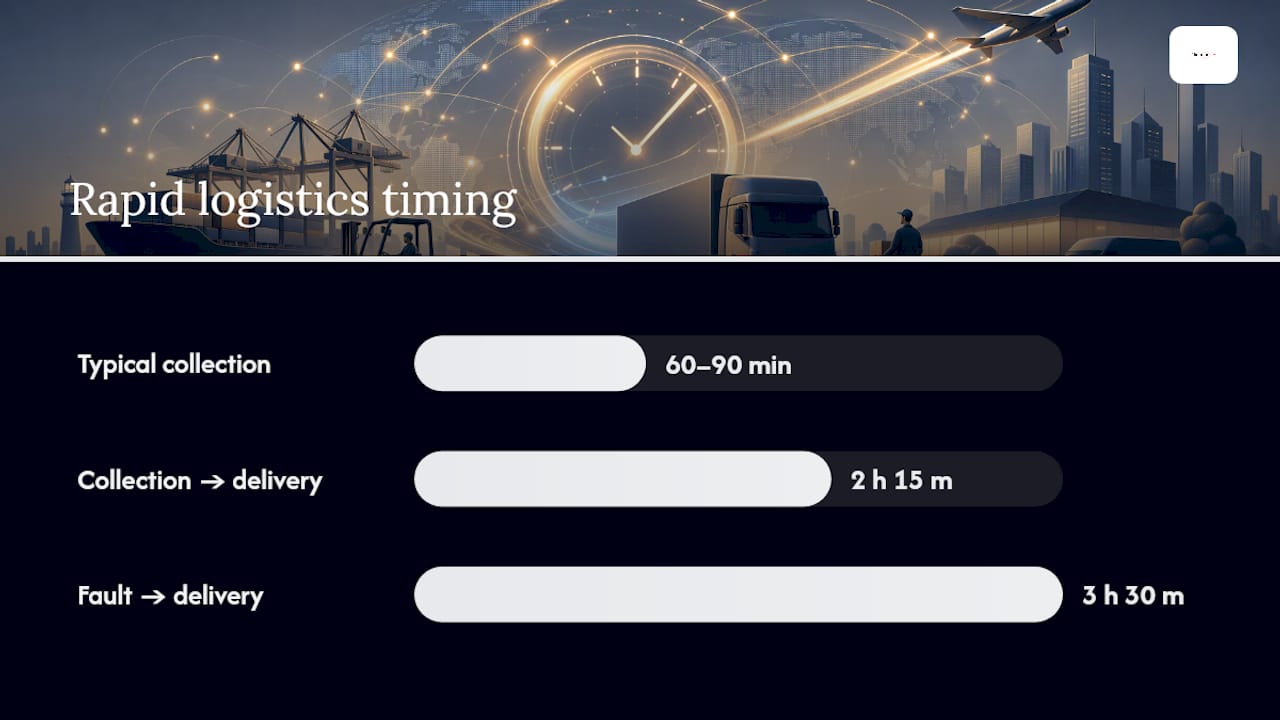
Booking and dispatch. A dedicated vehicle is allocated. For same-day services, collection typically occurs within 60–90 minutes of booking confirmation.
In-transit visibility. Real-time tracking and ETA communication keep the receiving team informed so they can prepare for arrival without waiting blind.
Hand-off and confirmation. Proof of delivery, including time-stamped confirmation and signature where required, is issued immediately on completion.
The technology stack supporting this flow typically includes:
Real-time GPS tracking with live ETA updates
Digital booking platforms with instant quote generation
TMS or ERP integration for automated escalation triggers
Electronic proof of delivery (ePOD)
Temperature monitoring for cold-chain or pharmaceutical consignments
Example workflow: urgent engineering part delivery. A production manager identifies a failed component at 09:00. The part is available from a supplier 80 miles away. The decision threshold (line stoppage cost per hour) is met within minutes. A dedicated van is booked, collects by 10:15, and delivers direct to the factory gate by 12:30. The line restarts before the afternoon shift. No co-loading, no depot sorting, no delay.
Corporate courier workflows for dedicated services follow this structure consistently, which is why businesses that document their escalation process recover faster than those that improvise each time.
How to adopt rapid logistics inside your business
A structured pilot is the most reliable way to prove value before committing to a full programme. The following steps apply to UK businesses of any size.
Define your time-critical use cases and thresholds. Identify which shipment types carry a cost of delay that justifies a premium freight charge. Document the threshold (e.g., “any line-stop risk” or “any order over £X with same-day SLA”).
Select partners and modes. Evaluate courier partners against response time, direct transport options, 24/7 availability, UK geographic coverage, handling protocols for your goods, and SLA terms including proof of delivery.
Integrate tracking and communication. Connect your courier partner’s tracking to your internal systems so the receiving team always knows ETA without manual chasing.
Run a defined pilot. A 24–90 day pilot with a fixed set of shipment types gives enough data to evaluate performance without overcommitting.
Measure KPIs and apply go/no-go criteria. Set clear targets before the pilot starts (see the KPIs section below). Review at 30 days and again at the pilot’s end.
Partner selection criteria:
Collection response time (target: within 60–90 minutes of booking)
Direct, point-to-point transport with no co-loading
24/7 operational availability, including weekends and bank holidays
Nationwide UK coverage with a verified courier network
Clear SLA documentation with defined remedies for failure
Electronic proof of delivery issued on completion
Specialist handling capability for your goods (temperature control, fragile, high-value)
Practical delivery tips for small businesses cover the documentation and packaging steps that make a pilot run cleanly from day one.
KPIs to measure rapid logistics performance and ROI
Tracking the right metrics ties rapid logistics performance to financial outcomes rather than leaving it as an operational cost with no visible return.
KPI | What it measures | Suggested target (UK SME context) |
Lead time (escalated shipments) | Time from booking to delivery for urgent jobs | Same-day: under 4 hours local; under 8 hours national |
OTIF (on-time-in-full) | Percentage of urgent orders delivered on time and complete | High for dedicated services |
Fill rate | Percentage of urgent orders fulfilled without substitution or short-ship | High |
Inventory turns | How often stock is cycled per year | Improvement of 10–20% after tighter replenishment |
Cost per expedited job | Total freight cost per urgent shipment | Benchmarked against cost of delay for each category |
Cost of delay | Financial impact of a missed or late delivery | Calculated per product line; used as the decision threshold |
Data for these KPIs should come from your ERP, WMS, or TMS rather than manual spreadsheets. A simple dashboard showing OTIF and cost per expedited job alongside cost of delay gives commercial and operations teams a shared view of whether rapid logistics is paying for itself.
To convert KPI improvements into estimated ROI: calculate the reduction in inventory carrying cost from smaller safety stocks, add the value of production hours saved from avoided stoppages, and subtract the incremental freight cost. For most manufacturing and medical businesses, the net figure is positive within the first quarter of a structured pilot.
UK time-critical use cases where rapid logistics is essential
Rapid logistics is not a universal solution, but for certain business scenarios it is the only practical option.
Manufacturing: aircraft-on-ground and line-stoppage parts. A single missing component can halt a production line worth thousands of pounds per hour. Dedicated same-day couriers collect the part from the supplier and deliver direct to the factory floor, bypassing depot networks entirely. Real-world examples of urgent shipments show how this plays out across engineering and automotive sectors in the UK.

Medical and pharmaceutical: temperature-sensitive supplies. Patient-critical therapeutics, blood products, and diagnostic samples cannot be co-loaded with general freight. They require dedicated vehicles, temperature monitoring, and chain-of-custody documentation. Arriving outside the delivery window can render the consignment unusable.
Retail and quick commerce: dark store replenishment. Quick commerce models increase pressure on suppliers to replenish frequently within tight time windows. A rejected or late consignment at a dark store results in penalties and lost sales. Rapid logistics supports the frequent, time-bound replenishment these models require.
Items that should never be co-loaded include:
High-value goods (electronics, jewellery, precision instruments)
Critical production spares where any delay causes a line stop
Patient-critical therapeutics and biological samples
Legal documents with court deadlines
Confidential or sensitive commercial documents
Rapid logistics should be planned for known risk windows (peak season, product launches, scheduled maintenance periods) rather than used only as a last resort. Businesses that pre-agree capacity with a courier partner avoid the scramble that occurs when every competitor needs urgent transport simultaneously.
Challenges of rapid logistics and how to manage them
Higher per-job cost, limited capacity at peak periods, and integration gaps are the three challenges most UK businesses encounter first.
Higher per-job cost. A dedicated vehicle costs more than a shared pallet network slot. The mitigation is a clear cost-of-delay threshold: if the delay costs more than the freight, the decision is straightforward.
Limited capacity at peak periods. Christmas, bank holidays, and sector-specific peaks (e.g., end of financial quarter for legal documents) reduce available courier capacity. Retainer or contract arrangements with a courier partner guarantee capacity when demand spikes.
Integration gaps. If booking a rapid courier requires manual phone calls and email chains, the process adds delay. Digital booking with ERP or TMS integration removes that friction.
Scheduling windows at receivers. Arriving outside a warehouse’s booking window can result in a rejected consignment. Dedicated couriers coordinate precise arrival slots to avoid this, but the receiving team’s constraints must be communicated at booking.
Regulatory and security constraints. Some consignments (pharmaceuticals, certain chemicals, high-value goods) require specific documentation, vehicle security, or driver vetting. Pre-approved documentation packs and vetted courier networks address this.
Pro Tip: Before peak season, create a pre-approved escalation workflow: a named contact at your courier partner, a pre-agreed rate card for urgent jobs, and a documented list of shipment types that automatically qualify for rapid dispatch. This removes internal approval delays when time is critical.
How dedicated same-day courier services make rapid logistics work in the UK
A same-day urgent part delivery through Dedicatedsamedaycourier follows a straightforward sequence. A booking is placed by phone, email, or online quote form. A dedicated vehicle is allocated and collects within 60–90 minutes. The consignment travels direct, point-to-point, with no co-loading and no intermediate depot handling. Real-time tracking keeps the receiving team informed throughout. Proof of delivery is issued on completion.
Urgent couriers shape UK business deliveries precisely because this model removes the variables that cause standard networks to fail time-critical consignments.
Checklist for briefing a courier partner:
Consignment details: dimensions, weight, handling requirements, temperature sensitivity
Collection address and contact name with direct phone number
Delivery address, contact name, and any access or appointment requirements
Required delivery window and any hard deadlines
Documentation required: commercial invoice, chain-of-custody form, dangerous goods note if applicable
Proof of delivery format: signature, photograph, ePOD
Insurance requirements for high-value goods in transit
Pro Tip: After each pilot job, record three figures: on-time pickup (was the vehicle at the collection point within the agreed window?), on-time delivery (did the consignment arrive within the agreed slot?), and claims rate (any damage or loss reported?). These three metrics tell you everything you need to know about whether a courier partner is performing.
Typical pricing models and timelines for rapid logistics in the UK
Rapid logistics pricing reflects the dedicated capacity and time certainty it provides. Understanding the models helps procurement teams budget accurately and avoid surprises.
Pricing models:
Per-job urgent fee. A single charge covering vehicle allocation, driver, fuel, and distance. Rates vary by vehicle size, distance, and urgency. Dedicated same-day services typically carry a minimum charge.
Retainer or contract for guaranteed capacity. A monthly or annual agreement that reserves courier capacity and often provides a pre-agreed rate card. Suitable for businesses with predictable urgent shipment volumes.
Premium for dedicated point-to-point. The core premium over standard services reflects the exclusive vehicle allocation and direct routing with no co-loading.
Surcharges for specialist handling. Temperature-controlled vehicles, tail-lift equipment, or driver vetting for secure deliveries carry additional charges that should be agreed in advance.
A same-day courier job covering the same gap might cost £150–£300 per occasion. If the business needs that buffer fewer than 20 times per year, the courier option is cheaper than the stock. Above that frequency, a retainer arrangement reduces the per-job cost further.
Typical timelines:
Local same-day collection: within 60–90 minutes of booking
National same-day delivery (UK mainland): typically 3–8 hours depending on distance
Next-flight-out (NFO): collection to airport within 2 hours; delivery dependent on flight schedule
Air charter: arranged within hours for oversized or high-value urgent freight
SLA language should specify collection window, delivery window, notification requirements, and the remedy for failure. Vague terms like “as soon as possible” are not enforceable. A well-drafted SLA names the collection window in minutes and the delivery window in hours.
What most businesses get wrong about rapid logistics
The conventional advice on rapid logistics focuses almost entirely on cost: it is expensive, use it sparingly, treat it as a last resort. That framing is understandable but it leads businesses to make a consistent and costly mistake. They deploy rapid logistics reactively, without process, under pressure, and then judge it by the per-job freight cost rather than by what it actually prevented.
The research tells a different story. Time-critical logistics practitioners treat cost as secondary to uptime for high-stakes deliveries. The true cost of delay includes hidden operational losses measured in production hours, customer penalties, and lost repeat business. A business that calculates its cost of delay per product line and compares it honestly against the freight charge will find that rapid logistics is cheap at the price for a defined subset of shipments.
What is genuinely overrated is the idea that speed alone defines rapid logistics. Predictability matters more. A consignment that arrives reliably within a four-hour window is more useful to a production manager than one that might arrive in two hours or might arrive in six. Dedicated, point-to-point transport delivers that predictability. Shared networks, however fast their marketing claims, cannot.
The priority for any supply chain manager reading this is not to find the fastest courier. It is to define the thresholds that trigger rapid logistics, document the escalation process, and pre-agree capacity with a partner before the emergency happens. Businesses that do this recover faster, hold less stock, and spend less on freight overall than those that improvise each time.
Sources
Recommended


Comments