
UK courier trends to optimise your urgent logistics
Updated: May 14
TL;DR:
UK courier volumes grew by 25% in 2023, with SMEs capturing a significant market share through niche services.
Key trends include rising e-commerce growth, demand for same-day delivery, and technological innovations accessible to SMEs.
Same-day delivery volumes grew 25% to 180 million parcels in 2023 alone, yet many small and medium-sized businesses in the UK still treat courier decisions as an afterthought. The assumption that only large logistics firms shape delivery trends is a costly one. In reality, SMEs account for a significant slice of the UK’s courier market, and the trends now emerging in 2026 directly affect how you price, fulfil, and retain customers. This guide breaks down the key data, service shifts, and operational strategies relevant to your business right now.
Table of Contents
Key Takeaways
Point | Details |
Market growth driven by SMEs | Small businesses now contribute 22% of courier revenues, especially in same-day sector. |
Express and same-day deliveries surge | Demand and volume for rapid deliveries are increasing much faster than traditional services. |
Delivery failures cost billions | Missed first attempts add £1.6 billion costs annually, making optimisation crucial for SMEs. |
Fulfilment costs are SMEs’ top barrier | Over half of UK e-commerce brands say logistics expenses restrict their growth most. |
Tech innovation enables SME agility | Tools like AI routing and digital twins allow SMEs to compete with major courier firms efficiently. |
What shapes UK courier trends in 2026?
The UK courier, express and parcel (CEP) market is substantial. The UK CEP market is valued at USD 18.32 billion in 2026, growing at a 3.11% CAGR through to 2031. Separately, IBIS World estimates the UK courier industry at £17.4bn in 2025, with 4.4% growth and projections of 3 to 4% growth in 2026 driven largely by e-commerce.
These figures are not just background noise. They signal where investment is flowing, where capacity is being built, and what service expectations customers now carry. For SMEs, understanding this context is the starting point for smarter procurement decisions.
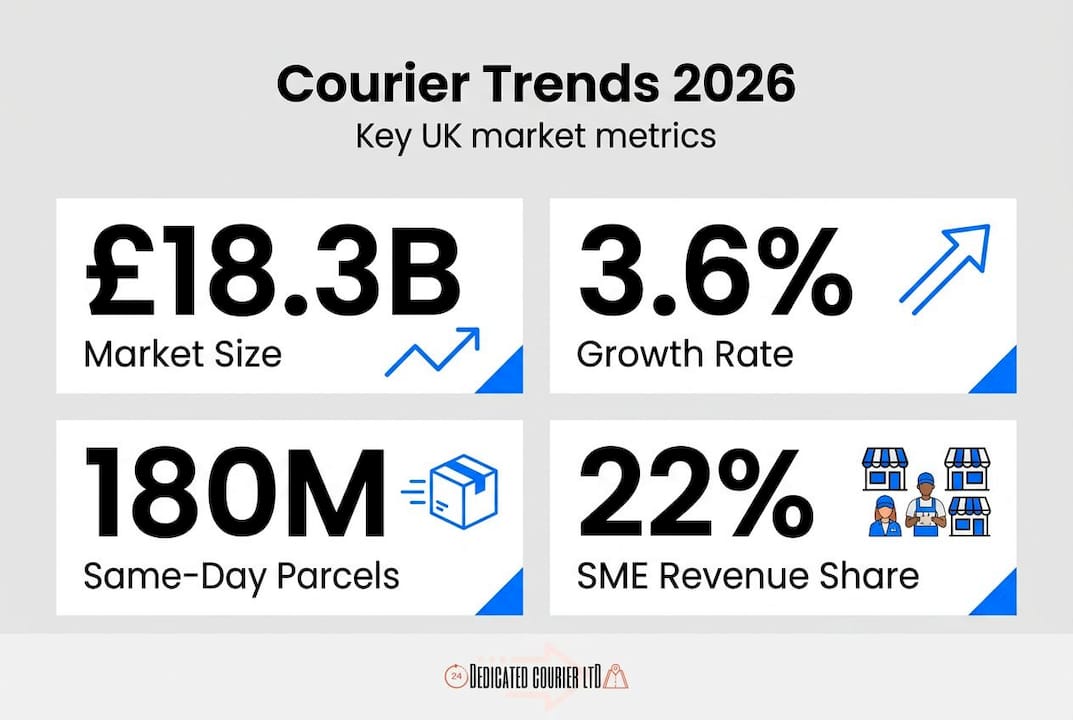
SMEs capture 22% of market revenue, equating to roughly £2.9 billion in 2023. That share is earned primarily through specialised, local, and same-day deliveries where large networks are less agile. E-commerce acceleration continues to be the primary engine. As more consumers expect fast, trackable delivery, businesses of all sizes must respond with reliable courier arrangements. For SMEs, this creates both pressure and opportunity, particularly in last-mile and niche delivery sectors.
Market indicator | Figure |
UK CEP market value (2026) | USD 18.32 billion |
UK courier industry value (2025) | £17.4 billion |
Industry growth rate (2026 projection) | 3 to 4% |
SME market revenue share (2023) | 22% (£2.9 billion) |
Key market forces shaping 2026 include:
Continued e-commerce growth driving parcel volumes upward
Rising customer expectations for same-day and next-day fulfilment
SME nearshoring bringing shorter, medium-weight shipments into focus
Greater emphasis on e-commerce courier reliability to reduce cart abandonment
Same-day delivery, express and parcel trends explained
Not all courier services grow at the same rate. Express services are currently growing at a 3.63% CAGR from 2025 to 2030, which is faster than non-express alternatives. Medium-weight shipments in the 5 to 31.5 kg range are growing at 3.50% CAGR, largely because SME nearshoring is producing more frequent, shorter-range consignments that do not require bulk freight arrangements.
Same-day delivery, in particular, stands out. Volumes in this segment reached 180 million parcels in 2023, representing a 25% increase, with the broader same-day market expanding at a 9.2% CAGR. This is one of the fastest-growing delivery modes in the UK and understanding its practical implications matters for any business relying on urgent goods movement.
Service type | Growth rate | Typical use case |
Express delivery | 3.63% CAGR | Time-sensitive B2B and e-commerce |
Non-express parcel | Slower growth | Standard retail and scheduled shipments |
Same-day dedicated | 9.2% CAGR | Urgent, single-collection consignments |
Medium-weight (5 to 31.5 kg) | 3.50% CAGR | SME nearshoring and local fulfilment |
Understanding the same-day courier impact on your operations involves more than speed. Dedicated same-day services mean one vehicle, one collection, one delivery. There is no shared loading and no depot sorting, which reduces handling risk and transit time considerably.
Here is how to decide which service mode suits a given consignment:
Assess urgency first. If the item must arrive the same day, a dedicated same-day service removes all ambiguity.
Consider the weight and dimensions. Medium-weight items often fit dedicated van services rather than parcel network pricing brackets.
Factor in handling sensitivity. Fragile or high-value goods benefit from dedicated transport rather than shared network sorting.
Evaluate cost against risk. Express services cost more, but the cost of a failed or delayed delivery can far exceed the premium.
Review retail delivery trends to understand what your end customers already expect from your sector.
Pro Tip: Reserve express or same-day services for operationally justified scenarios. Overusing premium delivery modes without assessing need drives costs upward without proportional benefit. Apply these modes selectively and document outcomes to refine your criteria.
Delivery performance, fulfilment costs and key pain points
UK delivery performance in 2025 is broadly positive. First-attempt delivery success reached 97.24% in Q2 2025, up from 96.65% in Q1, with an on-time ratio of 98.64% and an average transit time of just 1.32 days. These numbers set a useful benchmark for evaluating courier partners.
However, the 2.76% of deliveries failing first-attempt create a disproportionate cost burden. Failed first-time deliveries cost £1.6 billion annually across the UK, with a 14% failure rate recorded across 574 million delivery attempts in 2023. Each failure means a redelivery cost, a delayed customer, and often a customer service interaction.
“Failed first-time deliveries cost UK businesses £1.6 billion annually, with a 14% failure rate across 574 million attempts in 2023.”
Beyond failed deliveries, fulfilment cost is a structural pressure. 53% of UK e-commerce brands cite fulfilment costs as their biggest barrier to growth. For SMEs without the volume discounts of large retailers, this pressure is acute.
The most common pain points include:
Redelivery costs and administration following failed first attempts
Carrier surcharges for fuel, remote areas, and large items
Inconsistent performance between courier partners and time windows
Lack of real-time visibility causing reactive customer service calls
Poor courier logistics optimisation leading to missed collection windows
Pro Tip: Reducing failed first-time deliveries by even one percentage point across your monthly volume can recover significant cost. Pre-delivery notifications, accurate address validation, and recipient contact protocols are straightforward improvements that reduce failure rates without capital investment. Reviewing avoiding courier mistakes is a practical starting point.
Choosing a courier partner with strong first-attempt rates and transparent courier reliability credentials reduces these costs more effectively than chasing the lowest base rate.
Performance metric | Q1 2025 | Q2 2025 |
First-attempt delivery success | 96.65% | 97.24% |
On-time delivery ratio | Not specified | 98.64% |
Average transit time | Not specified | 1.32 days |
Technologies, operational shifts and SME innovation
Technology is reshaping courier operations in ways that SMEs can now access without enterprise budgets. AI route optimisation integrates live traffic, weather data, and time-window requirements to produce dynamic routing that is predictive rather than reactive. RESTful APIs allow real-time integration between e-commerce platforms and courier dispatch systems, enabling elastic capacity during demand peaks such as promotions or seasonal spikes.
Digital twins, which are virtual simulations of a logistics network, allow operators to model changes before committing operationally. This is no longer exclusive to large firms. Smaller courier networks and specialist providers are adopting these tools to improve route planning and resource allocation.
On the ground, rural and urban delivery challenges are being addressed through micro-hubs, cargo bikes in city centres, and consolidated rural routing that makes previously unprofitable routes viable. The EV transition is accelerating but carries real costs, particularly for smaller fleets where leasing and charging infrastructure investment can strain margins. There is also a documented supply chain workforce gap of approximately 76,000 drivers needed nationally, which affects capacity planning and service reliability.
The top five courier firms including Royal Mail, Evri, DPD, Amazon Logistics, and DHL control 87% of the UK market. For SMEs, competing head-on is neither practical nor necessary. The opportunity lies in the 13% served by specialists, with same-day, local, and niche delivery segments offering the clearest margin potential.
Pro Tip: Digital tools do not require large IT budgets to deliver results. Even basic route optimisation software or a courier platform with live tracking capability can meaningfully improve delivery consistency and reduce administrative time for smaller operations.
The uncomfortable truth about SME courier success
The market data presents a broadly optimistic picture, 3 to 4% growth, rising same-day volumes, improving first-attempt success rates. But the reality for most SMEs is more constrained. Margins face pressure from rising labour costs, fuel volatility, insurance obligations, and regulatory demands, regardless of market growth headlines.
The EV transition is a clear example. Incentives exist, but the transition costs for small fleets often outpace those incentives in the short term. Charging infrastructure is patchy outside urban centres, and vehicle availability at appropriate payload capacities remains limited. Following the large-firm EV strategy without assessing your own operational geography and cash flow position is a risk, not an automatic upgrade.
The more reliable path to SME courier success is recognising local strengths and applying technology in targeted ways rather than attempting to replicate corporate logistics infrastructure. An SME that knows its local delivery geography intimately, maintains reliable driver relationships, and responds to clients within hours holds real advantages that no national network can easily replicate.
Pro Tip: Focus on last-mile excellence and client responsiveness as your primary competitive levers. Speed of response, accurate communication, and consistent delivery performance build retention more effectively than competing on price against high-volume national operators.
Connect with specialist courier solutions for your business
The trends in this guide point clearly toward specialist, flexible courier arrangements as the most practical fit for SME logistics in 2026.
[
DedicatedSameDayCourier.co.uk offers same-day courier services designed specifically for businesses that cannot afford delivery failure on urgent consignments. With a range of courier vehicle options suited to everything from documents to pallets, and 24/7 availability across the UK, the service is built around the operational realities SMEs face daily. The nationwide dedicated courier model means your goods travel on an exclusive vehicle, with no shared sorting or unnecessary handling. Request a quote by phone, email, or online form and get a solution matched to your specific delivery requirement.
Frequently asked questions
How can UK SMEs reduce fulfilment costs in 2026?
SMEs can reduce costs by optimising delivery routes, using predictive scheduling, and focusing on last-mile accuracy, as over half of UK e-commerce brands identify fulfilment costs as their primary growth barrier.
What are the key benefits of same-day courier for SMEs?
Same-day courier services provide speed, reliability, and direct client responsiveness, with SMEs earning 22% of market revenue through these specialist and local delivery capabilities.
Are failed first-time deliveries still a major issue?
Yes, failed first-time deliveries cost UK businesses £1.6 billion annually, with a recorded 14% failure rate across 574 million delivery attempts in 2023.
How do SMEs compete with major courier firms?
SMEs compete effectively by specialising in same-day, niche, and local deliveries, where the top five firms controlling 87% of the wider market have less operational flexibility and local knowledge.
Recommended


Comments