
What is proof of delivery and why it matters

TL;DR:
Proof of delivery confirms that goods have reached the recipient and transfers delivery risk. It includes details such as signature, timestamp, GPS location, and shipment reference number. Digital POD records improve transparency, speed up processing, and are essential for regulated industries requiring audit-ready documentation.
Proof of delivery (POD) is the official document or electronic record that confirms a shipment has successfully reached its intended recipient. Known formally as a POD in logistics and supply chain management, it typically captures the recipient’s name, signature, exact delivery date and time, GPS location, and shipment reference numbers. POD serves as legal and contractual evidence that delivery obligations have been fulfilled. Vendors are generally required to retain POD documents for a minimum of 4 years and must produce them within 10 calendar days of request.
What does proof of delivery include?
A valid POD document contains several standard elements. Each element serves a specific purpose in confirming that the right goods reached the right person at the right time.
The core components of any POD record are:
Recipient’s full name and signature confirming acceptance
Delivery date and time, recorded at the moment of handover
GPS location data or delivery address confirmation
Shipment reference number linking the record to the original order
Condition notes recording any visible damage at the point of receipt
Courier or driver identification for accountability
POD documents come in several formats, each with different levels of detail and legal weight.
POD format | Typical contents | Common use case |
Paper signed receipt | Signature, date, recipient name | Low-value parcel deliveries |
Electronic signature (ePOD) | Digital signature, timestamp, GPS | Business-to-business freight |
Timestamped photo | Image of goods at door, GPS tag | Unattended residential deliveries |
Combined digital record | Signature, photo, GPS, reference | High-value or regulated shipments |

Pro Tip: Always request a combined digital record for high-value shipments. A single photo or signature alone may not satisfy a formal dispute or insurance claim.
How does proof of delivery work legally?
POD is the legal trigger that transfers risk from the seller or carrier to the buyer. Once a recipient signs a POD without noting any damage, the risk and responsibility shift from the carrier to the recipient. That single act of signing has significant consequences in any subsequent claim.
A common source of confusion is the difference between a bill of lading and a POD. The bill of lading confirms goods at the shipment origin. The POD confirms condition and receipt at the destination. Mixing up these two documents creates liability gaps that are difficult to close after the fact.
POD also functions as prima facie court evidence confirming contract fulfilment. Courts treat a signed POD as strong evidence that delivery occurred as agreed. This makes it central to invoice disputes, chargeback defence, and final payment processing.
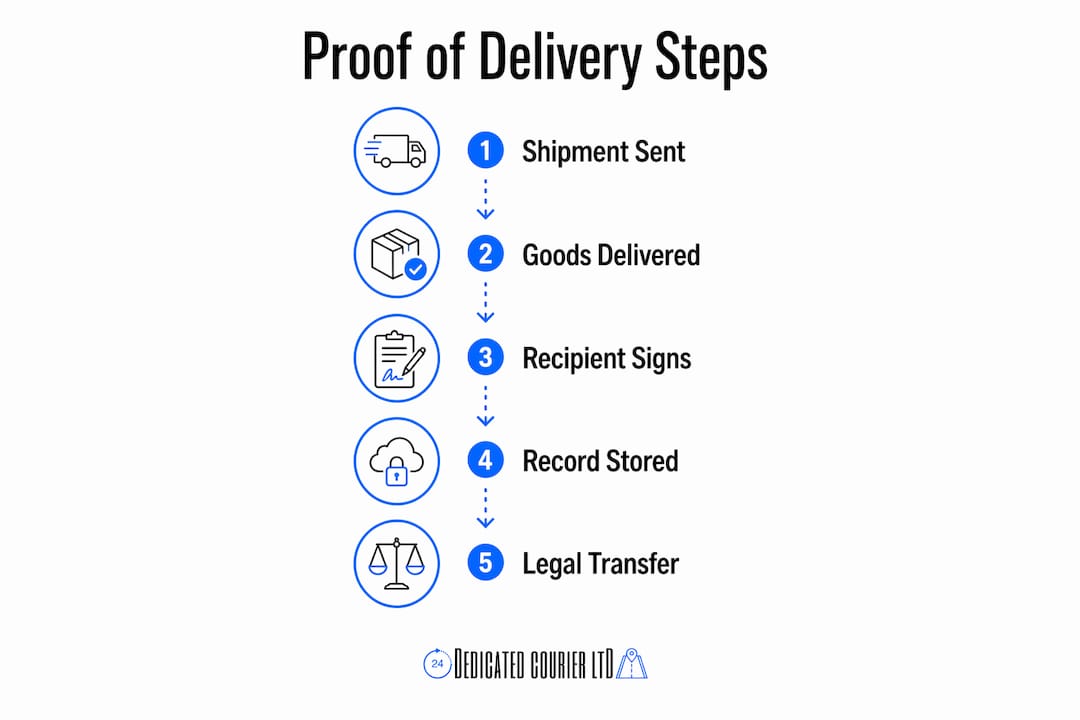
The legal steps in a typical POD process are:
Carrier arrives at the delivery address with goods and a POD document
Recipient inspects the goods before signing
Recipient notes any visible damage on the POD before signing
Signed POD is returned to the carrier and logged against the shipment record
POD is stored for the mandatory retention period of at least 4 years
“A recipient signing a POD without noting damage surrenders the ability to claim poor condition easily.” — LegalClarity
Pro Tip: Combine GPS location data, a timestamped photo, and an electronic signature on every delivery. This multi-point verification creates a near-unbreakable defence against non-delivery fraud and disputed claims.
Why is digital proof of delivery changing logistics?
Digital proof of delivery, commonly called ePOD, has moved from a convenience to a standard expectation in most UK logistics operations. Real-time ePOD with photo confirmation and electronic signatures reduces service overhead and gives customers immediate visibility of their deliveries. That transparency directly answers the most common customer query: “Where is my order?”
The shift to ePOD brings clear operational benefits:
Instant delivery confirmation sent to the sender without manual paperwork
Reduced risk of lost or illegible paper records
Faster invoice processing because POD data links directly to order management systems
Improved dispute resolution through timestamped, GPS-tagged evidence
In regulated sectors, ePOD is not optional. Healthcare and pharmaceutical deliveries require audit-ready digital records to meet compliance standards. Failure to produce verified delivery records in these sectors can result in fines or rejected contracts.
Switching from paper to digital POD requires planning. Drivers need mobile devices and training. Systems need to integrate with existing order management platforms. Businesses handling secure document delivery should prioritise platforms that capture all required data fields automatically, rather than relying on manual entry.
Proof of delivery examples across different industries
POD requirements vary significantly depending on the industry, the value of the goods, and the contractual obligations in place. A residential parcel delivery and a government contract shipment demand very different levels of documentation.
Industry | POD type | Key requirements |
Retail courier | Timestamped photo or signature | Recipient name, delivery time |
Commercial freight | ePOD with GPS | Condition notes, reference number |
Government contracts | Formal signed document | Production within 10 days of request |
Healthcare/pharma | Verified digital record | Audit trail, compliance-ready format |
Secure document delivery | Combined digital record | Chain of custody, recipient ID |
Government vendors must produce formal POD documents within 10 calendar days of request. Failure to comply can delay payment or lead to rejected claims. Generic tracking screens do not meet this standard.
POD also supports payment processing in vendor-customer relationships. Many businesses tie invoice approval directly to confirmed POD. Without a valid record, payment can be withheld until delivery is verified. For businesses managing time-sensitive deliveries, this makes POD a direct factor in cash flow.
The level of detail in a POD should match the risk of the shipment. Low-value parcels may need only a signature and timestamp. High-value freight or regulated goods require a full digital record with GPS, photos, and condition notes. Businesses that apply the same minimal POD process to all shipment types expose themselves to unnecessary liability.
Key takeaways
Proof of delivery is the legal and operational record that confirms goods have been received, transfers risk from carrier to recipient, and protects all parties in the event of a dispute.
Point | Details |
POD definition | A physical or digital record confirming successful delivery, including signature, timestamp, and GPS data. |
Legal risk transfer | Signing a POD without noting damage shifts liability from the carrier to the recipient immediately. |
Document retention | Vendors must retain POD records for a minimum of 4 years and produce them within 10 calendar days. |
Digital POD benefits | ePOD improves transparency, speeds up invoicing, and meets compliance requirements in regulated industries. |
Match detail to risk | High-value or regulated shipments require combined digital records; minimal POD is insufficient for complex claims. |
POD has changed more than most businesses realise
I have watched the proof of delivery process evolve considerably over the years. When paper receipts were the norm, disputes were slow, expensive, and often unresolvable. The shift to digital records has changed that entirely, but many businesses have not kept pace.
The most common mistake I see is treating POD as an afterthought. Businesses invest in fast delivery but neglect the documentation that protects them after the handover. A missed damage note or a missing GPS record can turn a straightforward claim into a drawn-out dispute.
The other issue is assuming that a tracking screen counts as POD. It does not. Formal contracts, especially in government and regulated sectors, require structured documents with specific fields. Businesses that rely on informal records find this out at the worst possible moment.
My advice is simple: adopt a digital POD process that captures signature, photo, and GPS on every delivery. Review your delivery optimisation process to make sure POD is built into the workflow, not bolted on afterwards. The cost of getting it right is far lower than the cost of a disputed claim.
— andrew
Proof of delivery with Dedicatedsamedaycourier
Dedicatedsamedaycourier provides dedicated, same-day delivery across the UK with verified proof of delivery as standard. Every shipment travels on an exclusive vehicle, reducing handling risk and making POD records cleaner and more reliable.
[
Dedicatedsamedaycourier operates 24/7, covering urgent collections and deliveries nationwide. POD records are available to clients promptly, supporting invoice processing and dispute resolution without delay. Whether you need a dedicated delivery service for documents, parcels, or freight, Dedicatedsamedaycourier handles the full process from collection to confirmed receipt. For businesses that need to match vehicle size to shipment type, the full range of courier vehicle options is available online. Get a quote today by phone, email, or the online form.
FAQ
What is the proof of delivery meaning in logistics?
Proof of delivery is the formal record confirming that goods have been received by the intended recipient. It typically includes a signature, delivery timestamp, GPS location, and shipment reference number.
How does proof of delivery work in practice?
The carrier presents a POD document at the point of delivery, the recipient inspects the goods, notes any damage, and signs to confirm receipt. The signed record is then stored against the shipment for a minimum of 4 years.
What is the difference between a bill of lading and proof of delivery?
A bill of lading confirms goods were collected at the shipment origin. A POD confirms condition and receipt at the destination. Confusing the two creates liability gaps in loss or damage claims.
Why is proof of delivery necessary for businesses?
POD protects businesses by providing legal evidence of contract fulfilment, supporting invoice approval, and defending against chargeback or non-delivery claims. Without it, payment can be withheld and disputes are difficult to resolve.
What does proof of delivery include for regulated industries?
In healthcare and pharmaceutical sectors, POD must be a verified digital record with a full audit trail. Compliance standards in these industries require structured documentation that a standard tracking screen cannot provide.
Recommended


Comments