
Why use urgent delivery for time-sensitive shipments

TL;DR:
Urgent delivery prioritizes shipments for faster arrival than standard services, focusing on speed and reliability. It offers significant benefits for time-sensitive goods, including reduced transit time, lower damage risk, and increased customer satisfaction. Choosing dedicated, direct-routing couriers with transparent communication ensures optimal protection, efficiency, and long-term operational advantages.
Urgent delivery is the prioritisation of a shipment to guarantee arrival faster than standard postal or courier services allow, making it the correct choice whenever a missed deadline carries a real cost. Also referred to in the industry as expedited or express delivery, the service covers same-day, overnight, and next-day options. Reliability sits alongside speed as the defining quality: 73% of shoppers say on-time arrival defines a great delivery experience, often rating it above raw transit speed. For small businesses and individuals with time-critical consignments, understanding what urgent delivery offers is the starting point for making the right logistics decision.
Why use urgent delivery: the primary benefits
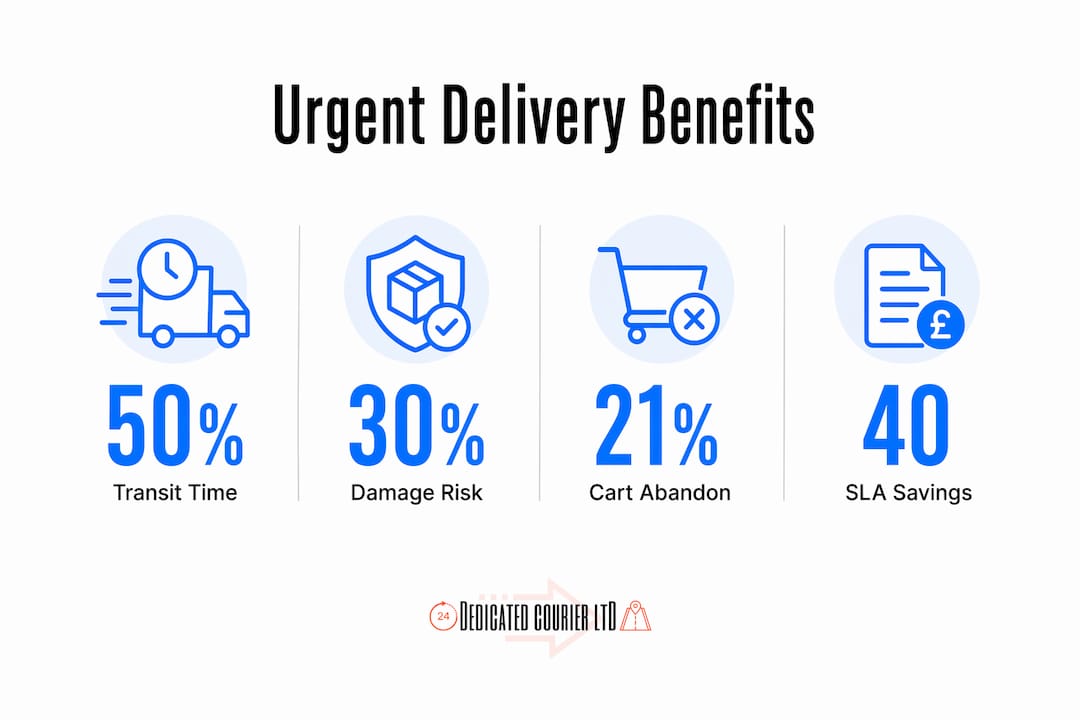
The core case for choosing fast delivery rests on four measurable advantages: reduced transit time, lower damage risk, stronger customer satisfaction, and protection against lost sales.

Reduced transit time is the most obvious gain. Standard domestic delivery in the UK typically takes two to five working days. Same-day or overnight urgent services compress that to hours. For a business shipping a replacement part to a production line, or an individual sending legal documents ahead of a court deadline, that difference is not a convenience. It is the difference between completing the task and failing it.
Lower damage risk follows directly from how urgent shipments are handled. Expedited packages follow priority paths with fewer stops and less manual handling at sorting facilities. Fewer handling points mean fewer opportunities for goods to be dropped, crushed, or mislabelled. This matters most for fragile items, perishables, and high-value goods in transit.
Customer satisfaction and repeat business are directly tied to delivery performance. 21% of shoppers abandon carts specifically because of slow delivery estimates. Offering an urgent option removes that barrier and converts hesitant buyers. Walmart demonstrated this at scale: its 30-minute delivery service reached 60% of US households by early 2026, fundamentally changing how customers approach last-minute purchases.
Protection against SLA penalties and order cancellations is the fourth benefit, and arguably the most financially significant for small businesses. A single missed service level agreement can trigger penalty clauses, damage client relationships, and invite competitors into accounts you have spent months building.
Pro Tip: Always calculate the cost of delay before comparing it to an urgent delivery surcharge. A £40 same-day fee is cheap if the alternative is a £500 SLA penalty or a lost client.
How does urgent delivery compare to standard and expedited options?
Understanding the service tiers helps you choose the right option without overspending or under-delivering.
Service type | Typical transit time | Handling points | Cost level | Best use case |
Standard delivery | 2 to 5 working days | Multiple | Low | Non-urgent parcels |
Expedited shipping | 1 to 2 working days | Reduced | Medium | Time-sensitive but flexible |
Express delivery | Next day or overnight | Few | Medium-high | Firm next-day deadlines |
Urgent same-day | Same day, hours | Minimal or direct | High | Critical, time-bound shipments |
Standard delivery routes packages through regional sorting hubs, which adds time and handling. Expedited shipping jumps the queue at those same hubs but still passes through them. Urgent same-day courier services, by contrast, often use dedicated vehicles that travel directly from collection point to destination with no intermediate stops. That direct routing is why dedicated couriers reduce delivery delays by around 30% for urgent shipments compared to standard expedited options.
The distinction between express and urgent is worth noting. Express services like overnight delivery follow a fixed schedule and cut-off time. Urgent same-day services are reactive: a courier collects within the hour and delivers without waiting for a scheduled run. If your shipment misses an express cut-off, it moves to the next available slot. Cut-off times and stock availability are the two most common reasons same-day orders slip to next-day delivery, so confirming both before booking is non-negotiable.
Pro Tip: If your deadline is tomorrow morning rather than today, overnight express is usually more cost-effective than same-day. Reserve same-day for genuine same-day requirements.
When is urgent delivery worth the cost?
The economic justification for urgent delivery is situational. Businesses must weigh the true cost of delay against the premium charged for the service. The following scenarios represent the clearest cases where urgent delivery is financially worthwhile.
Perishable goods. Food, flowers, pharmaceuticals, and temperature-sensitive products have a fixed shelf life. A delayed shipment is not a late shipment. It is a write-off. Urgent delivery, including temperature-sensitive handling, protects the value of the goods themselves.
Legal and medical documents. Contracts, court filings, prescriptions, and medical samples carry deadlines that cannot be renegotiated. The cost of missing them is measured in legal liability, not inconvenience.
High-value corporate shipments. When the average order value is high, the surcharge for urgent delivery represents a small percentage of the total transaction. A £60 courier fee on a £2,000 order is a 3% insurance premium.
Seasonal and last-minute demand spikes. Retailers and individuals face predictable peaks around Christmas, Valentine’s Day, and other events. Urgent delivery absorbs the gap between a late order and a firm gifting deadline.
Production line continuity. A manufacturing business waiting on a single replacement component loses output for every hour the part is delayed. The cost of downtime almost always exceeds the cost of urgent shipping.
Urgent delivery is not always the right call. For non-time-sensitive shipments, standard or expedited services deliver acceptable results at lower cost. The decision should always start with a clear answer to one question: what does an extra day actually cost?
How urgent delivery improves business operations and customer loyalty
Beyond individual shipments, the advantages of 24/7 urgent delivery compound into operational and competitive benefits for businesses that use the service consistently.
Workflow continuity is the most direct operational gain. Businesses that can source and ship urgently are not held hostage by supply chain delays. They can take on last-minute client orders, respond to stock shortfalls, and maintain production schedules without building excessive safety stock.
Competitive advantage follows. In markets where multiple suppliers offer similar products, delivery speed and reliability become differentiators. A small business that can guarantee same-day or next-day delivery competes on a dimension that larger, slower competitors cannot easily match.
Customer loyalty is the long-term return. Retailers that invest in reliable, flexible delivery see measurable improvements in repeat purchasing and brand trust. The data reinforces this: 61% of shoppers abandon carts when delivery options are inflexible, and 54% avoid retailers altogether after a poor delivery experience. Offering urgent delivery as an option, even if most customers do not use it, signals that you take fulfilment seriously.
Delivery quality surpasses speed as a driver of customer loyalty once base expectations are met. On-time delivery and responsive support matter most.
Communication transparency reinforces all of the above. Customers who receive accurate tracking updates and realistic delivery windows are more forgiving of minor delays than those left without information. Choosing an urgent delivery provider with live tracking and clear communication is as important as choosing one with fast transit times. The key benefits for UK businesses consistently include communication quality alongside speed.
Key takeaways
Urgent delivery is worth using when the cost of delay, whether financial, reputational, or operational, exceeds the premium charged for the service.
Point | Details |
Speed and reliability together | 73% of customers rate on-time arrival above raw speed, so choose providers that deliver both. |
Fewer handling points | Urgent shipments follow direct routes with minimal stops, reducing damage risk for fragile or perishable goods. |
Cost-of-delay calculation | Compare the SLA penalty, lost revenue, or downtime cost against the urgent delivery surcharge before deciding. |
Cut-off times matter | Confirm collection cut-offs and stock availability before booking to avoid slipping to next-day delivery. |
Customer loyalty impact | 61% of shoppers abandon carts when delivery is inflexible, making urgent options a retention tool, not just a logistics one. |
The case for urgency: a practical view from the field
The most common mistake I see businesses make is treating urgent delivery as an emergency measure rather than a planned capability. They wait until a crisis forces their hand, then pay premium rates under pressure with no time to vet the provider. That is the worst possible way to use the service.
The smarter approach is to identify your top five scenarios where a delay would genuinely hurt you, whether that is a key client order, a production-critical component, or a regulatory document, and then establish a relationship with a reliable urgent courier before you need one. Knowing your provider, their cut-off times, their vehicle options, and their tracking capability means you can act in minutes rather than hours when the situation arises.
Speed alone is not the measure of a good urgent delivery service. I have seen same-day shipments arrive on time but in poor condition because the provider used a shared vehicle with multiple drops. Direct, dedicated routing is the specification that actually protects your goods and your deadlines. Ask specifically whether the vehicle is exclusive to your consignment before you book.
The best practices for choosing a UK urgent courier in 2026 all point to the same conclusion: transparency, direct routing, and 24/7 availability are the three non-negotiable criteria. Price is secondary to those three.
— andrew
How Dedicatedsamedaycourier can handle your urgent shipments
[
Dedicatedsamedaycourier operates a nationwide same-day courier service built specifically for urgent and time-critical consignments across the UK. Every booking uses a dedicated vehicle, meaning your goods travel directly from collection to destination with no shared loads and no intermediate sorting. The service runs 24 hours a day, seven days a week, covering documents, parcels, pallets, and specialist freight. You can request a quote by phone, email, or online form, and the team will match the right vehicle size to your consignment within minutes. For businesses and individuals who cannot afford a missed deadline, Dedicatedsamedaycourier provides the direct routing, live tracking, and reliable communication that urgent delivery actually requires.
FAQ
What is urgent delivery and how does it differ from standard shipping?
Urgent delivery prioritises a shipment for same-day, overnight, or next-day transit using dedicated routing and minimal handling stops. Standard delivery routes packages through shared sorting hubs over two to five working days.
Why choose fast delivery for business shipments?
Fast delivery protects against SLA penalties, prevents production downtime, and reduces the risk of losing clients to competitors who can fulfil orders more quickly.
Does urgent delivery reduce the risk of damage to goods?
Urgent shipments follow direct routes with fewer handling points, which measurably reduces the exposure of goods to damage during transit compared to standard multi-stop services.
When is urgent delivery not cost-effective?
Urgent delivery is not cost-effective for non-time-sensitive shipments where a delay carries no financial or reputational consequence. Standard or expedited services are sufficient in those cases.
What should I check before booking a same-day courier?
Confirm the collection cut-off time, whether the vehicle is dedicated exclusively to your consignment, and whether live tracking is included. Missing a cut-off can push your shipment to the next available slot.
Recommended


Comments