
Delivery options for online stores: 2026 guide
- Andrew Buttrick
- 11 hours ago
- 8 min read

TL;DR:
Choosing the right delivery options significantly impacts customer satisfaction and business growth for online stores.
Offering diverse methods, including same-day, standard, and click-and-collect, can improve conversions and reduce cart abandonment.
Choosing the right delivery options for online stores is one of the most consequential decisions a small e-commerce merchant can make. Get it wrong and you lose customers at checkout. Get it right and you build loyalty that outperforms any marketing spend. Multiple delivery methods alongside accurate carrier integrations have been shown to improve conversion rates, reduce cart abandonment, and protect profit margins. This guide covers the criteria you need to evaluate, the main shipping options for online retailers, and a clear comparison to help you decide what fits your business now and as it grows.
Table of Contents
Key takeaways
Point | Details |
Multiple methods boost sales | Offering diverse delivery choices increases conversions and reduces cart abandonment at checkout. |
Speed must match your product | Match delivery timeframes to your product type and customer expectations before committing to a service. |
Same-day suits urgent goods | Dedicated courier services work best for time-sensitive, high-value, or perishable goods. |
3PL has an order threshold | Consider outsourcing fulfilment only once monthly orders consistently exceed 100 to 500 dispatches. |
Transparency builds trust | Displaying accurate delivery dates on product pages is as persuasive as offering faster shipping. |
1. Key criteria for evaluating delivery options for online stores
Before you select any carrier or method, you need a clear framework for comparison. Not all businesses have the same priorities, and the wrong choice will cost you more than just money.
The core criteria to weigh are:
Cost: Both the carrier rate and your operational overhead. Factor in packaging, staff time, and return handling.
Speed: Standard delivery typically takes 5 to 7 business days; expedited options run 1 to 3 days. Know what your customers expect.
Reliability and tracking: Customers want visibility. A carrier without real-time tracking will generate support queries and damage your reputation.
Geographic coverage: Are you shipping locally, nationally, or internationally? Not every carrier serves all areas at the same standard.
Flexibility and scalability: A method that works at 50 orders per month may break at 500. Build with growth in mind.
Customer experience: Accurate delivery promises displayed on product pages can double conversion rates by giving shoppers confidence before they commit.
Pro Tip: Audit your top 20 customer postcodes before selecting a carrier. If most of your buyers are concentrated in urban areas, a carrier with strong city networks will outperform a generalist every time.
2. Same-day and express delivery options
Same-day and express delivery are no longer exclusive to large retailers. Small online stores handling urgent, perishable, or high-value goods can now access dedicated courier services that collect and deliver on the same day, often within hours of dispatch.
The appeal is clear. Customers who need something fast will pay a premium for it, and same-day delivery services generate significantly higher average order values in categories like medical supplies, gifts, and fresh produce.
Key considerations for same-day and express delivery include:
Goods must typically be ready for collection within a short window after order placement.
Dedicated vehicle options, from motorcycles to large vans, allow merchants to match the vehicle to the consignment size.
Coverage can vary. Some providers operate nationwide through courier exchange networks; others are limited to specific regions.
Cost is higher per shipment, but margins can absorb this when the product price justifies it.
The rapid delivery market is clearly growing. Amazon expanded same-day delivery to over 2,300 US cities by mid-2026, which signals where consumer expectations are heading. UK merchants who offer a credible express option now are positioning themselves ahead of that curve.
3. Standard and economy shipping methods
Standard shipping remains the workhorse of e-commerce. For non-urgent, heavier, or bulky goods, it is usually the most practical and cost-effective option available to small retailers.
Method | Typical timeframe | Best for | Cost profile |
Standard tracked | 3 to 5 days | General goods, low urgency | Low to medium |
Economy untracked | 5 to 7 days | Books, low-value items | Lowest |
Expedited | 1 to 3 days | Mid-priority orders | Medium to high |
Flat rate | Varies by carrier | Predictable margin products | Fixed per parcel |
Free shipping is a powerful conversion tool, but it needs to be priced into your product margins honestly. Offering free standard shipping on orders over a set threshold, such as £40, often increases average basket values enough to offset the cost.
Pro Tip: If you sell products across a wide weight and size range, consider table rate shipping. It calculates postage based on order weight or value bands, which is far more accurate than a blanket flat rate and protects your margins on heavier consignments.
4. Click and collect, parcel lockers, and pick-up points
Not every customer wants a parcel left on a doorstep or delivered to a workplace. Click and collect, parcel lockers, and third-party pick-up points address this directly, and they are growing in popularity particularly in urban areas.
Urban online shopping growth was twice as high as rural growth in Q2 2026, which has accelerated investment in store-based and locker-based fulfilment models. The logic is straightforward: concentrating deliveries at fixed collection points reduces last-mile costs dramatically and gives customers flexibility over when they collect.
Key points for merchants considering this approach:
Partner with an existing click-and-collect network or set up your own if you have a physical premises.
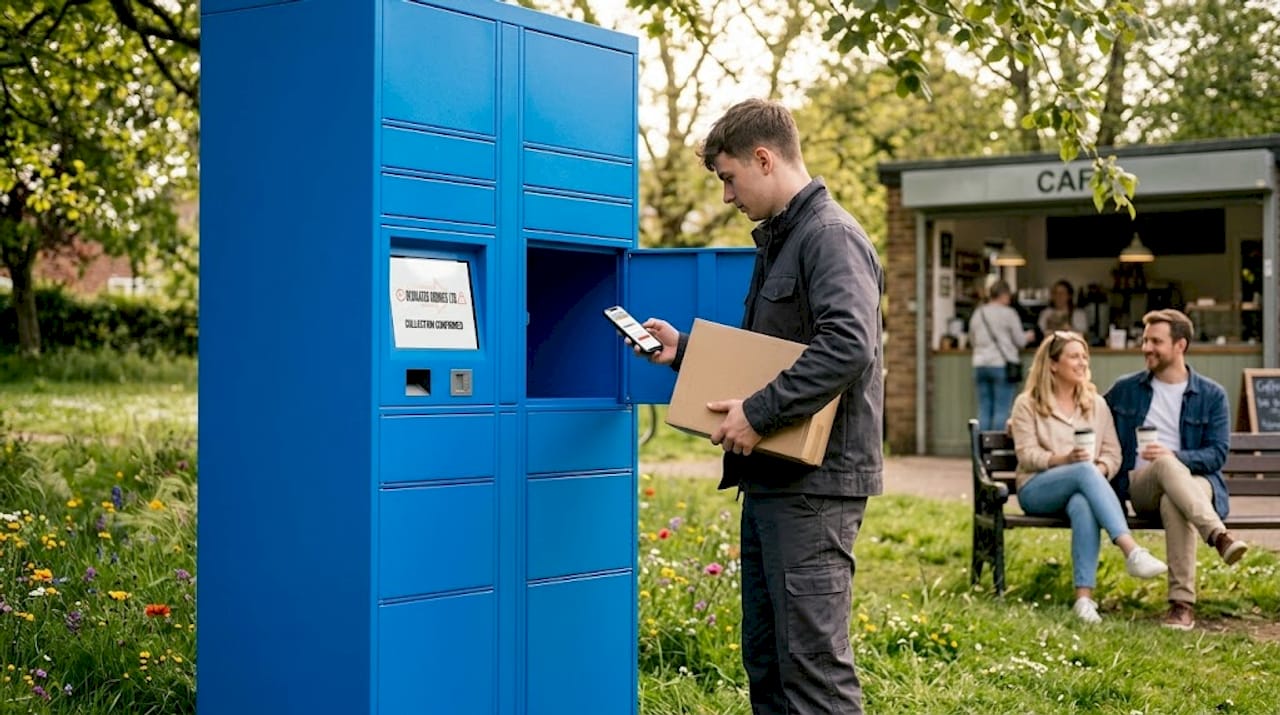
Parcel lockers from third-party providers, including solutions like secure parcel boxes for home delivery, reduce failed delivery attempts and re-delivery costs.
Pick-up point networks, available through major carriers, give customers dozens of local collection options at checkout.
Clear communication is critical. Customers need to know collection windows, locker codes, and holding periods upfront.
This method suits merchants whose customers are time-poor or who operate in areas where home delivery failure rates are high.
5. Third-party logistics (3PL) and hybrid delivery
A third-party logistics provider, or 3PL, takes over your warehousing, picking, packing, and dispatch. For small merchants at the right stage of growth, this can free up significant time and unlock carrier rates that would otherwise be unavailable at lower volumes.
Outsourcing to a 3PL makes most commercial sense once monthly orders reliably exceed 100 to 500 dispatches. Below that threshold, the fixed costs of 3PL contracts often outweigh the savings.
Assess your current monthly order volume and project six months forward.
Compare your current per-shipment cost against 3PL quoted rates, including storage fees.
Evaluate whether the 3PL covers your core delivery zones at the required service level.
Check contract flexibility. Avoid long tie-ins until you have validated the relationship.
Consider hybrid models that combine your own fulfilment for local orders with 3PL for national or international shipping.
The 3PL market is also shifting. Amazon’s Supply Chain Services now bundles integrated logistics in a way that challenges established carriers on cost and convenience, which means small merchants have more credible 3PL options than ever before. Unified shipping platforms also allow merchants to switch dynamically between parcel and freight modes based on real-time costs, reducing spend leakage without manual carrier management.
6. Summary comparison of delivery options for small online retailers
Use this table to match the right method to your business model and customer base.
Method | Cost | Speed | Best use case |
Same-day courier | High | Same day | Urgent, high-value, or perishable goods |
Express/next-day | Medium to high | 1 to 2 days | Time-sensitive standard orders |
Standard tracked | Low to medium | 3 to 5 days | General e-commerce orders |
Economy | Lowest | 5 to 7 days | Low-value, non-urgent items |
Click and collect | Low | Customer-led | Urban customers, failed delivery reduction |
3PL hybrid | Variable | Variable | Growing merchants, multi-carrier needs |
The right combination depends on your product mix, average order value, and where your customers are located. Many successful small stores run two or three of these methods simultaneously, giving customers genuine choice at checkout.
My view on delivery strategy for small e-commerce businesses
I have seen merchants make the same mistake repeatedly. They add same-day delivery because a competitor has it, without checking whether their margins or fulfilment setup can actually support it. The result is a service that either loses money on every order or underdelivers on the promise, which is worse than not offering it at all.
What actually builds loyalty is not speed in isolation. It is reliability and honesty. A merchant who promises three-day delivery and delivers in three days consistently will retain more customers than one who promises next-day and misses it half the time. Real-time delivery promises that factor in actual inventory and carrier capacity are far more persuasive than aspirational timelines.
My advice: start with your bestselling products and figure out the right delivery method for those first. Then build outward. Revisit your delivery tips and strategy every six months as your order volume and customer base evolve. Delivery is not a one-time decision. It is an operational commitment that needs reviewing.
— andrew
How Dedicatedsamedaycourier can support your delivery needs
[
If your online store handles time-sensitive goods, high-value consignments, or urgent customer orders, Dedicatedsamedaycourier offers a practical solution. The service operates 24 hours a day, seven days a week, with dedicated courier vehicles ranging from motorcycles to large panel vans, each assigned exclusively to your consignment. That means no shared loads, no unnecessary stops, and a direct route from collection to delivery.
With nationwide courier coverage and a network built on courier exchange technology, Dedicatedsamedaycourier can respond to urgent same-day requests across multiple UK locations within short timeframes. Quotes are available by phone, email, or online form, and the service supports next-day, overnight, and future-dated bookings as well. For small e-commerce merchants who need a reliable rapid delivery partner without committing to a full 3PL contract, this is a direct and dependable option worth considering.
FAQ
What are the main delivery options for online stores?
The main delivery options for online stores include same-day courier, express or next-day delivery, standard tracked shipping, economy untracked shipping, click and collect, parcel lockers, and third-party logistics. Each suits different product types, order volumes, and customer expectations.
When should a small e-commerce business use same-day delivery?
Same-day delivery suits small online stores selling urgent, perishable, or high-value goods where the customer is willing to pay a premium for rapid fulfilment. It requires a reliable courier partner and goods ready for prompt collection.
How do I choose between standard and expedited shipping?
Standard shipping, which typically takes 3 to 5 business days, works well for non-urgent general goods. Expedited options, delivering within 1 to 3 days, suit time-sensitive orders where the customer is likely to pay more or abandon the basket without a faster option.
At what point should I consider a 3PL provider?
Most e-commerce merchants benefit from a 3PL provider once monthly orders consistently exceed 100 to 500 dispatches. Below that level, the fixed costs of 3PL contracts often outweigh any savings made on carrier rates.
Does offering multiple delivery options really increase sales?
Yes. Displaying accurate delivery dates alongside multiple shipping choices at checkout has been shown to significantly increase conversion rates, with some merchants reporting doubled conversions after adding real-time delivery promise functionality.
Recommended


Comments