
Direct Delivery Service: Impact on Urgent UK Logistics

Updated: May 20

Unexpected last-minute orders or urgent supply chain disruptions can put major pressure on small businesses across the United Kingdom. When every minute counts, traditional courier networks often fall short due to multiple handling points and slower processing. With direct delivery service offering speed by transporting goods straight from sender to recipient, you gain a reliable solution designed for critical timelines. This article highlights how modern same-day courier options can simplify logistics, reduce delays, and support your operations.
Table of Contents
Key Takeaways
Point | Details |
Direct Delivery Service Enhances Efficiency | It streamlines logistics by eliminating unnecessary handling, offering faster transportation from source to recipient. |
Diverse Delivery Options | Same-day, scheduled, and point-to-point delivery methods cater to various business needs and increase flexibility. |
Technological Integration is Crucial | Real-time tracking and route optimisation ensure transparency and reduce potential delays in delivery operations. |
Cost-Benefit Analysis is Essential | Businesses should evaluate the total costs and long-term benefits of direct delivery compared to alternative courier services. |
What Is Direct Delivery Service?
Direct delivery service represents a streamlined logistics approach designed to transport goods, documents, or digital products directly from the source to the end recipient without unnecessary intermediary handling. Efficient transportation methods fundamentally aim to reduce processing time and enhance overall delivery performance.
In the context of urgent UK logistics, direct delivery service operates on a principle of minimising unnecessary stops and maximising speed. The core characteristics include:
Bypassing traditional distribution centers
Point-to-point transportation
Minimal handling of packages
Dedicated courier assignments
Rapid collection and drop-off times
The service can encompass both physical and digital product transportation, offering flexibility across various business needs. Digital direct delivery might involve electronic document transmission, while physical direct delivery focuses on immediate courier services transporting tangible goods.
Direct delivery eliminates unnecessary logistical complexity, creating a more efficient transportation ecosystem.
Businesses leveraging direct delivery services benefit from reduced transit times, increased reliability, and enhanced customer satisfaction. By removing intermediate processing stages, companies can significantly improve their operational efficiency and responsiveness.
Pro tip: Select a courier service with proven track records of rapid, secure direct deliveries to maximise your logistics performance.
Same-Day, Scheduled, and Point-to-Point Options
In the world of urgent UK logistics, delivery services have evolved to offer multiple sophisticated options tailored to diverse business and consumer needs. Point-to-point delivery systems have revolutionised how businesses approach transportation and distribution, providing unprecedented flexibility and efficiency.
Three primary delivery approaches dominate the modern logistics landscape:
Same-Day Delivery: Guarantees goods are transported and received within 24 hours of order placement
Scheduled Delivery: Allows customers to select specific time slots or dates for delivery
Point-to-Point Delivery: Direct transportation between two locations without intermediate stops
Each delivery method offers unique advantages for different scenarios. Same-day delivery proves critical for urgent documents, time-sensitive medical supplies, or last-minute business materials. Scheduled delivery provides predictability, enabling customers to plan around specific receiving windows, which is particularly valuable for businesses requiring precise logistical coordination.
Here’s how the main delivery approaches suit different business needs:
Delivery Method | Best-Suited Scenario | Typical Transit Speed | Scheduling Flexibility |
Same-Day Delivery | Emergency shipments | Under 24 hours | Limited |
Scheduled Delivery | Planned distribution | Within agreed timeframe | High |
Point-to-Point | Direct transfers, urgent | Fastest available | Moderate |
Point-to-point delivery minimises transit complexities, reducing potential handling errors and accelerating overall transportation speed.
Point-to-point delivery represents the pinnacle of logistics efficiency, eliminating unnecessary intermediary stages. This approach ensures minimal package handling, reduced transit times, and enhanced reliability. Businesses can leverage these options to create bespoke delivery strategies matching their specific operational requirements.
Pro tip: Evaluate your specific logistics needs carefully to select the most appropriate delivery method that balances speed, cost, and reliability.
How Direct Delivery Operates in Practice
The operational framework involves multiple strategic components designed to streamline the delivery process from collection to final destination.
Key operational elements of direct delivery include:
Real-time tracking capabilities
Dedicated single-driver assignment
Precise route optimisation
Minimal handling protocols
Advanced communication systems
Flexible pickup and drop-off windows
Technological integration plays a crucial role in modern direct delivery operations. Sophisticated GPS tracking, digital communication platforms, and route optimization algorithms enable couriers to navigate complex urban and rural landscapes with unprecedented precision. These technological tools ensure that packages are monitored continuously, reducing potential delays and providing transparency throughout the transportation process.
Direct delivery minimises administrative complexity, creating a streamlined path from sender to recipient.
The operational model emphasises end-to-end accountability, where a single courier manages the entire journey of a package. This approach reduces transfer points, minimises potential handling errors, and provides a clear chain of responsibility. By eliminating intermediate logistics stages, direct delivery services can dramatically reduce transit times and improve overall service reliability.

Pro tip: Select courier services that offer comprehensive tracking and transparent communication to ensure maximum visibility during your delivery.
Key Benefits for Businesses and Individuals
Direct delivery services offer transformative advantages by simplifying supply chain processes and delivering unprecedented operational efficiency. These benefits extend across both business and individual contexts, creating substantial value through streamlined logistics solutions.
Key advantages for businesses include:
Reduced delivery processing times
Enhanced supply chain control
Improved customer satisfaction metrics
Greater inventory management precision
Lower operational complexity
Minimised transportation costs
Competitive advantage emerges as a primary benefit for businesses adopting direct delivery approaches. By eliminating intermediary logistics stages, companies can respond more rapidly to market demands, reduce operational overheads, and provide more predictable service experiences. This direct approach allows for real-time tracking, immediate problem resolution, and enhanced transparency throughout the delivery lifecycle.
Direct delivery transforms logistics from a complex network into a streamlined, customer-centric experience.
Individual consumers also benefit significantly from these services. Personalised delivery experiences mean faster access to goods, more convenient receiving options, and greater reliability compared to traditional delivery models. The ability to track packages in real-time, select precise delivery windows, and interact directly with couriers represents a substantial improvement in personal logistics management.
Pro tip: Negotiate delivery terms and explore flexible options that align with your specific operational or personal logistics requirements.
Comparing Direct Delivery to Alternative Couriers
Understanding the nuanced differences between direct delivery and alternative courier services is crucial for businesses seeking optimal logistics solutions. Delivery model comparisons reveal complex trade-offs between efficiency, cost, and service quality that organisations must carefully evaluate.
Key distinguishing characteristics include:
Direct Delivery Strengths:
Higher accountability
Consistent service quality
Dedicated personnel
Precise tracking
Minimal handling points
Alternative Courier Weaknesses:
Multiple handling stages
Less predictable service
Potential communication gaps
Variable personnel
Operational control represents a significant differentiator between these delivery models. Direct delivery services maintain end-to-end management of transportation, ensuring uniform service standards and immediate problem resolution. In contrast, alternative couriers often rely on outsourced networks, which can introduce variability and potential service inconsistencies.
Alternative courier models compromise precision for potential cost savings, whereas direct delivery prioritises reliability.
The financial implications also differ substantially. While alternative couriers might initially appear more cost-effective, direct delivery often provides superior long-term value through reduced transit times, lower damage rates, and enhanced customer satisfaction. Businesses must weigh immediate expense against comprehensive logistical performance.
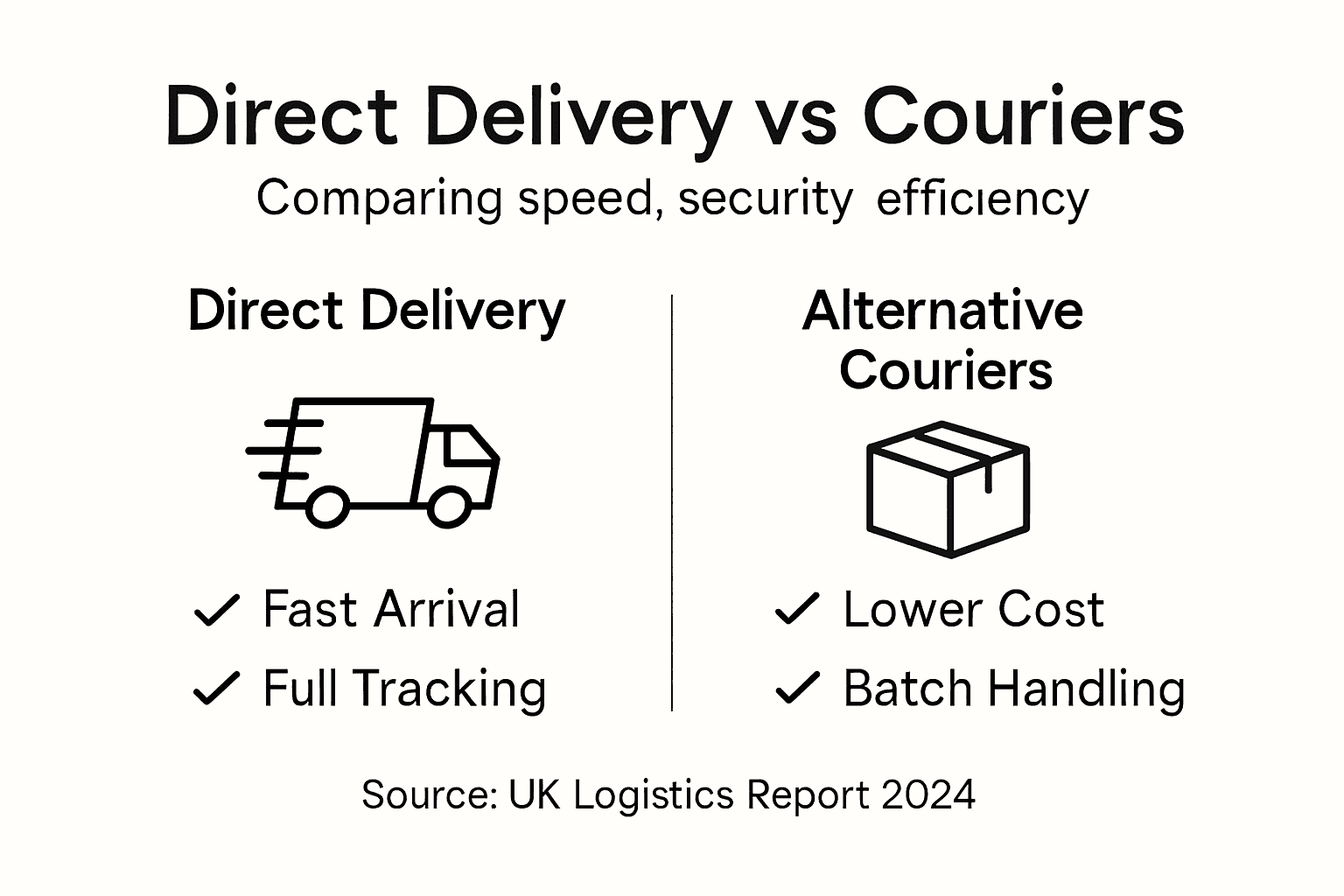
Direct delivery brings unique advantages over alternative courier models:
Aspect | Direct Delivery | Alternative Couriers |
Accountability | Dedicated personnel, clear chain | Shared responsibility, less clarity |
Tracking Precision | Real-time monitoring throughout | Possible intermittent tracking |
Handling Points | Minimal, end-to-end management | Multiple transfer stages |
Service Consistency | Uniform standards per delivery | Variable by subcontractor |
Pro tip: Conduct a comprehensive cost-benefit analysis comparing total delivery expenses, not just initial pricing, when selecting between direct delivery and alternative courier services.
Costs, Risks, and Security Considerations
Navigating the complex landscape of direct delivery requires comprehensive understanding of risk management strategies. Organisations must carefully balance financial implications, operational risks, and security protocols to ensure efficient and reliable logistics solutions.
Direct delivery cost structures encompass multiple critical components:
Direct Costs:
Personnel wages
Vehicle maintenance
Fuel expenses
Equipment investment
Indirect Costs:
Administrative overheads
Compliance management
Insurance premiums
Technology infrastructure
Risk mitigation represents a fundamental consideration in direct delivery operations. Potential vulnerabilities include shipment delays, cargo damage, theft, and technological disruptions. Successful logistics providers implement robust monitoring systems, comprehensive insurance coverage, and advanced tracking technologies to minimise these operational risks.
Effective security measures transform potential vulnerabilities into opportunities for enhanced service reliability.
Security considerations extend beyond physical protection, encompassing data integrity, confidential handling, and compliance with stringent transportation regulations. Advanced encryption, secure communication channels, and background-checked personnel are essential elements in creating a trustworthy delivery ecosystem that protects both organisational and client interests.
Pro tip: Conduct regular security audits and invest in comprehensive insurance coverage to protect against potential logistical risks and unexpected disruptions.
Elevate Your Urgent UK Logistics With Direct Delivery Excellence
The challenge in today’s fast-paced UK logistics is clear: how to guarantee rapid, reliable, and accountable point-to-point transport without the delays and risks of multiple handlings. Direct delivery service, as discussed, demands seamless coordination, precise tracking, and dedicated couriers who ensure your parcels, documents, or pallets move swiftly and securely. At Dedicated Same Day Courier, we specialise in exactly that—offering a tailored direct delivery solution that bypasses unnecessary stops to provide rapid collection within 60 minutes and nationwide coverage with the same trusted driver from start to finish.
Experience the peace of mind that comes with truly dedicated courier service. Benefit from real-time updates, point-to-point direct delivery without detours, and flexible options designed for your urgent or scheduled logistics needs. Don’t let delays or handling risks jeopardise your business or personal deliveries. Visit Dedicated Same Day Courier today for instant quotes and discover how we transform urgent UK logistics into fast, dependable service you can count on. Act now to streamline your deliveries and gain a critical edge in your supply chain.
Frequently Asked Questions
What are the main characteristics of direct delivery service?
Direct delivery service includes bypassing traditional distribution centres, point-to-point transportation, minimal handling of packages, dedicated courier assignments, and rapid collection and drop-off times.
How does direct delivery improve operational efficiency for businesses?
Direct delivery enhances operational efficiency by reducing transit times, improving customer satisfaction, and minimising logistical complexities through end-to-end accountability and real-time tracking capabilities.
What are the different types of delivery options available under direct delivery services?
Direct delivery services offer various options including same-day delivery for urgent shipments, scheduled delivery which allows specific time slots, and point-to-point delivery that ensures direct transportation without intermediate stops.
How does direct delivery compare to alternative courier services?
Direct delivery provides higher accountability, consistent service quality, and precise tracking with minimal handling points, whereas alternative couriers may involve multiple handling stages, leading to potential service inconsistencies.
Recommended


Comments