
A retailer logistics workflow guide that cuts cost per order
- Andrew Buttrick
- 5 days ago
- 8 min read
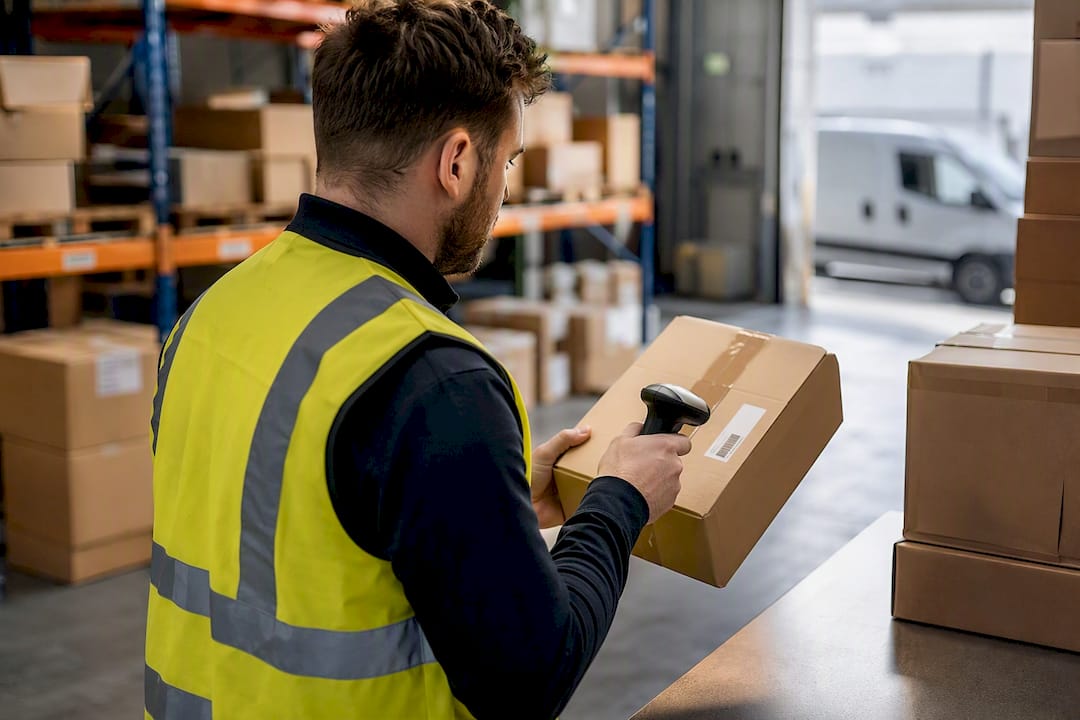
A repeatable retailer logistics workflow follows one sequence every time: receive, validate, allocate, pick, pack, rate-shop, hand off, track, manage exceptions, and process returns. Get this sequence right and two numbers move fast: OTIF (on-time-in-full delivery) rises, and SKU accuracy stops causing split shipments. Three controls make or break the whole chain: inventory accuracy, consistent labelling, and a clear routing rule set. When a lane turns urgent and the standard chain can’t hold the deadline, Dedicatedsamedaycourier exists precisely for that escalation.
Receiving discipline first, automation second.
One order management system as the single source of truth.
A named urgent-lane fallback, agreed before you need it.
Roughly 60% of supply chain leaders had committed to investing in digital supply chain technology by the end of 2022, and that appetite has only grown since.
Key Takeaways
A retailer logistics workflow succeeds when inventory accuracy, standardised labelling, and automated order routing are locked in before any automation spend follows.
Point | Details |
Fix receiving first | Double-scan at receiving and picking to stop phantom stock causing split shipments. |
Track five core KPIs | Measure OTIF, pick accuracy, cost per order, handling time, and returns rate weekly. |
Pilot before rollout | Test changes over 30 to 60 days on limited SKUs and lanes with a control cohort. |
Standardise returns grading | Set restock, refurbish, and scrap thresholds in advance to stop dead stock building up. |
Escalate urgent lanes early | Use Dedicatedsamedaycourier as the agreed fallback the moment a delivery window is at risk. |
Table of Contents
What does retailer logistics actually involve?
Retailer logistics is four connected segments, not four separate jobs: inbound receiving, warehousing and inventory, fulfilment and shipping, and returns. Move stock badly in one segment and the damage shows up two steps later, usually as a customer complaint. Shopify’s guidance on shipping operations treats inventory accuracy, consistent labelling, and regulatory compliance as prerequisites, not nice-to-haves, before a retailer tries to scale.
Two flows run in parallel through every segment: the physical flow of pallets and parcels, and the information flow of orders, stock counts, and tracking events. Retailers that treat the information layer as an afterthought end up chasing paper trails while stock sits in the wrong place.
Receiving discipline: scan everything in, no exceptions.
Channel-agnostic inventory: one stock pool, not one per sales channel.
Routing logic: orders map automatically to the nearest fulfilment node.
What is the step-by-step retailer logistics workflow?
This is the sequence that turns a pile of individual decisions into a repeatable process. Each step has an acceptance check, meaning you don’t move to the next stage until the current one passes.
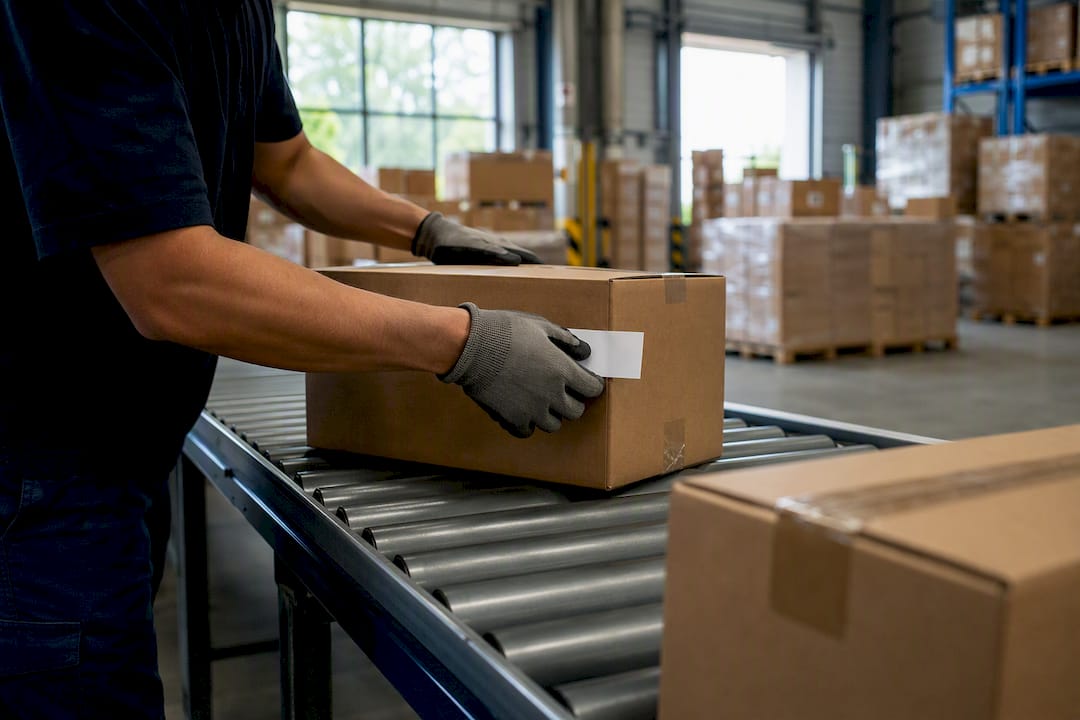
Receive stock – scan every carton against the purchase order; flag discrepancies before shelving.
Validate the order – check stock availability, delivery address, and run basic fraud screening at checkout.
Allocate inventory – reserve stock against the order in your OMS the moment it’s confirmed.
Pick – use a pick path (zone, batch, or wave) suited to your order density.
Pack and cartonise – standard box sizes and consistent labelling reduce damage claims and carrier surcharges.
Weigh and measure – dimensional weight errors are one of the most common causes of billing disputes with carriers.
Rate-shop and generate the label – compare cost against delivery reliability, not price alone.
Hand off to the carrier – confirm manifest and collection time.
Track and manage exceptions – flag delays before the customer does.
Authorise and process returns – grade and disposition stock the moment it’s back.
Receiving is where most downstream errors originate. AgileSCS’s fulfilment research identifies it as the single most common failure point in the entire chain, and a double scan at both receiving and picking closes most of that gap by catching phantom stock before it causes a split shipment.
Daily shift handover checklist:
Open exceptions from the previous shift
Stock discrepancies flagged but unresolved
Carrier collection times confirmed for the day
Pending returns awaiting grading
Backorders and their expected fulfilment date
Any address or fraud flags needing manual review
Packaging stock levels (boxes, void fill, labels)
Scanner and printer hardware checks
Escalation lanes booked for urgent orders
KPI snapshot: pick accuracy and OTIF from the prior shift
Pro Tip: Automated rate-shopping at the label stage typically saves more time than any other single change, because it removes a manual comparison step that otherwise repeats on every single order.
Which fulfilment model fits your retailer: in-house, 3PL, hybrid, or dropship?
The right model depends on order volume, SKU complexity, and how spread out your customers are geographically, not on which model sounds most modern.
Model | Best for | Main risk | Essential tools |
In-house | Low-to-mid volume, high control needs | Fixed labour and space costs scale badly | WMS, barcode scanners, label printer |
3PL | Rapid growth, seasonal spikes | Less visibility, integration lag | API-connected OMS, shared inventory feed |
Hybrid | Mixed SKU profile (bulky + small parcel) | Split inventory pools if not synced | Central OMS routing across nodes |
Dropship | Long-tail SKUs, low stockholding appetite | Supplier reliability, inconsistent packaging | Vendor portal, automated order forwarding |
Watch for these thresholds as prompts to reconsider your model:
Monthly orders exceed your team’s picking capacity by more than 20%
SKU count grows past what manual allocation can track reliably
Delivery SLA breaches climb for two consecutive months
Labour costs per order rise faster than order volume
What technology actually reduces error rates in a retail workflow?
Software groups into five functions: order management and routing, warehouse management and picking, shipping and rate-shopping, tracking and visibility, and analytics. A central OMS that automatically routes orders to the nearest fulfilment node cuts both transit cost and delivery time without a human making that call each time, according to Shopappy’s retail logistics research.
On the hardware side, don’t skimp on the basics:
Mobile barcode scanners with real-time OMS sync, not batch upload
Label printers rated for your daily volume, not just peak-day estimates
Weigh scales and dimensioners accurate enough to avoid carrier billing disputes
A single inventory feed across every sales channel, so stock never splits into separate pools
Inbound Logistics’ best practice research points to predictive analytics and IoT visibility as the highest-impact additions once the fundamentals are solid, particularly for cutting stockouts.
Pro Tip: Before buying new software, check whether your existing OMS has a plug-and-play integration for the carrier or marketplace you’re adding. Building a custom integration usually costs more in delay than the tool itself.
Which KPIs and pilot plan prove a workflow change works?
Track five numbers: OTIF, pick accuracy, cost per order, average handling time, and returns rate. Each one ties directly to a cost driver: labour per pick, packaging spend, carrier cost, and failed delivery fees all move when these KPIs shift.
A Transportation Management System alone can cut logistics costs by roughly 10–15% through route optimisation, with carrier diversification reducing disruption by up to 20%.
Run any workflow change as a pilot before rolling it out fully:
Pick a pilot window of about one to two months.
Select a limited set of SKUs and delivery lanes.
Keep a control cohort running the old process.
Collect KPI data on a fixed cadence, weekly at minimum.
Set a go/no-go threshold before you start, not after you see the results.
Cost per order should be your primary go/no-go metric.
Exception rate tells you where the process still breaks.
How should retailers handle returns without losing margin?
Returned stock becomes dead stock the moment it sits ungraded on a shelf. The sequence that prevents that: self-service authorisation, then a return label or collection, inbound inspection, grading, and finally restock, refurbish, or disposal.
Authorise the return and issue a label or arrange collection.
Inspect on arrival against the stated reason code.
Grade: resell as new, refurbish, or scrap.
Restock immediately if graded resellable; route to disposition if not.
Common reason codes: wrong size, damaged in transit, changed mind, not as described.
Set restock thresholds in advance so staff aren’t deciding case-by-case.
Route high-value or complex returns to a central processing node rather than handling them at every store.
Our returns logistics guide covers the label and inspection mechanics in more depth.
Your 30-day checklist to stabilise the workflow
Lock the fundamentals before spending on automation. This runs in roughly four weekly blocks.
Week 1: Introduce double-scan receiving; owner: warehouse lead.
Week 2: Standardise carton sizes and labelling across all SKUs; owner: packing supervisor.
Week 3: Set reorder points for your highest-turn SKUs; owner: inventory manager.
Week 4: Test address validation at checkout and run a one-lane carrier reliability pilot; owner: logistics coordinator.
Success signal: pick accuracy improves measurably within the first two weeks.
Success signal: exception volume on the pilot lane drops against the control lane.
For any lane where the delivery window can’t slip, agree upfront that Dedicatedsamedaycourier is the fallback the moment an exception triggers.
When does a dedicated same-day courier change the outcome?
Four situations where standard shipping isn’t fast enough: urgent store replenishment, rescuing a missed delivery window before it breaches a retailer compliance clause, high-value or temperature-sensitive consignments, and time-critical B2B shipments between sites.
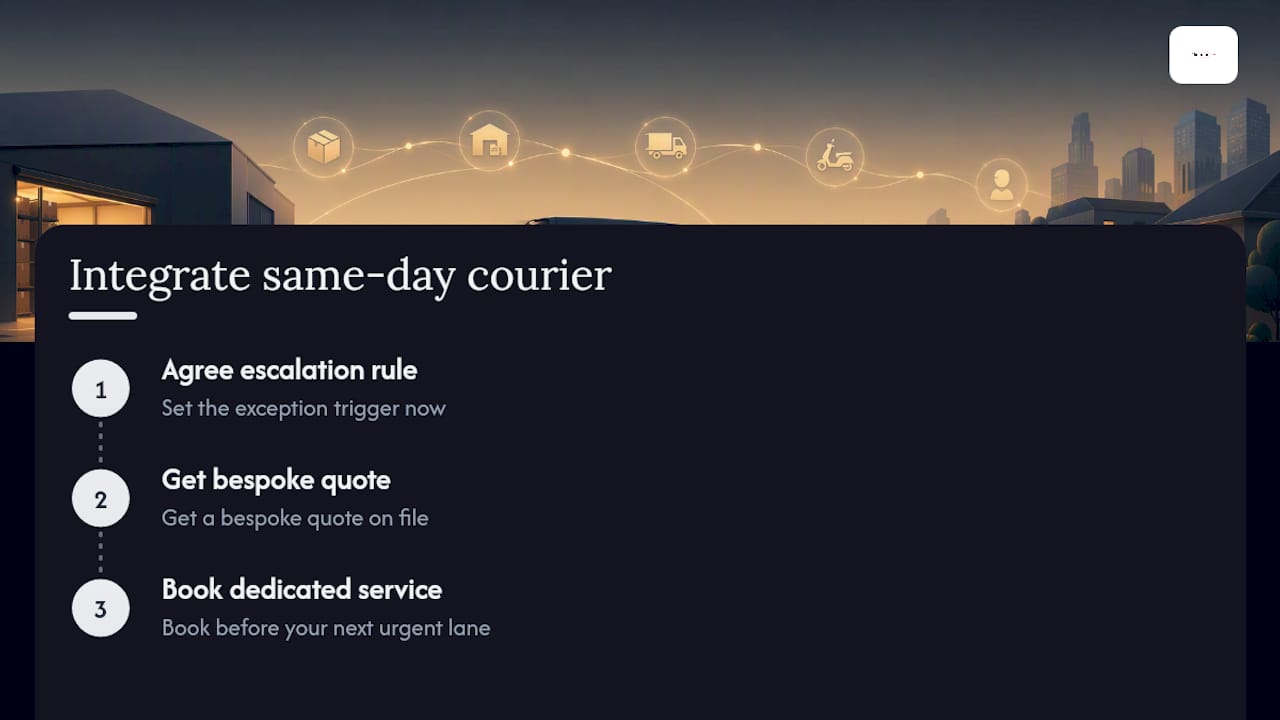
Integrating this into your workflow means defining upfront: which exception triggers an escalation, who confirms the booking, and how proof of delivery feeds back into your OMS. Our step-by-step same-day delivery guide walks through the booking mechanics.
Trigger: missed carrier collection cutoff on a compliance-bound order.
Trigger: store stockout on a fast-moving line during trading hours.
Pro Tip: Weigh the courier fee against the cost of failure. Once a chargeback, a lost sale, and store downtime are added together, a same-day booking is almost always the cheaper outcome.
What actually works on the warehouse floor
Every operations team underestimates receiving discipline until it’s too late. The single change that pays back across every KPI, from pick accuracy to returns rate, is slowing down at the point stock comes in the door. Staff training and consistent shift handovers cost almost nothing and catch more errors than most software upgrades ever will.
Need a dedicated same-day courier that plugs straight into your escalation process?
Dedicatedsamedaycourier gives retail logistics teams what a standard carrier network can’t guarantee on a bad day: a dedicated vehicle collecting within 60 to 90 minutes, with no co-loading and no waiting for a depot sort to catch up with your deadline.
[
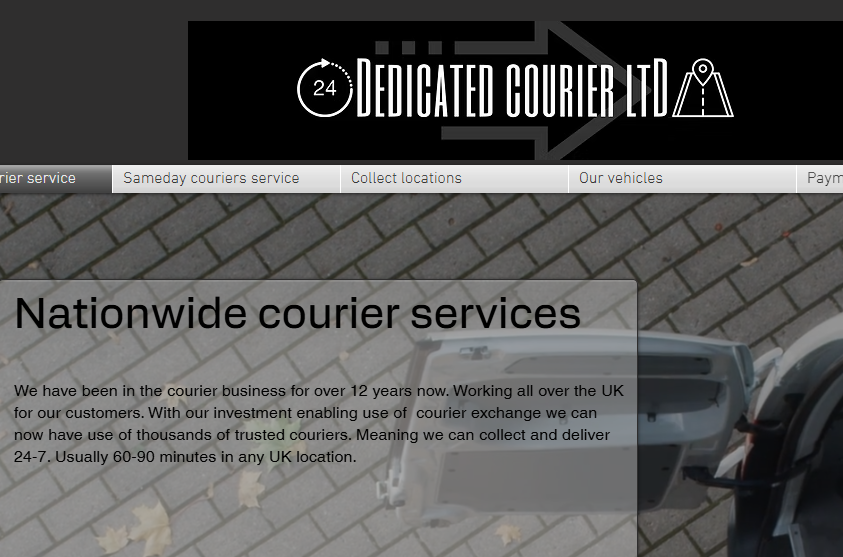
Every booking runs on point-to-point transport, meaning your consignment doesn’t sit in a hub while other parcels get sorted around it. That matters most on the lanes this guide has flagged as highest-risk: compliance-bound store deliveries, high-value or temperature-sensitive goods, and B2B shipments where a missed window costs more than the courier fee. The service runs 24/7, with vehicle sizing to match anything from a document to a pallet, and proof of delivery feeds back so your OMS records the handoff cleanly.
To integrate it into your workflow, set the exception trigger now rather than during a crisis: agree the escalation rule, get a bespoke quote on file, and book through the dedicated same-day courier service before your next urgent lane comes up.
Frequently asked questions
What is the fastest way to reduce cost per order? Automated rate-shopping at label creation typically delivers the quickest saving, because it removes a manual comparison that repeats on every order without exception.
How long should a logistics workflow pilot run? Thirty to sixty days is usually enough to see whether pick accuracy and OTIF actually move, provided you run a control cohort alongside the change.
Which KPI matters most for a retailer logistics workflow guide? OTIF and pick accuracy together give the clearest signal, since one tracks delivery reliability and the other tracks whether the warehouse is sending the right stock in the first place.
When should a retailer use a dedicated same-day courier instead of standard shipping? When the cost of failure, a chargeback, a lost sale, or store downtime, exceeds the courier fee, particularly on compliance-bound or high-value consignments.
Sources
The workflow steps and KPI framework in this guide draw on Shopify’s shipping operations research, Inbound Logistics’ retail logistics best practices, and the MDPI review on logistics process optimisation. Use them to build your own pilot templates and checklists, and check our delivery optimisation tips for applied detail on carrier mix.
Recommended


Comments