
Guide to point-to-point delivery for UK businesses
Updated: May 18

TL;DR:
Point-to-point delivery involves transporting shipments directly from the sender to the recipient without passing through sorting hubs, ensuring faster delivery. It offers significant benefits such as increased speed, better security, and real-time tracking, especially for urgent or high-value shipments. Businesses should choose this model for time-critical deliveries, while considering proper preparation and understanding its higher costs compared to hub-and-spoke systems.
Many UK businesses assume that using a large courier network automatically means faster delivery. It does not. Hub-based models route your shipment through sorting facilities, adding time and handling stages that work against urgency. This guide to point-to-point delivery will clarify how direct courier delivery actually works, why it outperforms hub models for time-critical shipments, and what practical steps you need to take to use it effectively for your business.
Table of Contents
Key benefits of point-to-point delivery for urgent UK business shipments
How to prepare and book point-to-point delivery for urgent shipments
Common pitfalls and how to avoid them in point-to-point delivery
When to choose point-to-point delivery over hub-and-spoke alternatives
Rethinking urgent delivery: why point-to-point is often overlooked yet ideal
Explore dedicated point-to-point courier services for your urgent UK deliveries
Key Takeaways
Point | Details |
Direct routing advantage | Point-to-point delivery removes intermediaries, enabling faster and more reliable urgent shipments. |
Precise shipment details | Providing exact package size and weight upfront prevents delays and vehicle mismatches. |
Improved security | Dedicated drivers and real-time tracking reduce risk of loss and ensure chain of custody. |
Selective use cases | Point-to-point delivery suits urgent, mission-critical, or perishable shipments best. |
Professional services available | Dedicated couriers offer 24/7 booking, flexible vehicles, and secure handling for UK businesses. |
What is point-to-point delivery and how does it work
Point-to-point delivery is exactly what the name suggests. A courier collects your shipment directly from you and drives it straight to the recipient, with no detours through warehouses or sorting centres. As noted in distribution model analysis, the point-to-point model removes the intermediary, with goods travelling directly from the supplier to the customer without passing through a central hub.
The point-to-point delivery process follows a straightforward sequence:
You contact a courier service and provide shipment details, including dimensions, weight, collection address, and delivery address.
A suitable vehicle is dispatched to your location, often within the hour.
The driver collects your goods and begins the direct route to the destination.
Real-time tracking keeps you informed throughout transit.
The driver delivers directly to the recipient and obtains confirmation, typically via signature or photograph.
This model is particularly well suited to certain shipment types:
Urgent legal or financial documents that cannot risk delay or mishandling
Medical supplies and samples requiring chain-of-custody integrity
High-value parcels where security and minimal handling are non-negotiable
Mission-critical business freight tied to production deadlines or client commitments
Same-day retail or e-commerce orders where customer experience depends on speed
The simplicity of the process is what makes it reliable. Fewer stages mean fewer opportunities for things to go wrong.
Key benefits of point-to-point delivery for urgent UK business shipments
Understanding the advantages of point-to-point delivery helps you make the right call when urgency is involved. The most immediate benefit is speed. Without sorting hubs or consolidation stops, transit time drops significantly compared to standard courier networks.
The same-day courier market targets 98%+ on-time delivery and collection under 60 minutes with dedicated vehicles. That performance standard is only achievable with direct routing.
Here is a comparison of point-to-point against hub-and-spoke delivery for urgent UK shipments:
Factor | Point-to-point | Hub-and-spoke |
Transit speed | Very fast, direct routing | Slower, multiple stops |
Handling stages | Minimal, usually one driver | Multiple, sorting facility involved |
Chain of custody | Maintained throughout | Disrupted at each hub |
Suitability for urgency | High | Low to moderate |
Cost | Higher per shipment | Lower for volume |
Tracking precision | Real-time, vehicle-level | Checkpoint-based |
Beyond speed, there are other clear benefits to consider:
Greater control: One driver handles your goods from collection to delivery, reducing the chance of misdirection or loss.
Improved security: Fewer hands on your shipment means lower risk of damage or theft.
Better customer satisfaction: Clients and recipients receive reliable, on-time deliveries, which strengthens your business relationships.
Competitive edge: Meeting urgent deadlines that a hub model would miss can be the difference between winning and losing a client.
You can read more about the benefits of same-day delivery for UK businesses to understand the broader commercial value.
Pro Tip: If you regularly send urgent shipments to the same recipients, set up a standing account with a dedicated courier service. Pre-agreed vehicle types and collection windows reduce booking time considerably when urgency strikes.
How to prepare and book point-to-point delivery for urgent shipments
Knowing how to plan point-to-point delivery correctly makes a real difference to the outcome. Poor preparation is one of the most common causes of preventable delays. The good news is that the booking process is straightforward when you follow the right steps.
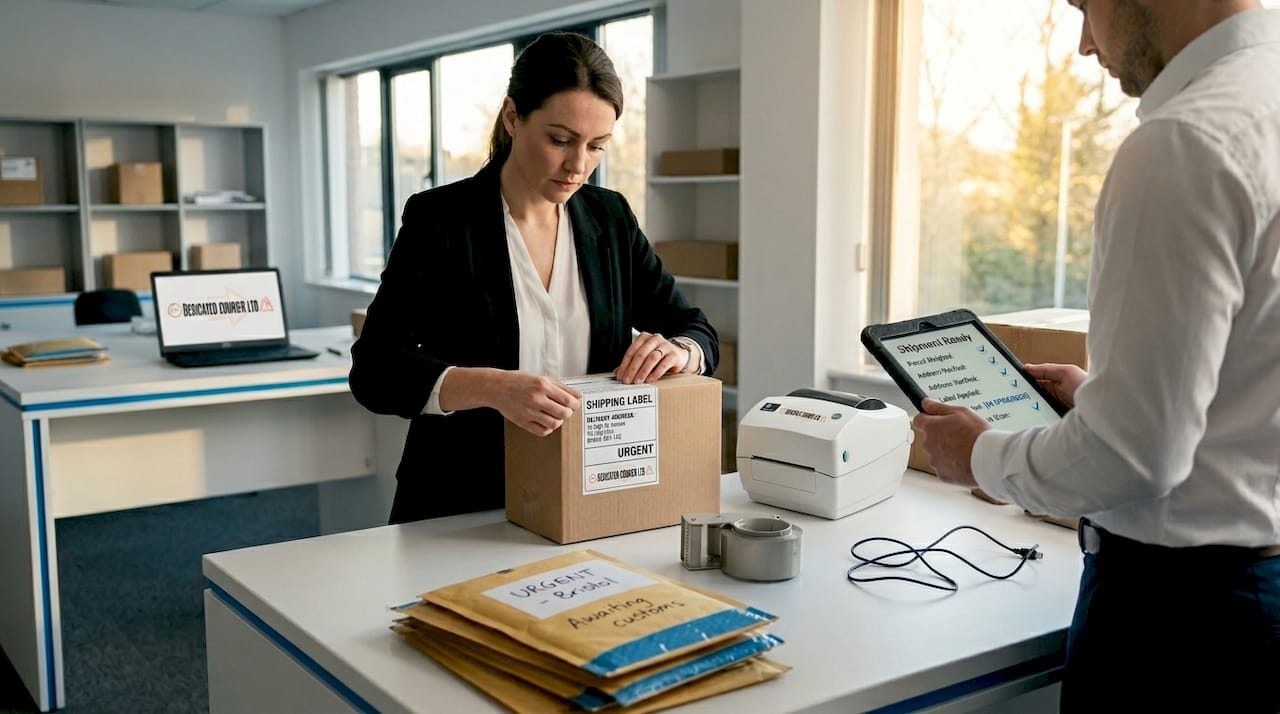
As confirmed by courier logistics professionals, providing exact dimensions and weight upfront during quoting prevents vehicle mismatches and delays. Do not guess or round up loosely.
Follow these steps for effective delivery preparation and booking:
Assess your shipment. Note exact dimensions, weight, fragility, and any special handling requirements before you contact a courier.
Determine urgency. Establish your latest acceptable delivery time so the courier can confirm feasibility and prioritise accordingly.
Request an instant quote. Use an online booking portal and enter all shipment data accurately to receive a precise quote and avoid surprises.
Select the right vehicle. A small van suits standard parcels and document boxes. A larger vehicle may be needed for pallets or oversized freight. Match the vehicle to the load.
Confirm collection details. Provide a precise collection address, contact name, and a clear time window. Ambiguity here causes delays.
Monitor tracking in real time. Once the driver is en route, use the tracking link or updates provided to stay informed and manage your recipient’s expectations.
Obtain proof of delivery. Request a signature, photograph, or digital confirmation once the delivery is complete.
Learning how to book an urgent courier properly is worth the ten minutes it takes to read through a reliable guide before your first booking.
Pro Tip: Always package your goods before the driver arrives. Delays at collection point push back the entire delivery schedule, and same-day windows are tight.
Common pitfalls and how to avoid them in point-to-point delivery
Even with a straightforward delivery model, things can go wrong when businesses do not take the process seriously. These are the most frequent mistakes and how to avoid them.
As logistics experience consistently shows, incomplete information and poor packaging often cause delays or loss in urgent same-day deliveries.
Treating urgent delivery like a standard parcel booking is the fastest way to create a problem you cannot solve mid-transit.
Watch out for these pitfalls:
Inaccurate shipment data. If you understate weight or dimensions, the wrong vehicle arrives. That wastes time and may mean rescheduling.
Inadequate packaging. Goods in transit face vibration and movement. Secure packaging protects your items and reduces liability complications.
Ignoring real-time tracking. If an issue arises mid-journey, early awareness allows faster response. Do not wait for a missed delivery notification.
Skipping proof of delivery. Without a signature or photographic confirmation, resolving disputes is significantly harder.
Choosing the wrong service type. Not every urgent shipment needs same-day delivery, but if it does, booking a next-day service by mistake is a costly error.
A practical way to cut courier delays is to create an internal checklist your team uses before every booking. Standardising the process takes the risk of human error out of the equation.
When to choose point-to-point delivery over hub-and-spoke alternatives
This is a decision that comes down to what you are actually sending and when it needs to arrive. Not every shipment warrants direct point-to-point routing, but for the right circumstances, it is the only sensible choice.
As distribution model comparisons show, point-to-point prioritises speed and fewer handling stages but has higher operational costs compared to hub-and-spoke models.
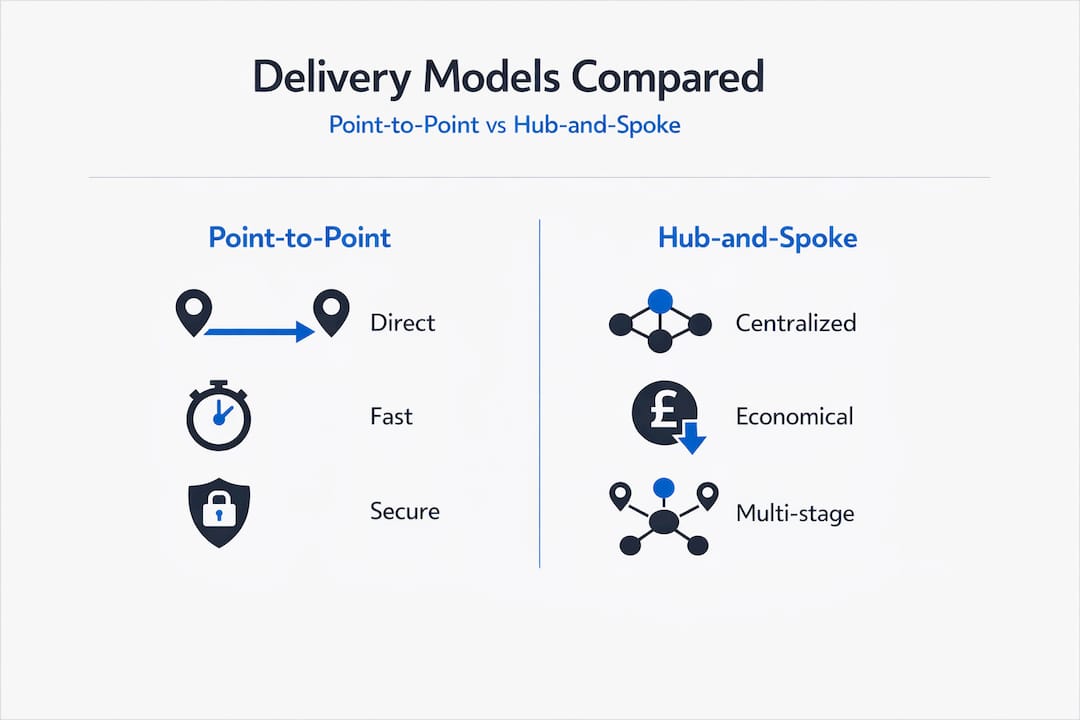
Scenario | Best model |
Urgent, time-critical document | Point-to-point |
Weekly pallet deliveries to multiple depots | Hub-and-spoke |
High-value goods requiring secure chain of custody | Point-to-point |
Large-volume, non-urgent freight | Hub-and-spoke |
Medical or legal items with strict handling requirements | Point-to-point |
Regular, planned bulk shipments | Hub-and-spoke |
Some businesses benefit from a hybrid approach, using a hub-and-spoke network for regular, planned freight while reserving point-to-point for urgent or sensitive deliveries. This keeps costs manageable without sacrificing reliability when it matters most.
For more on making the right service choice, reviewing urgent courier best practices for 2026 gives a clear framework for UK businesses.
Rethinking urgent delivery: why point-to-point is often overlooked yet ideal
Most businesses that turn to point-to-point delivery do so after a hub-based courier lets them down on an urgent shipment. The frustrating reality is that many of those failures were predictable. Hub models are designed for volume and cost efficiency, not for urgency or accountability.
What decades of direct courier experience makes clear is that every additional handling stage introduces a new variable. A package sorted through three facilities has three opportunities to be misdirected, delayed, or damaged. A package handled by one driver has one. That difference compounds significantly when your shipment is time-critical or high-value.
Technology has also shifted the argument firmly in favour of point-to-point for urgent work. GPS tracking technology paired with dedicated drivers means you have live visibility of your goods throughout the journey, not just at checkpoint scans. That level of transparency is simply not replicable in a hub-sorting environment.
The cost objection is the most commonly cited reason businesses default to hub-based models for urgent shipments. But consider the actual cost of a missed deadline. A failed legal document delivery. A medical sample arriving too late to be usable. A client who places their next contract elsewhere because your delivery let them down. The price difference between hub-based and point-to-point direct delivery solutions looks very different when set against those outcomes.
The businesses that use point-to-point delivery well treat it as a deliberate tool, not a last resort. They know which shipments warrant it, they prepare correctly, and they build relationships with reliable courier providers before urgency strikes.
Explore dedicated point-to-point courier services for your urgent UK deliveries
Putting this point-to-point logistics guide into practice requires a courier partner who can actually deliver on the standards described here.
[
At DedicatedSameDayCourier.co.uk, the dedicated sameday courier service operates 24 hours a day, seven days a week, covering the whole of the United Kingdom. Every shipment travels on an exclusive vehicle, handled by one driver from collection to delivery. There is no hub sorting, no consolidation, and no unnecessary handling stages. The range of courier vehicle options covers everything from small document runs to full pallet loads, with real-time tracking and proof of delivery included as standard. Request an instant quote online, by phone, or by email, and have a driver on the way within the hour.
Frequently asked questions
What exactly is point-to-point delivery?
Point-to-point delivery means sending your shipment directly from the pickup location to the recipient without stopping at central hubs or sorting facilities, reducing transit times and handling. As confirmed by distribution model analysis, goods travel directly from supplier to customer without passing through a central hub.
How quickly can I expect collection in a dedicated same-day point-to-point service?
Most dedicated same-day couriers offer collection within 60 minutes, especially when detailed shipment information is provided upfront. The UK same-day courier market targets collection under 60 minutes and 98%+ on-time delivery with dedicated vehicles.
What package details are essential to provide for an instant courier quote?
You should provide exact dimensions, weight, delivery urgency, pickup and drop-off addresses, and any special handling requirements. Providing exact dimensions and weight upfront prevents vehicle mismatches and booking delays.
Are point-to-point deliveries more expensive than hub-based options?
Yes, typically they cost more due to direct routing and dedicated vehicles, but the reliability and speed justify the expense for time-critical shipments. Point-to-point distribution has higher operational costs than hub-and-spoke models due to more vehicles and routes required.
How can I ensure my urgent documents arrive securely and on time with point-to-point delivery?
Use dedicated same-day couriers with real-time GPS tracking, chain-of-custody documentation, and always request proof of delivery. Dedicated same-day couriers provide full chain of custody, real-time tracking, and digital proof of delivery to secure urgent shipments.
Recommended


Comments